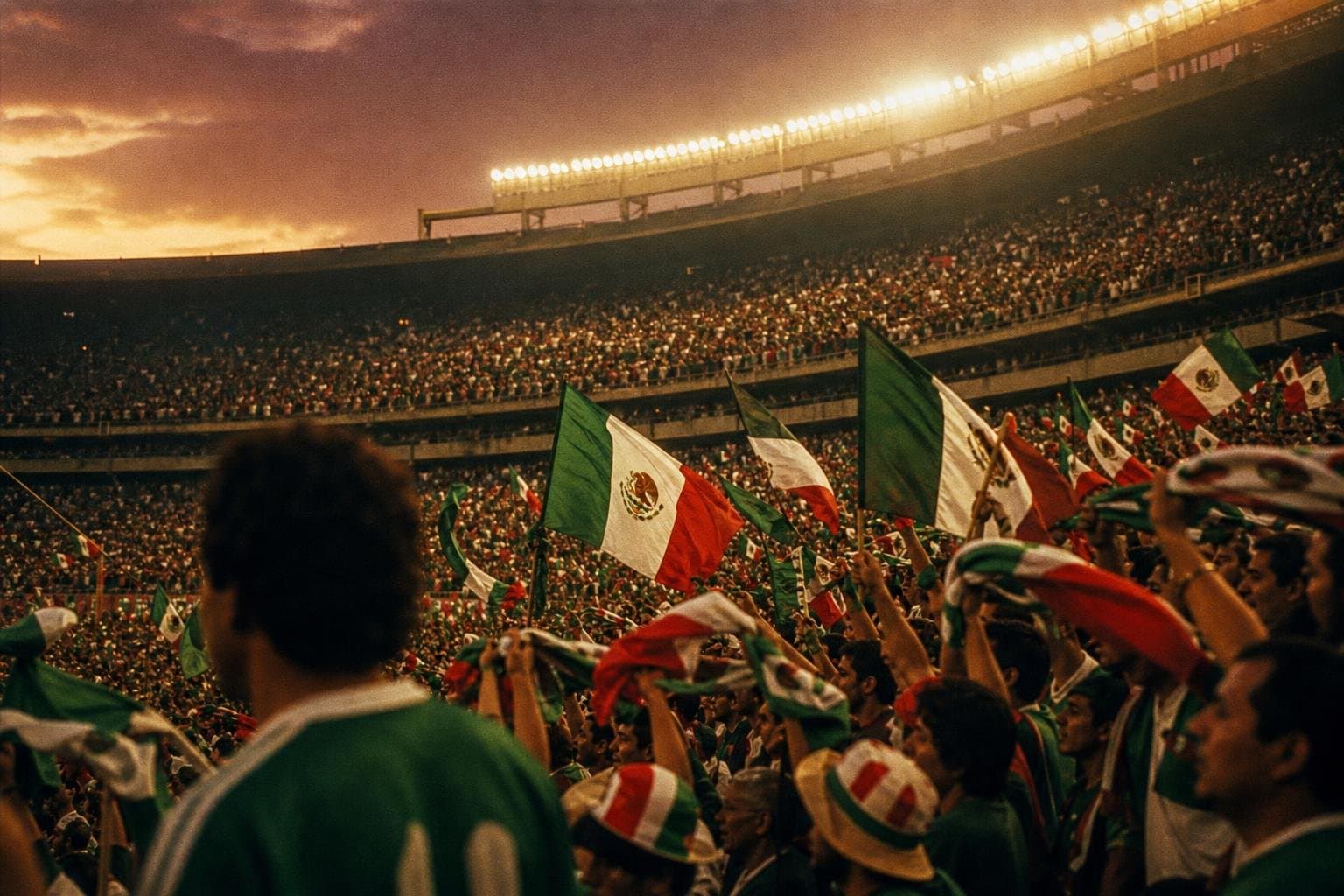

Day 9 until kickoff
Forty years is a long time to carry a burden. Mexico has reached the Round of 16 in every World Cup since 1994 — a streak of consistency that would be the envy of most nations — and been eliminated in every single one. The quinto partido, the elusive fifth game, has become the defining obsession of Mexican football. Now, in 2026, El Tri gets to chase it at home. That changes everything. Whether it changes it for better or worse is the real question.
The Gift: A Schedule Built for a Fairytale
Start with the fixture list, because it really is extraordinary. As Sports Illustrated notes, Mexico's best-ever World Cup results came on home soil — quarterfinal runs in 1970 and 1986, both as hosts, both still the ceiling of what El Tri has ever achieved. The 2026 draw has handed Aguirre's side all three group games in Mexico: the opener against South Africa at the Azteca on June 11, a second match against South Korea in Guadalajara on June 18, and the group finale against the Czech Republic in Monterrey on June 24.
That is not just favorable — it is structurally unprecedented for Mexico in the modern era. Every match in the group stage played on home soil, in front of home crowds, at altitude. As Scorelisto puts it, it is "the easiest possible start in modern World Cup history" for a host nation.
Javier Aguirre has leaned into it without apology. Speaking to ESPN ahead of the tournament, he told his players exactly what he thought the schedule meant: "It's on a silver platter for us to not let it slip away," he said, invoking England's 1966 triumph at Wembley as the template. Playing at home, he argued, turns ordinary sides into lions.
The opening match carries its own layer of narrative weight. TuringStats points out that Mexico vs. South Africa on June 11 is a rematch — to the exact day — of the 2010 World Cup opener at Soccer City, where Siphiwe Tshabalala's thunderbolt and a Rafael Márquez equalizer produced a famous 1-1 draw. Sixteen years later, the roles are reversed: Mexico is the host, the Azteca is the stage, and the symmetry is almost too deliberate to feel accidental.
The Cathedral: What the Azteca Actually Means
No discussion of Mexico's home advantage is complete without sitting with what the Azteca actually is. The Athletic's stadium guide calls it "one of the World Cup's holy sites" — a place that has hosted 19 World Cup matches across two tournaments, including two finals. The Hand of God happened here. The Goal of the Century happened here. Brazil lifted the trophy here in 1970.
Officially renamed Estadio Banorte after a naming-rights deal with a Mexican banking group (it will be called "Mexico City Stadium" during the tournament, per FIFA's commercial rules), it sits at roughly 2,200 metres above sea level in the capital's southern sprawl. That altitude is not incidental — it is a genuine competitive factor. Visiting teams who haven't acclimatized feel it in their lungs by the second half. Mexico's players grew up at it.
The Azteca hosts the opening ceremony and Mexico's first match. Its final scheduled appearance in 2026 is the round of 16 — after which, as The Athletic notes with a touch of local melancholy, Mexico and Canada will be watching the United States host the rest of the party. That detail quietly underlines the stakes: for Mexico, the tournament's emotional peak is concentrated in the first three weeks.
The Curse: Pressure Has Weight
Here is where the silver platter gets complicated. The same home crowd that will roar Mexico forward in the group stage will also be the one that falls silent if El Tri stumbles. The quinto partido curse isn't just a statistical quirk — it's a psychological reality that has outlasted coaches, generations, and tactical systems. CBS Sports notes that after an "embarrassing exit from the group stage in Qatar 2022," Aguirre's squad carries "the hopes of a nation and what feels like an endless chase for a return to the quarterfinals."
The squad itself reflects that tension. Goal.com's breakdown of the final 26 names shows a roster built on trust as much as form. Guillermo Ochoa — nearly 41 — is set to become one of only three players to appear at six World Cups, alongside Messi and Ronaldo. Santiago Giménez, the AC Milan striker who is arguably Mexico's most dangerous finisher, arrives having gone nine months without a goal for his club. Aguirre acknowledged the situation plainly: "We are not bringing everyone in the same physical and athletic moment."
That is a coach managing expectations while simultaneously projecting belief. It's a difficult needle to thread when the whole country is watching.
Player Spotlight: Raúl Jiménez's Final Act
If there is one player who embodies the weight and the wonder of Mexico's 2026 campaign, it's Raúl Jiménez. At 35, the Fulham forward is appearing in his fourth World Cup — on home soil, leading the line, at the Azteca. Sports Illustrated describes it as "a career-defining moment in the crosshairs," the pinnacle of a remarkable resurgence for a player who fractured his skull in 2020 and spent years clawing his way back to relevance.
Jiménez won't be doing it alone. Gilberto Mora, described by SI as a "wonderkid," represents the bridge generation — the player Aguirre is betting will eventually carry the torch. The combination of Jiménez's experience and Mora's energy is the attack Mexico is counting on to finally push past the round that has broken them for four decades.
Host City Note: Three Stadiums, One Mission
Mexico's group stage is split across three venues that together tell the story of the country's football culture. The Azteca in Mexico City is the cathedral. Estadio Akron in Guadalajara — home of Chivas, one of Mexico's most passionately supported clubs — hosts the South Korea match. Estadio BBVA in Monterrey, a modern arena in Mexico's industrial north, closes out the group stage against the Czech Republic. Three cities, three atmospheres, one shared obsession with finally getting past the fifth game.
Countdown Corner
Mexico will become the first nation in history to host the FIFA World Cup three times — 1970, 1986, and now 2026. No other country has reached that number. The only two tournaments where El Tri reached the quarterfinals? The first two times they hosted. Make of that what you will.


