
This Week in Voltage
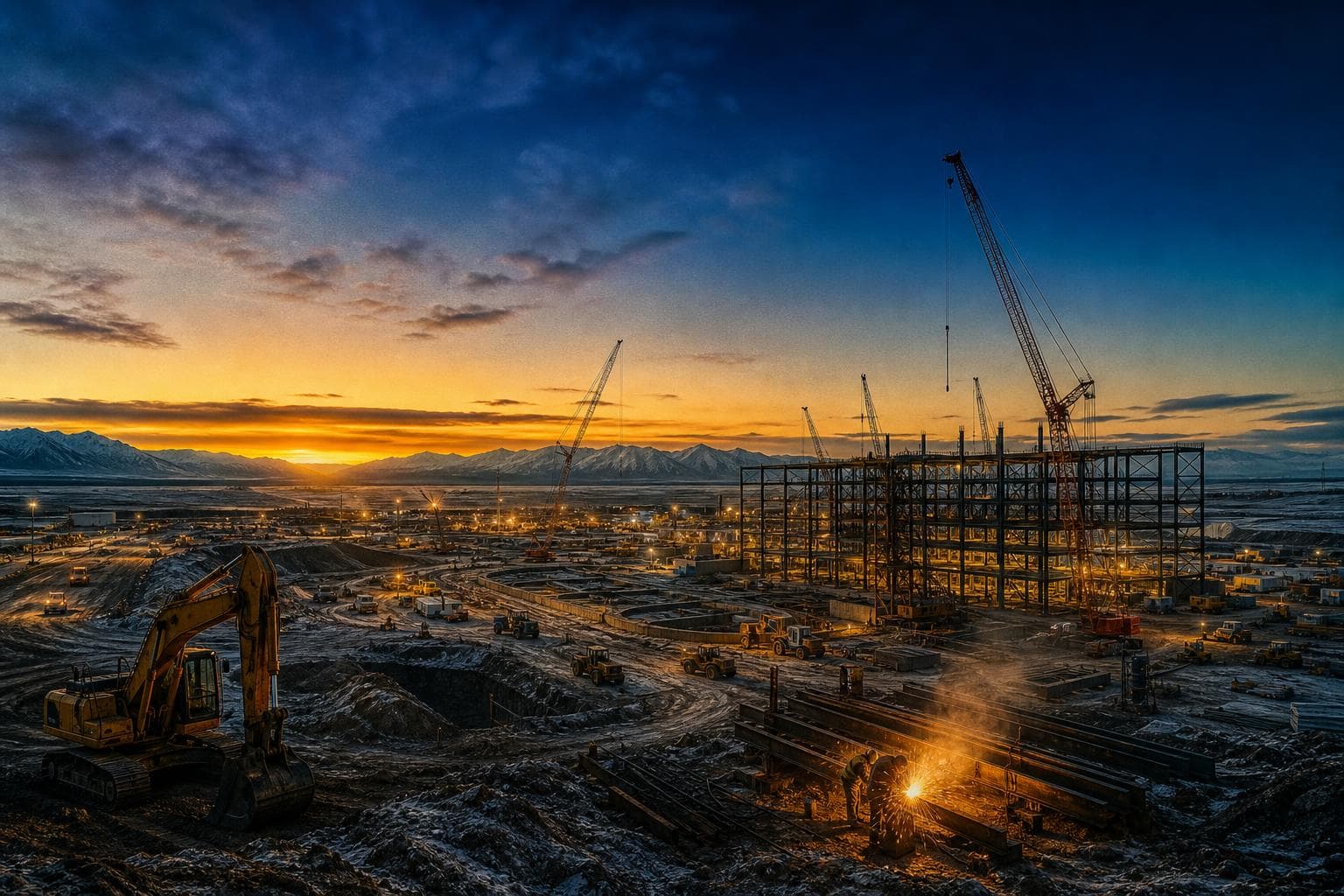
Construction has officially begun on TerraPower's Natrium reactor at Kemmerer, Wyoming — and if you want a single image to represent humanity's current position on the Kardashev ladder, this is it. A sodium-cooled fast reactor rising from a former coal town, backed by Bill Gates, contracted to Bechtel with explicit intent to build "nth-of-a-kind" repeatability from unit one. Not a prototype. A template.
The NRC issued the construction permit on March 4 — the first commercial non-light-water reactor approval in more than 40 years. TerraPower CEO Chris Levesque put it plainly: "It's real and people can start to work this into their plans." Target online date: 2031. Projected output: enough electricity for roughly half a million homes, with a molten-salt storage system that can surge net output from 345 MW to 500 MW on demand.
This is what progress looks like. Not a press release. Dirt moving.
Deep Charge: The Kardashev Scorecard, Honestly Assessed
Nikolai Kardashev proposed his civilization scale in 1964. Type I: a civilization harnessing all energy available on its planet. Type II: a star. Type III: a galaxy. We are, by most estimates, somewhere around 0.73 on that scale — firmly pre-planetary, still burning ancient carbon to keep the lights on.
So how fast are we actually climbing? The IEA's Global Energy Review 2026 gives us the most honest recent snapshot, and the picture is genuinely mixed.
The acceleration case is real. Global electricity generation grew by over 850 TWh in 2025, with renewables and nuclear together outpacing total generation growth — meaning fossil fuels are being displaced at the margin, not just supplemented. Solar PV posted its largest-ever single-year generation increase, up roughly 600 TWh. Nuclear hit a record annual output. Global coal-fired generation fell for the first time outside a crisis since 2015 — and for the first time in five decades, China and India saw simultaneous coal declines.
That's not a rounding error. That's a structural inflection.
The demand case is accelerating even faster. The IEA projects that U.S. data centers will need roughly 130% more energy by 2030 — driven by AI infrastructure buildout. The five largest tech companies spent over $400 billion in capex in 2025 and are expected to increase that by another 75% in 2026. "AI factories" — purpose-built data centers for frontier model training and inference — have more than tripled in capacity over the past 18 months.
Here's the civilizational read: demand is pulling supply up the curve faster than any policy mandate could. The Kardashev climb isn't being driven by idealism. It's being driven by compute hunger.
The honest caveat. Total global energy demand grew by only 1.3% in 2025, down from 2% in 2024. Some of that slowdown reflects efficiency gains — which I'd normally dismiss as small-ball thinking, except that per-AI-query energy consumption is dropping by an order of magnitude annually. That's not conservation. That's doing more with more, faster. The efficiency is enabling scale, not replacing it.
The bottleneck isn't ambition. It's construction timelines. Kemmerer won't be online until 2031. The interconnection queue is still measured in years. The gap between announced capacity and operational capacity remains the defining constraint on how fast we actually climb.
By the Numbers
- 850+ TWh — Global electricity generation increase in 2025 (IEA)
- ~600 TWh — Solar PV's largest-ever single-year generation gain (IEA)
- 130% — Projected increase in U.S. data center energy demand by 2030 (IEA, via NPR)
- $400B+ — Combined capex of the five largest tech companies in 2025 (IEA)
- 75% — Expected jump in that capex figure in 2026 (IEA)
- 2031 — TerraPower Kemmerer target online date
- 3x — Growth in AI factory capacity over the past 18 months (IEA)
What We're Fighting For
The Kardashev Scale isn't a metaphor. It's a measurement problem — and right now, the measurements are moving in the right direction, just not fast enough.
Solar is breaking records. Nuclear is breaking ground. AI is pulling electricity demand upward with a force that no conservation mandate could match. The question isn't whether we're climbing. We are. The question is whether the construction pipeline — reactors, transmission, grid interconnection — can keep pace with the demand curve that compute is drawing.
Watch the Kemmerer project's 2027 construction milestones. Watch whether TerraPower's META agreements translate into permitted sites. Watch FERC's interconnection reform implementation through Q3. Those are the real Kardashev checkpoints — not the vision, but the concrete poured.
The future is electric. The scoreboard says we're moving. Now build faster.


