


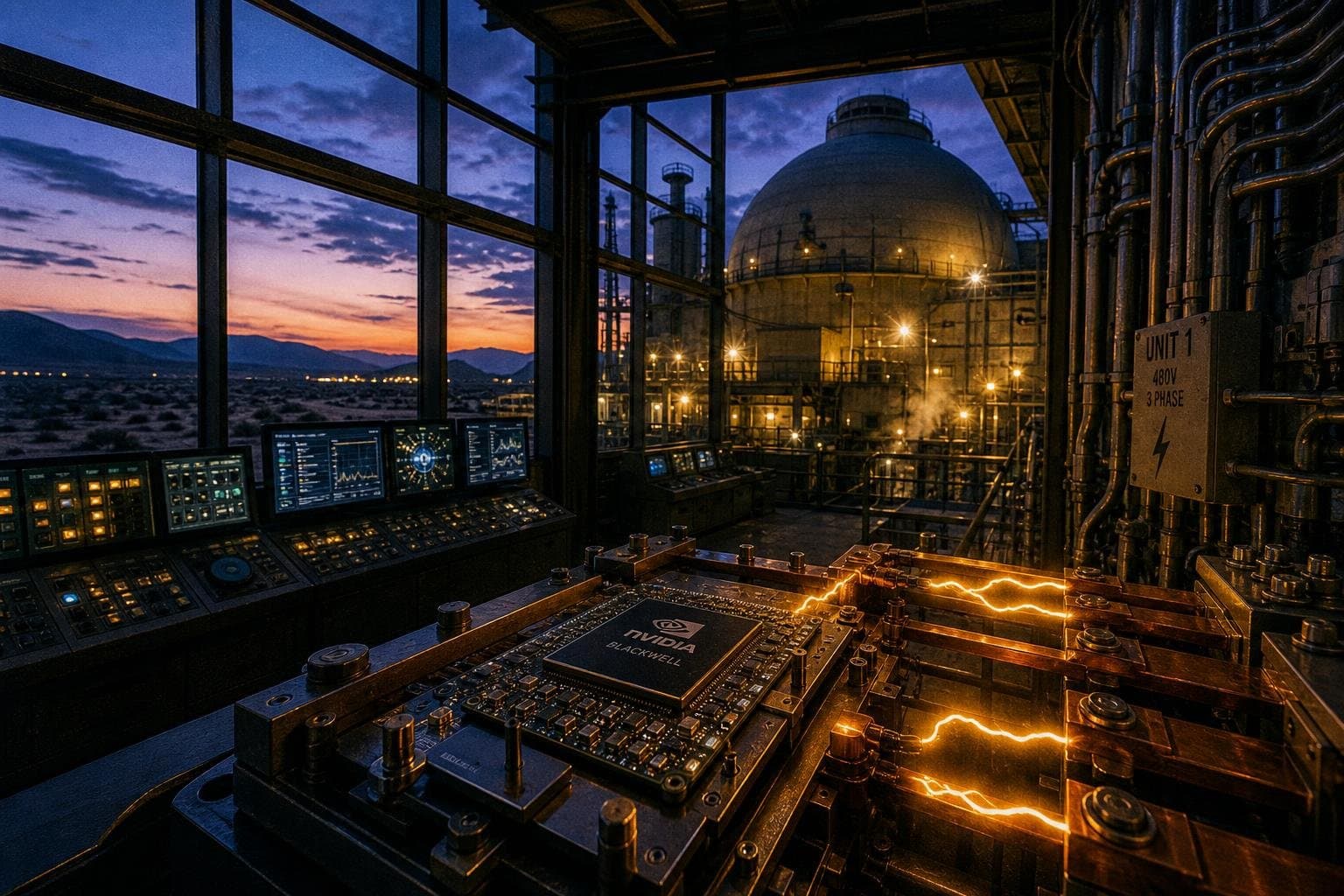

The skeptics had a clean argument: nuclear power and AI data centers are a marriage of convenience, not physics. Big tech companies sign nuclear PPAs to hit sustainability targets; the atoms and the chips never actually meet. That argument died Wednesday in a Utah desert.
Valar Atomics, a California-based startup, connected its Ward 250 advanced reactor to an Nvidia Blackwell chip — and used the generated electricity to temporarily host a website. It's the first time a next-generation reactor has powered an AI chip in the United States. The two companies also announced an agreement to jointly explore nuclear-powered AI systems.
Yes, it was a trickle of electricity. Yes, hosting a website is not training a frontier model. The point is the stack closed. Atom to inference, no grid in between.
Why "Trickle" Is the Wrong Frame
Every civilization-scale technology starts as a demonstration. The Wright Flyer flew 120 feet. The first nuclear reactor, Chicago Pile-1, produced half a watt. What matters about Valar's Utah demonstration is the architectural proof: a compact advanced reactor can generate electricity, route it directly to AI compute, and run a workload. The Bloomberg video coverage of Valar CEO Isaiah Taylor makes clear this was a deliberate integration demonstration, not an accidental proximity.
The civilizational implication is significant. The DOE has been tracking the collision between data center electricity demand and clean energy supply as one of the defining infrastructure challenges of this decade. The standard answer has been PPAs, grid upgrades, and long interconnection queues. Valar's demonstration gestures at a different answer: co-locate the reactor with the compute, skip the transmission problem entirely.
That's the same logic I flagged when covering SMRs last month — the transmission queue is the wall, and the way around the wall is to not need it. Valar just showed what that looks like in hardware, not in a pitch deck.
The Ward 250 is not operational at commercial scale. The Nvidia partnership is an agreement to explore, not a deployment contract. Those distinctions matter and I'll hold them. But the proof-of-concept threshold has been crossed, and that threshold is where every technology's clock starts running. Watch for Valar's next capacity milestone and whether the Nvidia agreement produces a formal development timeline — those are the signals that turn this from a demonstration into a buildout.
The future is electric. Increasingly, it's also nuclear. And now, for the first time in American history, those two sentences connect directly to a chip running inference.