
The United States wants 400 gigawatts of nuclear capacity by 2050. Right now it has roughly 100 GW. The math on that ambition is staggering — and the political will, for once, appears to match it. Advanced reactors are reaching criticality. The NRC is rewriting its permitting clock. Big Tech is signing power purchase agreements with nuclear operators like it's a competitive sport. The demand signal has never been clearer.
The uranium supply chain has not gotten the memo.
This is the structural problem that sits beneath every bullish nuclear headline: the fuel cycle that will power the AI era was never built for this moment. It was built for a world of slow, predictable demand growth — and it is now being asked to support an acceleration that compresses decades into years. The constraint is not ambition. The constraint is geology, chemistry, and geopolitics, stacked in sequence.
The Mine Layer Is Already Contracting
Start at the bottom of the fuel cycle, because that's where the leverage lives.
Kazakhstan alone supplies nearly 40% of the world's uranium. Its national operator, Kazatomprom, controls approximately 45% of global production capacity through 13 mining projects — 10 of which are joint ventures with foreign partners including Russia's Rosatom, France's Orano, Canada's Cameco, and China's CNNC. That concentration would be manageable if Kazatomprom were reliably hitting its production targets. It is not.
The culprit is sulfuric acid. Kazakhstan extracts uranium primarily through In-Situ Recovery, a process that requires injecting sulfuric acid into ore bodies to dissolve the minerals. Acid plant construction has lagged, and in late 2024, Kazatomprom lowered its 2025 output guidance by 12–17% citing these shortages. The "Kazakh cushion" that Western utilities relied on for decades is gone. The cumulative deficit is estimated at roughly 20 million pounds annually — a gap that secondary supplies and inventory drawdowns cannot fill indefinitely.
Meanwhile, geopolitical shifts have added a security premium to Western-sourced uranium. Transporting material across Russian territory now carries risk that didn't exist three years ago. Niger, another significant producer, has become politically unstable. The Western mining base — Canada, Australia, the United States — is being asked to fill a gap it spent the last two decades not preparing for. New uranium mines can take 10 to 20 years to move from discovery to production. The policy timelines don't wait for geology.
The market is reading this clearly. Spot prices consolidated in the mid-$80s per pound through much of 2026, and analysts are modeling a bull-case scenario of $200 per pound — not from speculation, but from a structural breakdown in supply coinciding with a demand surge driven by Big Tech's nuclear commitments.
The Enrichment Chokepoint Is Where It Gets Dangerous
Mining concentration is a problem. Enrichment concentration is a crisis in slow motion.
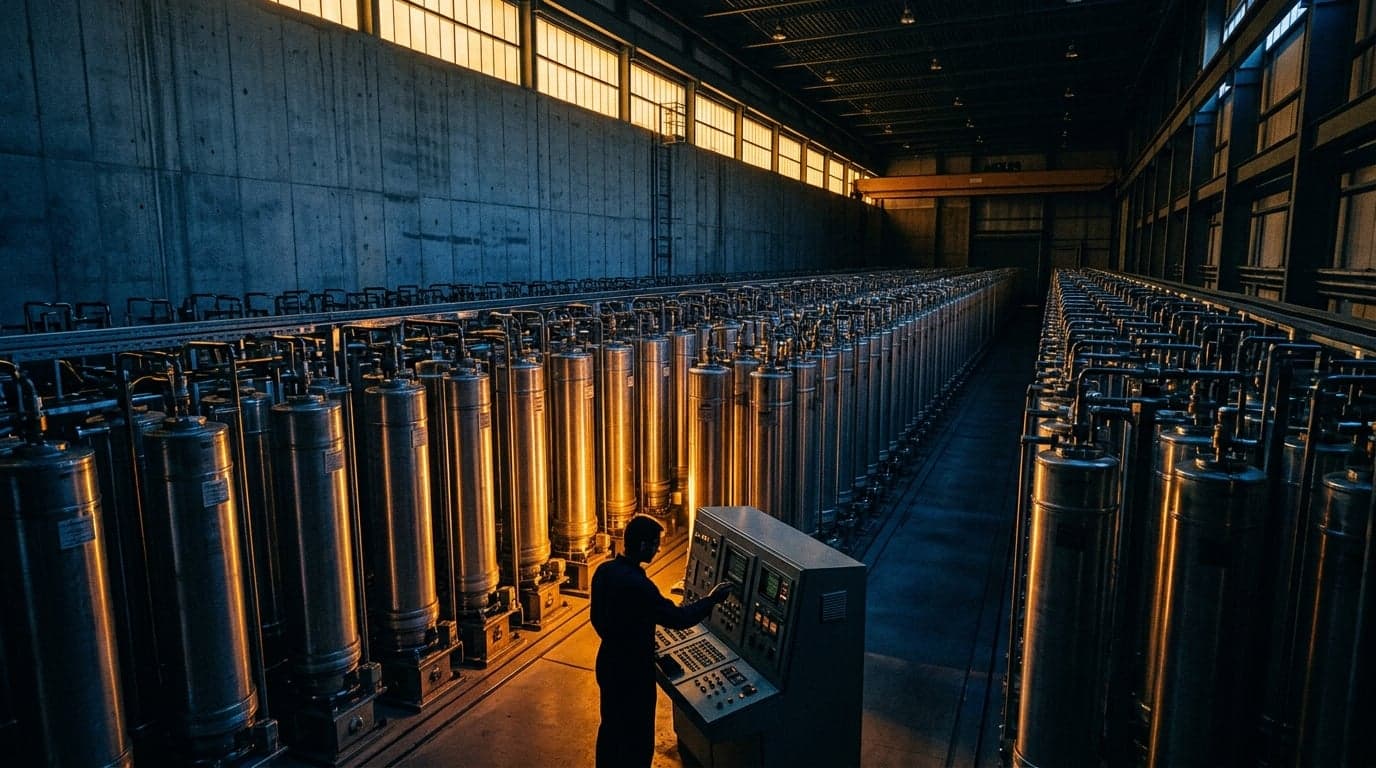
The United States currently imports up to 75% of the enriched uranium used in its reactors, from countries including Russia, France, and Germany. That number alone should stop every nuclear optimist cold. The country targeting 400 GW of nuclear capacity by 2050 is, right now, dependent on foreign enrichment for three-quarters of its reactor fuel.
Washington recognized this and acted. The Prohibiting Russian Uranium Imports Act banned Russian LEU imports starting August 2024, with waivers permitted until January 1, 2028. The DOE has allocated $2.7 billion to develop LEU and high-assay low-enriched uranium infrastructure capabilities, contracting with six companies and finalizing task orders in January 2026 to expand domestic enrichment capacity over the next decade. That's real money and real policy commitment.
But here's the timeline problem: the Russian waiver deadline is January 2028. The domestic enrichment buildout is a ten-year program. The gap between those two dates is where the fuel security risk lives. Advanced reactors are being pushed to criticality now — the DOE's Reactor Pilot Program had a target of three advanced reactor designs reaching criticality by July 4, 2026, and Antares Nuclear's Mark-0 design achieved that milestone on June 4. The reactors are moving faster than the fuel cycle.
Europe's situation is structurally worse. The CES Intelligence briefing published July 6 puts it bluntly: Europe wants to triple its nuclear capacity by 2035, and the uranium will come from mines it doesn't control, converted in facilities it can't replicate, and enriched by a competitor it's trying to decouple from. Enrichment — the binding layer of the entire fuel cycle — sits in the hands of a strategic competitor whose leverage compounds with every stage of decoupling. This is not a procurement problem. It is an architectural dependency.
The AI Demand Signal Is Rewriting the Urgency Calculus
The supply-side problems would be serious in any scenario. They become acute when you layer in what's happening on the demand side.
Big Tech's nuclear commitments have transformed uranium demand from a slow, utility-driven procurement cycle into something that looks more like a strategic arms race. India's largest power producer, state-controlled NTPC Ltd., issued a tender in July 2026 to identify potential uranium mining assets in Canada, Australia, Kazakhstan, and South Africa — part of a plan to build 30 gigawatts of nuclear capacity over the next two decades. India is not alone. Every major economy with serious AI infrastructure ambitions is running the same calculation: AI data centers need firm, dispatchable power; nuclear is the only carbon-free source that delivers it; therefore, nuclear capacity must expand; therefore, uranium supply must be secured.
The problem is that every country running this calculation is competing for the same constrained supply chain simultaneously. Kazakhstan's production is capped by acid plant construction timelines. Russia's enrichment capacity is politically off-limits for Western buyers. The Western mining base needs a decade to respond. And the AI buildout is happening now.
As the IEA's 2026 Global Critical Minerals Outlook notes, governments are now placing greater attention on supply chain resilience and diversification in an increasingly complex geopolitical environment — a recognition that the adequacy of supply for critical minerals, including those in nuclear fuel cycles, is a major concern. The IEA's framing is diplomatic. The operational reality is sharper: the race to secure uranium supply has begun, and late movers will pay for it in reactor downtime.
The Moonshot Hedge and the Decade It Can't Fill
Into this gap steps a Texas startup with a DOE license and an audacious pitch.
SuperCritical Materials Corp announced on July 14, 2026 that it has won an exclusive license from the DOE to extract uranium from seawater — a technology developed by U.S. national labs using specially treated acrylic fibers to which dissolved uranium ions bind. Uranium exists naturally in seawater at concentrations of about 3.3 parts per billion. SuperCritical's first plant is projected to produce 1.85 million pounds of uranium per year for at least 40 years — enough, the company says, to power about 4 million households annually.
The DOE's assistant secretary for nuclear energy called the technology "a potentially significant contribution to America's long-term fuel security." That framing — "potentially significant," "long-term" — is doing a lot of work. SuperCritical has raised $4.5 million privately, has not made a final investment decision, and says it can begin producing uranium as soon as 2030 or 2031. The company still needs to navigate 13 regulatory agencies before its first plant can operate.
Seawater extraction is genuinely interesting technology. The ocean contains an effectively inexhaustible supply of dissolved uranium — orders of magnitude more than all known terrestrial reserves. If the process becomes commercially viable, it changes the geopolitical calculus of nuclear fuel entirely. But "commercially viable by 2031" is an optimistic projection from a pre-revenue company with $4.5 million in funding. The reactors coming online between now and 2033 will be fueled by terrestrial uranium from concentrated, geopolitically exposed supply chains. The seawater hedge is a 2035-and-beyond story, not a solution to the gap that opens when Russian waivers expire in 2028.
What the Deadline Stack Actually Means
The DOE's nuclear deadline stack is worth reading as a document of civilizational ambition — and as a stress test for the fuel cycle that ambition requires.
Advanced reactors to criticality by July 2026: achieved. NRC rule revisions by November 2026: in progress. Russian uranium import waivers ending January 2028: fixed. DOE-site advanced reactors operating by late 2027: targeted. Ten new large reactors under construction by 2030: announced. A secure domestic fuel cycle by 2033: aspirational. 400 GW of nuclear capacity by 2050: policy target.
Each of those milestones is real. The tension is that the fuel cycle milestones — domestic enrichment capacity, secure mining supply, conversion facility buildout — are the slowest-moving elements in the stack, and they are being asked to support the fastest-moving deployment ambition in American nuclear history. The $2.7 billion DOE enrichment program is a ten-year buildout. The Russian waiver cliff is 18 months away.
The watch list for the next 24 months is specific: whether the six DOE-contracted enrichment companies can accelerate their capacity timelines ahead of the 2028 waiver expiration; whether NTPC's uranium asset acquisition strategy — bids due July 16 — signals a broader wave of state-backed resource competition that tightens Western access to Canadian and Australian supply; and whether Kazatomprom's acid plant construction, expected to reach fuller capacity in 2027, actually delivers the production recovery the market is pricing in.
The nuclear renaissance is real. The AI demand signal is real. The fuel cycle constraint is equally real, and it operates on timelines that don't bend to policy ambition or market enthusiasm. The reactors being built today will need fuel that the supply chain, as currently structured, is not positioned to deliver at scale. Solving that problem is the actual work of the next decade — and it starts with treating uranium enrichment as the strategic infrastructure it is, not the procurement line item it used to be.
The future is electric. Getting there requires getting the fuel cycle right first.


