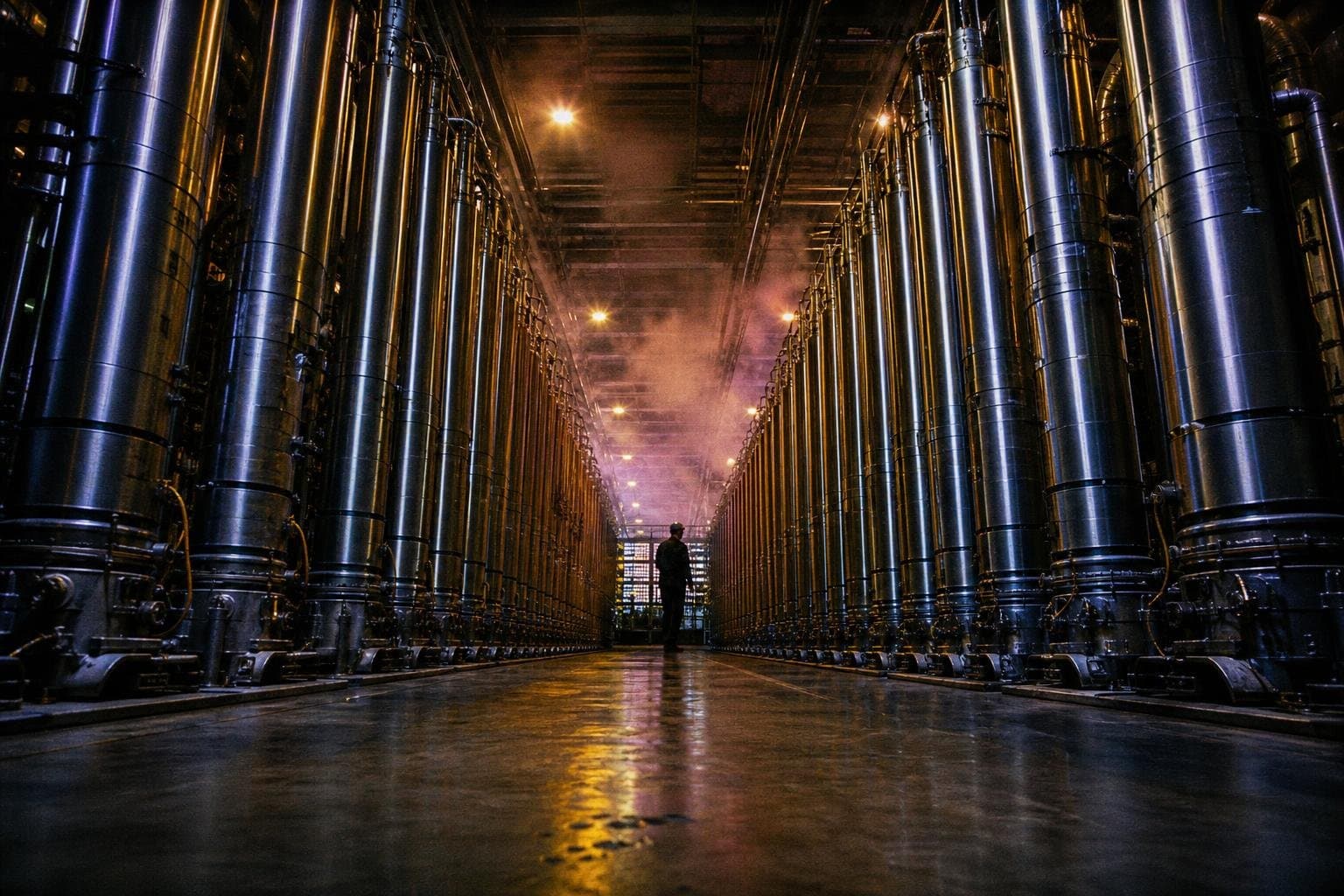

Rosatom controls roughly 40–46 percent of global uranium enrichment capacity. Let that number sit for a moment. The same civilization that is racing to build AI-powered data centers, that is signing nuclear power purchase agreements with tech giants, that is staking its energy future on a nuclear renaissance — that civilization is still, structurally, dependent on a Russian state monopoly for the fuel that makes it all run.
This is the contradiction at the heart of the nuclear-AI boom. And it's getting harder to paper over.
The Demand Signal Is Real — and It's Reshaping Fuel Markets
The nuclear revival has a specific ignition source this time: hyperscale data centers. According to the American Nuclear Society, the build-out of hyperscale data centers has created firm, baseload electricity demand on a scale not seen in at least a generation, with major technology firms entering long-term power purchase agreements with utility and developer partners. This is exactly the demand profile that nuclear loves — not the peaky, weather-dependent load that makes grid operators nervous, but the relentless, 24/7 draw that justifies a reactor's capital cost.
The geopolitical context amplifies everything. The ANS analysis notes that national security considerations, sharpened by the wars in Ukraine and the Middle East, have made fuel supply resilience a first-order strategic question rather than a procurement footnote. As of the second Nuclear Energy Summit in Paris in March, 38 countries have endorsed the Declaration to Triple Nuclear Energy globally by 2050. That's not a roadmap — that's a procurement obligation. Tripling nuclear capacity means tripling uranium demand, tripling enrichment throughput, tripling fuel fabrication. The fuel cycle has to scale with the ambition.
The uranium price signal is already responding. Per market data reported by The Industry Spread, uranium's long-term contract price reached $94 per pound at the end of June 2026 — its highest since 2008 — while spot prices have consolidated near $85–87 per pound. The gap between term and spot prices is itself a signal: utilities locking in multi-year supply are paying a premium over today's spot market, which means the buyers who understand the structural picture are already acting on it. The base case from that analysis puts spot at $100 per pound by mid-2027, with a bull case at $120 if primary supply cuts compound the Kazatomprom quota reduction already in effect.
That's the demand side. Now look at the supply side, and the picture gets uncomfortable fast.
The Western Fuel Cycle Has a Structural Gap — and Russia Is Filling It
Here is the civilizational problem in one sentence: no single allied nation currently possesses the full suite of front-end nuclear fuel capabilities. From mining through conversion, enrichment, fabrication, and the emerging deconversion and metallization steps required for advanced reactor fuels, capability is distributed across Canada, France, Japan, the United Kingdom, and the United States — what the ANS analysis calls the "Sapporo Five" — plus a small group of close partners.
Russia's Rosatom and its subsidiary Tenex, meanwhile, hold roughly 40–46 percent of global enrichment capacity and, until recent restart efforts, supplied a meaningful share of the world's conversion services. This isn't a legacy dependency that's being wound down — it's an active structural vulnerability at the exact moment Western nations are trying to accelerate nuclear deployment.
The advanced reactor problem is even sharper. Most next-generation reactor designs — the SMRs and advanced concepts that are supposed to power the AI data centers of the 2030s — require High-Assay Low-Enriched Uranium, or HALEU. The DOE's HALEU Availability Program exists precisely because HALEU is not currently available from domestic suppliers, and gaps in supply could delay the deployment of advanced reactors. The program is pursuing multiple pathways to secure domestic supply, including purchase agreements with domestic industry partners and limited initial production from DOE-owned assets — but the explicit goal is to spur private investment that eventually removes the federal government's role as a supplier. That's a long road from where we are today.
The supply picture from major producers adds texture. World Nuclear News reported that Kazatomprom — Kazakhstan's national atomic company and the world's largest uranium producer — produced 13,291 tonnes of uranium on a 100% basis in the first half of 2026, up 9% from the same period in 2025, in line with its 2026 guidance of 27,500–29,000 tonnes. Cameco, the Canadian giant, reported 10.1 million pounds U3O8 from its Canadian operations in the first half of 2026, down 5% from the prior year, partly due to flooding that temporarily disrupted supply routes in northern Saskatchewan. These are the two largest Western-aligned producers, and they're running at or near guidance — not surging to meet a demand signal that is clearly accelerating.
The math here is not comfortable. Demand is being pulled forward by AI. Supply is constrained by geology, infrastructure, and the long lead times of uranium mining. And the enrichment bottleneck sits squarely in Moscow.
The Geopolitical Pressure Cooker Is Already Running Hot
The energy crisis context makes this more urgent, not less. Reuters reported on August 20 that the Iran war has pushed the global oil refining industry to the brink, with Brent crude currently around $90 a barrel — up roughly 25% from pre-conflict levels, though retreating from a wartime peak of $118. European diesel prices have surged more than 70% since the conflict began in February, and U.S. gasoline prices have climbed around 60%. The IEA found that the war knocked out more than 20% of the Middle East's 9.6 million barrels per day of refining capacity.
This is the geopolitical pressure that makes nuclear's value proposition undeniable — and simultaneously makes its supply chain vulnerabilities more dangerous. Every barrel of oil that can't flow through the Strait of Hormuz is an argument for electrification. Every diesel price spike is an argument for nuclear baseload. But those arguments only convert to actual megawatts if the fuel cycle can deliver. Right now, it can't — not at the scale the AI-driven demand surge requires.
The geopolitical logic runs in both directions. The same instability that makes nuclear more attractive also makes the Russia dependency more dangerous. Rosatom has, so far, remained outside the most aggressive Western sanctions regimes — partly because Western utilities genuinely needed the enrichment capacity and had no ready alternative. That calculation is changing, but slowly. The ANS analysis argues that Russian and Chinese state-controlled vendors bring integrated financing packages that disparate allied vendors find difficult to match — meaning the competition isn't just about enrichment capacity, it's about who can offer a complete, financed fuel-cycle solution to countries building their first reactors.
This is where the geopolitical competition for uranium and nuclear fuel supply chains becomes a civilizational contest, not just a commodity trade.
The Allied Fuel Cycle Architecture Is the Strategic Bet Worth Making
The path forward that the ANS analysis describes — a deliberate multilateral architecture in which each Sapporo Five member contributes its strongest capabilities, with multiple qualified vendors in each category to preserve competitive discipline, supported by long-term offtake agreements and complementary public investment — is the right framework. It's also enormously difficult to execute.
The difficulty is structural. Allied nations have spent decades optimizing for cost, not resilience. They bought Russian enrichment because it was cheap and available. They let domestic conversion capacity atrophy. They didn't build HALEU production infrastructure because there was no commercial demand for it yet. Now the demand is arriving faster than the infrastructure can be built, and the geopolitical window for comfortable dependency has closed.
The DOE's HALEU program is a start, but it's explicitly designed as a bridge — the program is intended to spur demand for additional HALEU production and private investment, ultimately removing the federal government's initial role as a supplier. That's the right long-term design, but it means the near-term gap is being filled by government procurement rather than a functioning market. Advanced reactor developers who need HALEU to meet their deployment timelines are, right now, dependent on a program that is still in its early stages.
Meanwhile, uranium term prices at 18-year highs are sending exactly the signal that should attract private capital into mining and enrichment. The Industry Spread's analysis notes that Cameco's realized long-term price reached $91.50 per pound — the kind of number that justifies mine expansions and enrichment capacity investments that take years to come online. The capital is starting to move. The question is whether it moves fast enough.
The answer depends heavily on permitting timelines, financing structures, and whether allied governments treat nuclear fuel supply as the strategic infrastructure it actually is — rather than as a commodity procurement problem to be optimized for unit cost.
What the Next 24 Months Actually Decide
The civilizational stakes here are not abstract. The data centers being built right now, the ones signing 20-year power purchase agreements with nuclear developers, are betting that the fuel cycle will be there when the reactors come online. If HALEU supply lags advanced reactor deployment, those reactors either don't get built on schedule or they get built and sit idle. If Western enrichment capacity doesn't scale to reduce the Rosatom dependency, every nuclear power purchase agreement signed by a tech company carries embedded geopolitical risk that nobody is pricing correctly.
Watch three specific developments over the next 24 months. First, whether the DOE HALEU Availability Program successfully transitions from government-as-supplier to private-market function — the first commercial HALEU deliveries under private contracts will be the signal. Second, whether Kazatomprom's 2026 production guidance of 27,500–29,000 tonnes holds through year-end given the supply route vulnerabilities that already disrupted Cameco's Canadian operations; any further production shortfall from either major producer tightens the spot market toward the $100 base case. Third, whether the Sapporo Five framework produces actual multilateral offtake agreements or remains a strategic concept — the financing gap with Rosatom and Chinese state vendors is real, and closing it requires governments to put capital behind the rhetoric.
The AI electricity boom is the best demand signal nuclear has seen in a generation. The geopolitical crisis is the best argument for energy independence nuclear has ever had. The uranium market is already pricing in the tightness. The only thing that can prevent the nuclear-AI stack from delivering on its civilizational promise is the fuel cycle itself — and right now, that's the part nobody has fully solved.
This is what we're fighting for. Get the fuel cycle right, and the future is electric. Get it wrong, and we've built the most ambitious energy infrastructure in history on a foundation that Rosatom controls.


