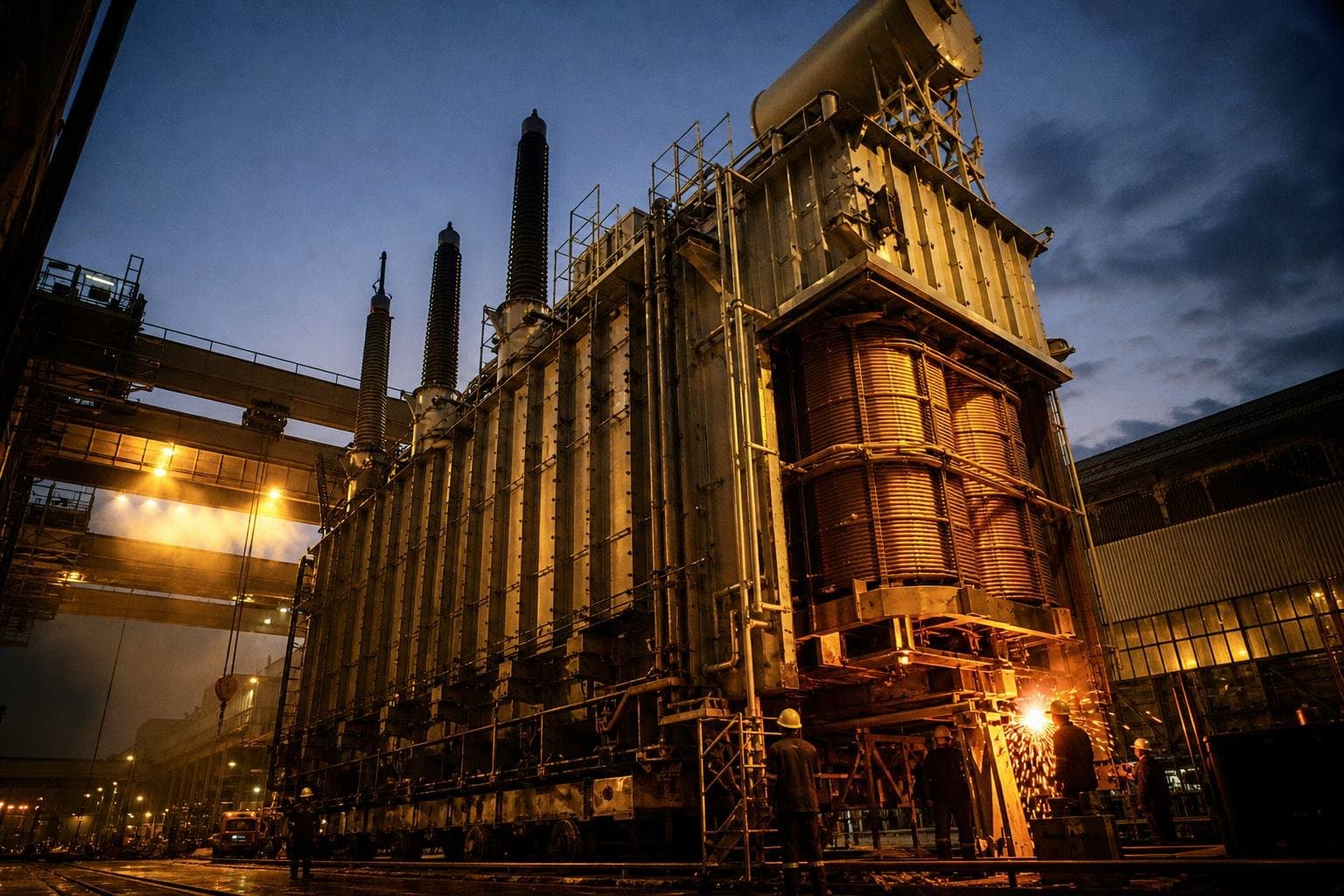

A large power transformer is roughly the size of a two-story house, weighs as much as a fully loaded 747, and takes more than three years to arrive once you order one — assuming the factory can even get the materials to build it, according to The Conversation. That's the bottleneck standing between every ambitious grid plan in America — solar farms, new gas plants, AI data centers — and the electrons actually reaching a customer. I've written before about the equipment queue behind the interconnection queue. This week the story gets sharper: the raw material underneath that equipment queue is itself in dispute.
The Grid Needs More Copper Right When the Mines Are Delivering Less
Transformers aren't mass-produced on an assembly line. They're custom-built, and demand for the two kinds that matter most to the grid has exploded. Between 2019 and 2025, demand for generator step-up transformers — the ones that connect power plants to the transmission grid — nearly tripled, while demand for the step-down transformers that bring power into neighborhoods more than doubled, with costs up 80% over the same stretch, per The Conversation.
That buildout runs on copper windings, among other scarce inputs. And copper's supply picture just took a hit. Chile — the world's largest copper producer — is coming off what its state copper commission Cochilco calls its worst quarter in at least two decades, driven by aging mines, deteriorating ore quality, and accidents compounded by severe weather. Cochilco cut this year's output estimate to 4.94 million metric tons, down from an earlier 5.27 million ton projection, and now expects only a modest 3% rebound in 2027, according to Bloomberg. When the biggest supplier in the world has its worst years on record, every transformer manufacturer downstream feels it eventually.
The "Deficit" Everyone's Citing Just Got Walked Back to a Surplus
Here's where I have to slow down, because this is exactly the kind of number that destroys credibility if you get it wrong. The copper market narrative all year has been "structural deficit, scarcity value, buy the miners." But the International Copper Study Group's own forecast reportedly reversed course — swinging from a projected deficit to a 104,000-ton surplus, as reported by Discovery Alert. That's not a rounding error in sentiment; it's a complete flip in the headline number traders and miners have been citing to justify investment decisions.
The same piece notes that even where cost pressure is real — Agnico Eagle's year-to-date all-in sustaining costs reached $1,529/oz, near the top of its $1,400-$1,550 guidance range, with diesel adding roughly $30/oz in the third quarter — a secondhand claim circulating about a 24% AISC spike couldn't be verified, and company materials point to something closer to 7%, per Discovery Alert. The lesson for anyone betting on copper-driven grid delays: the deficit case is live, not settled. Chile's output slump is confirmed and real. Whether that translates into a global shortfall this cycle is a forecasting fight, not a fact.
Why I Still Think This Favors the Builders, Not the Conservationists
None of this is an argument for slowing down. It's an argument for building the mining capacity that electricity maximalism actually requires. A civilization serious about 100x electricity usage needs the copper to wire it, and right now the industry's cash-rich majors are struggling to replace the reserves they mine each year even as energy costs eat into margins — which is exactly the setup that forces consolidation and new capital into exploration, per Discovery Alert. Scarcity, real or forecasted, is a price signal. It's supposed to pull new supply forward.
Meanwhile, the demand side isn't blinking. Norway's parliamentary allies are moving to freeze new data center development entirely over power supply worries, with the Red Party set to push a halt motion amid concerns over strain on the country's electricity balance, as reported by Bloomberg. That's a government choosing to ration growth rather than build through the constraint — precisely the small-minded instinct that electricity abundance has to overcome, whether the bottleneck is megawatts in Oslo or metric tons of copper in Antofagasta.
The thing to watch isn't a single headline deficit number — it's whether Cochilco's modest 2027 rebound actually materializes, and whether the ICSG's surplus call holds up against a transformer order book that's still backed up for years. Civilizations that run on electrons eventually have to run on copper first. Right now, the mines and the grid planners aren't even working from the same forecast.


