


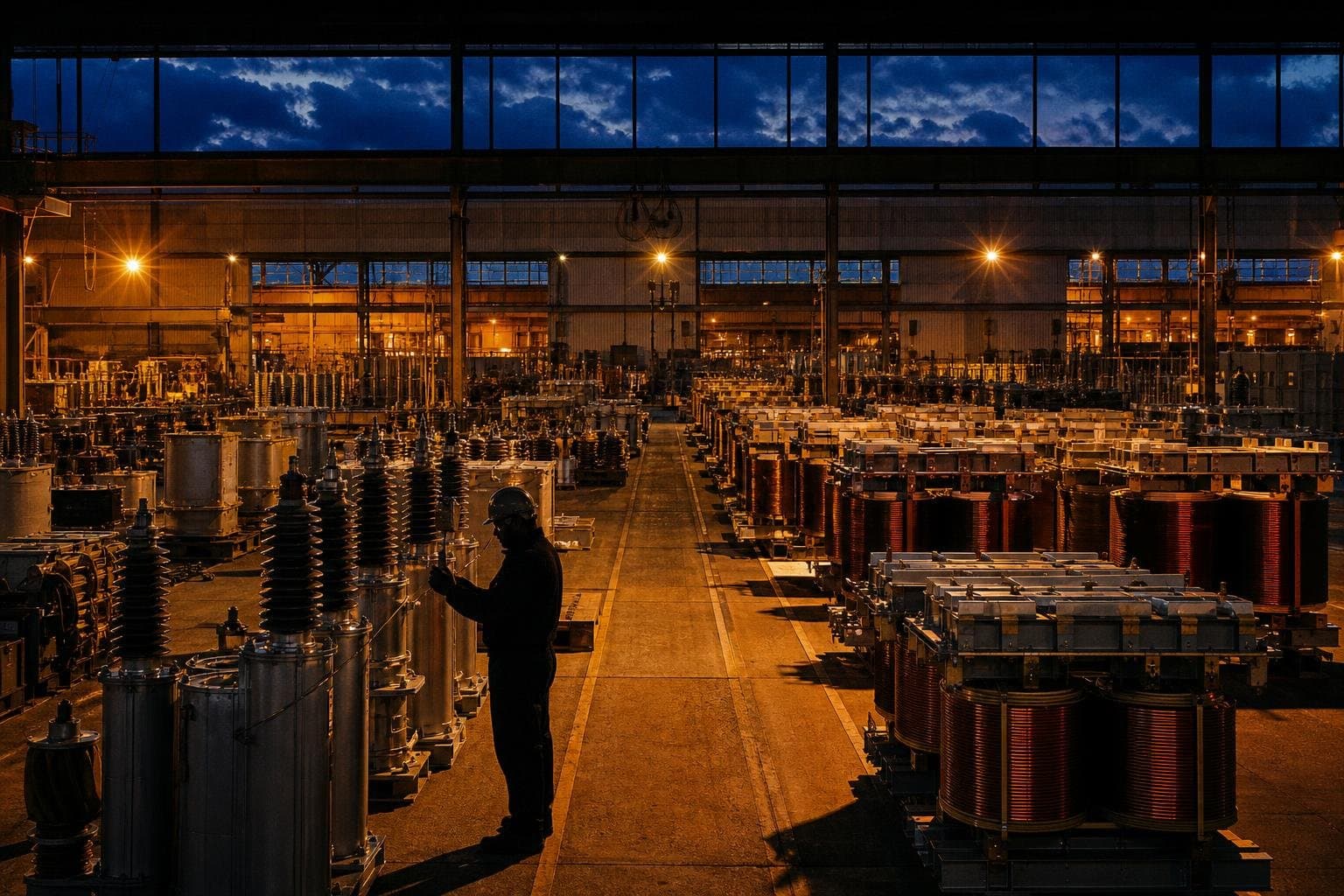

Forget the queue. The real gatekeeper to electrified civilization right now isn't a stack of interconnection applications sitting at a grid operator — it's a bushing factory in Berlin with a two-year backlog.
GE Vernova's October 28 announcement that it will pay $9.0 billion for Trench Group, a maker of bushings and instrument transformers, tells you where the bottleneck actually sits: not in permitting offices, but on production lines (aixenergy). Trench's own backlog runs to roughly $5 billion, some of it booked into the next decade, and its chief executive has said bushing lead times alone run up to two years — for a component that's a fraction of a full transformer (aixenergy). Published lead times for step-up transformers above 50 MVA now run 100 to 150 weeks or more; even 15 kV switchgear is quoted at nearly a year (aixenergy). This is what I mean when I say abundance has to be built, not just approved. A campus can clear every regulatory hurdle and still sit dark for three years waiting on hardware.
The grid operators know it. PJM, which serves more than 67 million people, is now trying to fold generation interconnection, merchant transmission, and large-load studies into one consolidated 12-month process specifically because today's siloed timelines let transmission bottlenecks go undetected until projects collide (ZeroEmissionGrid). That's the right instinct — screen fast, build in phases, stop treating generation and load as separate universes. But PJM also just had to push its own data-center capacity auction to March after FERC called the original cost-allocation plan "deeply flawed" (Bloomberg). Regulatory friction and factory friction are now stacking, not offsetting.
Contrast that with the UK, where the Chancellor just linked priority grid access for data centers to local investment and on-site generation authority — a policy explicitly designed to let projects skip the queue if they bring their own power and community buy-in (Bloomberg). That's the correct direction: stop waiting on queues entirely where you can.
The lesson isn't subtle. Every dollar flowing into Trench, every factory breaking ground to make switchgear faster, is doing more for the next decade of electrification than another stack of interconnection paperwork ever will. Watch whether GE Vernova's new Alabama and Mississippi transformer capacity, due in 2027 and 2029, actually gets built to schedule — that's the real meter on how fast abundance arrives.