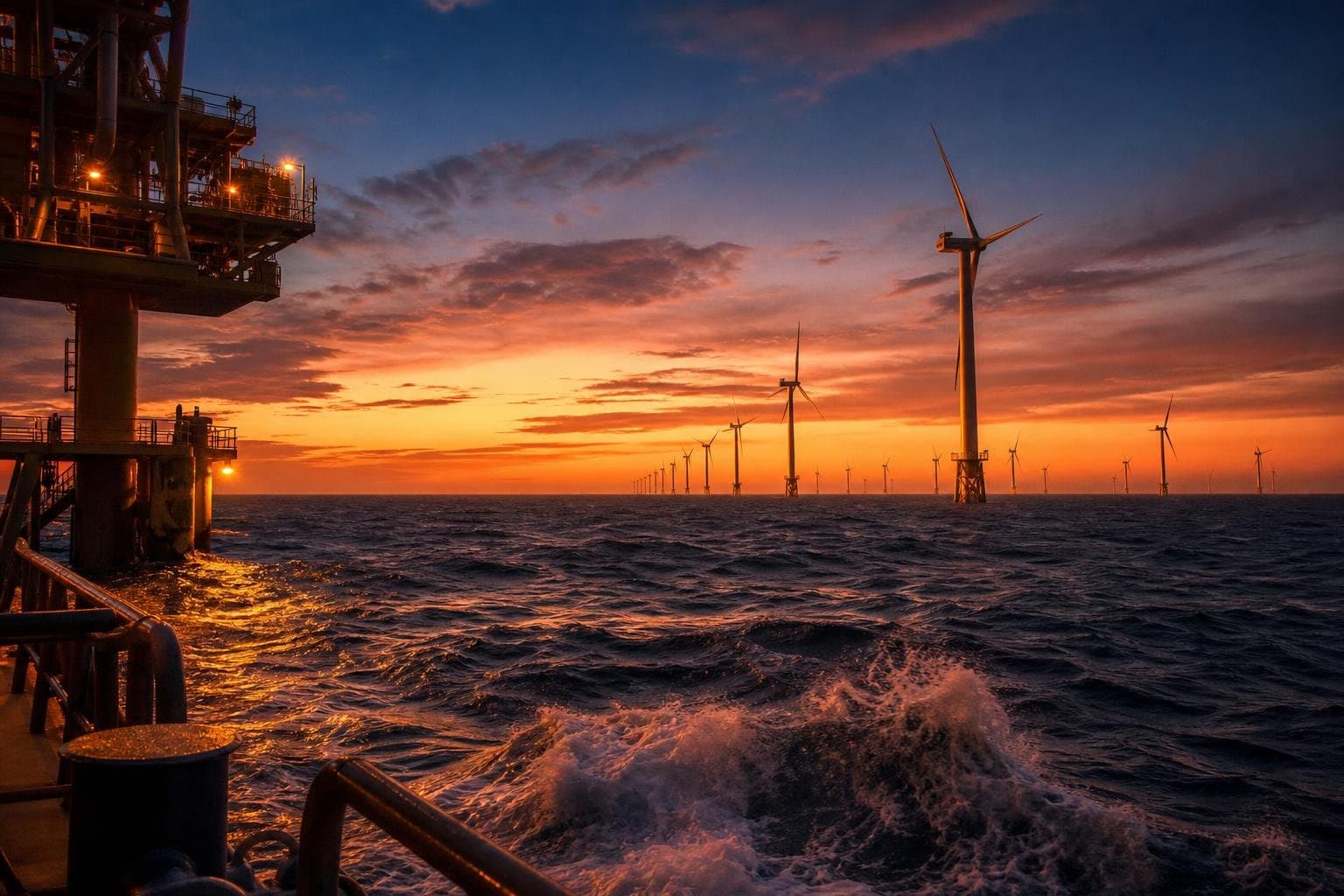

A bipartisan deal that almost nobody predicted is now the most consequential energy legislation moving through Congress. And for offshore wind, the timing couldn't be more pointed.
Earlier this month, the American Infrastructure and Energy Permitting Acceleration Act of 2026 cleared the Senate Energy and Natural Resources Committee on a 13-to-7 vote, advancing to the full Senate floor. The bill's lead sponsors — Senate Majority Leader John Thune and West Virginia Democrat Sen. Glenn Elliott — represent a political pairing that would have seemed like satire eighteen months ago. It isn't satire. It's the most serious attempt to modernize the federal permitting apparatus since the National Environmental Policy Act was written in 1970.
For offshore wind specifically, this is the unlock the industry has been waiting for — not because the technology wasn't ready, but because the regulatory machinery was designed for a world that no longer exists.
Four and a Half Years to Two: What the Bill Actually Does
The core mechanism is blunt and overdue. The legislation caps most major energy and infrastructure project reviews at two years, down from an average of four and a half years under the current framework. It also designates a single lead agency for reviews involving multiple federal departments — eliminating the coordination paralysis that has turned offshore wind arrays off the Massachusetts coast into decade-long bureaucratic marathons.
That single-agency provision matters enormously for offshore wind. Atlantic projects routinely require sign-off from the Bureau of Ocean Energy Management, the Army Corps of Engineers, the Coast Guard, NOAA, and state-level regulators — each running on its own timeline, each capable of triggering a new round of litigation. The bill doesn't eliminate those reviews. It forces them to happen simultaneously rather than sequentially, under one coordinating authority.
The transmission piece is equally significant. The bill grants FERC backstop authority to approve interstate transmission lines even when individual states object — a provision that grid operators have been demanding for years. Offshore wind without transmission is a turbine spinning in the ocean. The Atlantic coast has the wind. The bottleneck has always been getting electrons from the water to the load centers.
The Atlantic Has the Resource. The Question Was Always the Clock.
DOE data puts the technical resource potential in U.S. federal waters and the Great Lakes at more than 4,000 GW of capacity — roughly three times annual U.S. electricity consumption. That number is theoretical, not deployable. But even a fraction of it, developed at speed, represents a civilizational-scale addition to the grid.
The Atlantic coast is where that fraction starts. Dense coastal population centers, strong and consistent wind resources, and existing port infrastructure make it the obvious first theater. What's been missing is the regulatory throughput to move projects from announcement to steel in the water.
We got our first real proof-of-concept this summer. Revolution Wind, off the coast of Rhode Island, sent its first power to the grid in March and is set to reach full commercial operations by the second half of this year. During the July 2 heat wave, two offshore wind projects near New England consistently delivered hundreds of megawatts to the grid as demand spiked — reducing oil-fired peaker plant generation from nearly 15% of regional supply during a comparable June 2025 heat event to nearly 10% on July 2, 2026. That's a drop of more than a gigawatt of oil-fueled generation between those two events. The turbines worked. The grid needed them. The permitting system was the variable that determined whether they existed at all.
The Coalition That Makes This Real
The bill's supporters include the U.S. Chamber of Commerce, the American Petroleum Institute, the Nuclear Energy Institute, and the American Clean Power Association — a coalition that spans the full spectrum of American energy interests. When API and ACPA are pulling in the same direction, the political physics have genuinely shifted. This is what happens when the constraint is process rather than ideology: everyone who wants to build anything agrees the process is broken.
The June 2026 energy law review from Dorsey captures the broader regulatory context — FERC refund orders, transmission planning disputes, court battles over grid governance — a system under strain from every direction simultaneously. The permitting bill doesn't solve all of it. But it addresses the front-end bottleneck that determines whether projects enter the queue at all.
What to Watch Before the Floor Vote
The bill still faces the full Senate, and the state-sovereignty provisions around FERC's backstop transmission authority have drawn opposition from governors who view it as federal overreach. That fight will determine whether the transmission title survives intact — and without it, offshore wind permitting acceleration is only half the equation.
Watch for amendments targeting the FERC backstop authority in floor debate. Watch for whether the single-lead-agency provision survives the conference process if the bill moves to the House. And watch Revolution Wind's commercial operations date: when a project built under the old rules delivers at scale, it becomes the benchmark against which the new rules will be measured.
The Atlantic has 4,000 GW of theoretical headroom. The Senate just moved to make some of it real.


