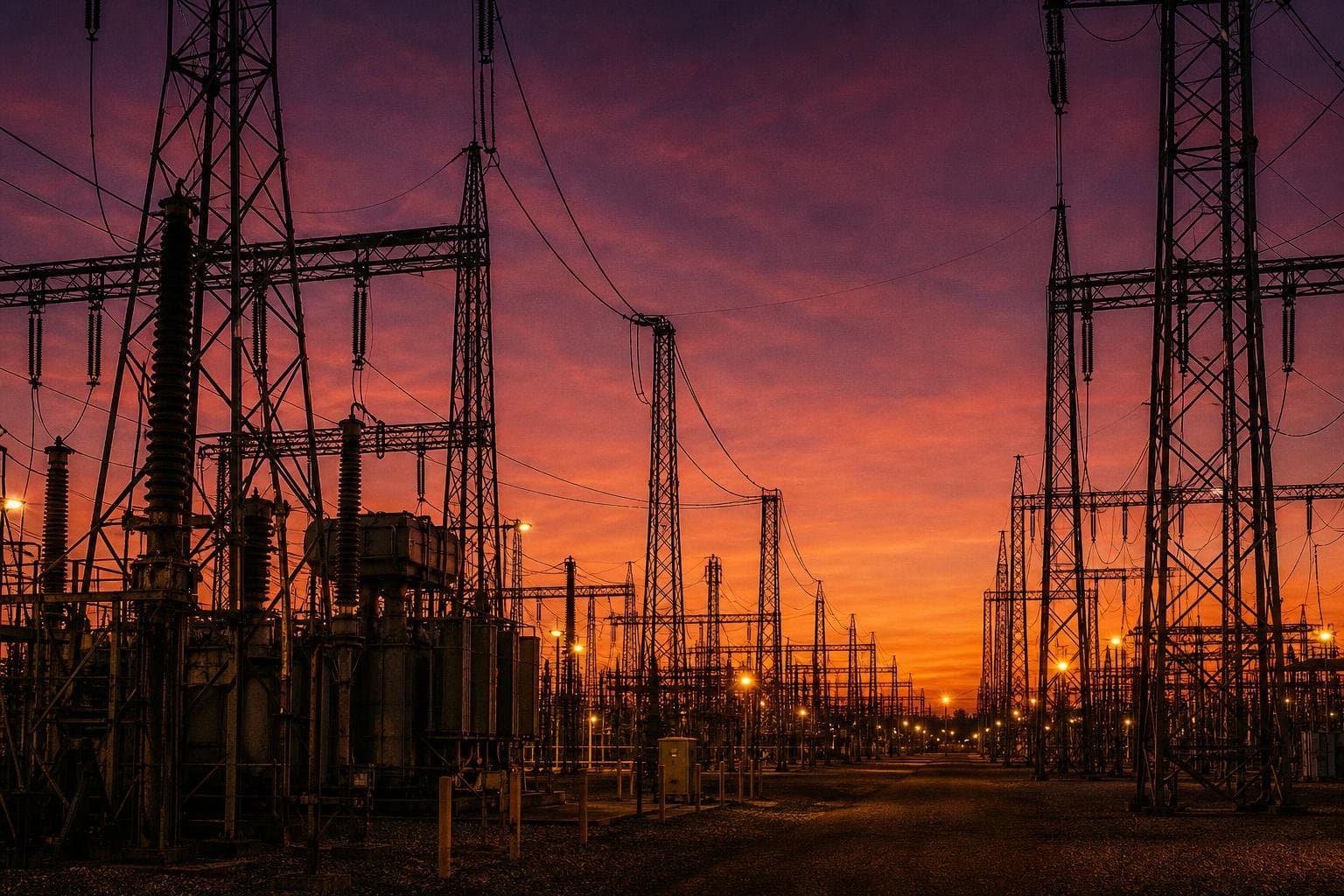

Eight years. That's the average time a project in PJM's interconnection queue waited to reach commercial operation in 2025, up from under two years in 2008, according to RMI's analysis cited by Codibly. Eight years is longer than most equipment supply contracts. It's longer than most site-control options. It is, in practice, longer than most developers' patience — and that's exactly what the latest queue data shows happening.
I've written before about the queue as a bottleneck and about FERC treating it as a capital decision (see The Queue Is the Bottleneck). What's new is the shape of the backlog itself. The headline number looks like progress — total active queue capacity fell 10% year over year, per Lawrence Berkeley National Laboratory's Queued Up: 2026 Edition, as reported by Codibly. But read past the topline and the story inverts. The backlog didn't clear. It got sorted — and the thing doing the sorting is capital discipline, not grid capacity.
The Numbers Don't Say What the Headline Implies
Berkeley Lab counted roughly 8,200 projects still actively seeking connection at the end of 2025, carrying 1,312 GW of generation and 749 GW of storage capacity, with total active queue volume down 10% from the prior year, according to Codibly's summary of the lab's data. That decline sounds like relief. It isn't. Berkeley Lab's own framing, relayed in that same analysis, is that the backlog "eased amid high withdrawals" — a materially different claim than "the backlog is clearing." Projects aren't graduating to commercial operation at scale. They're getting pulled by developers who ran the numbers and walked.
Break down what's actually still sitting in that queue and the composition tells you who's losing patience and who isn't. Solar fell 19% year over year. Storage fell 16%. Wind fell 19%. Natural gas rose 86%, per the same Berkeley Lab data relayed by Codibly. That's not a diversified retreat — that's renewable developers getting priced out of patience while gas developers, who can point to dispatchable capacity utilities actually want to contract against, keep filing. If you're building the electric civilization I keep writing about, a queue that's quietly reallocating toward gas because gas clears faster is not a victory lap. It's a signal that the interconnection process itself is now picking winners by bureaucratic endurance rather than by what the grid actually needs.
And even the projects that survive the queue aren't delivering power. A separate 549 GW already holds a draft or executed interconnection agreement — meaning it cleared the study phase — and still hasn't reached commercial operation, per Codibly's reporting on the Berkeley Lab dataset. That's the distinction this publication insists on every week: an interconnection agreement is a milestone, not a megawatt. Over half a terawatt of approved, studied, paper-ready capacity is sitting there generating nothing. The total active queue — over 2,060 GW — is several times the installed generating capacity of the entire country, per the same source. Most of that 2,060 GW will never produce a kilowatt-hour. The queue isn't a pipeline. It's a waiting room with a 10-to-1 ratio of applicants to open chairs.
FERC Is Trying to Fix the Front Door While the Back Door Stays Jammed
The regulatory response this fall has been real, if partial. FERC approved reforms to CAISO's interconnection process that took effect October 1, under which requests submitted during the annual application window get evaluated on commercial interest, project feasibility, and system demand before being ranked for the study phase — a screen intended to stop speculative projects from clogging a queue that, as of last year, held more than 500 GW waiting to come online, according to Data Center Dynamics. Aurora Energy Research's Oliver Kerr put the practical consequence bluntly to DCD: start a California project today and it could be eight-plus years before it delivers any power to the grid. That's not a fringe estimate — it's the same order of magnitude RMI found for PJM.
CAISO's board chair, Jan Shori, framed the overhaul as a response to "explosive growth in the number of applications for grid interconnection studies the past three years," per Data Center Dynamics. FERC gave conditional approval pending review of CAISO's compliance filing under Order No. 2023, the nationwide interconnection framework set last year. The DOE's parallel Distributed Energy Resource Interconnection Roadmap, built by its Interconnection Innovation e-Xchange, is tackling the same problem at the distribution level — pushing for transparent, standardized data sharing between utilities and regulators so interconnection studies stop running on stale or siloed information, per the Department of Energy. That roadmap explicitly names the pressure point: homes electrifying, manufacturing expanding, and AI data centers growing all at once, straining a distribution grid built for a slower world.
None of this is small. But it is screening reform, not throughput reform. Faster triage at the front door doesn't change the eight-year study-to-energization timeline for whatever gets through. It changes who gets in line.
PJM's Queue Problem Has Become a Load Problem, and the Two Are Colliding
Here's where the story turns from "renewables stuck in a slow queue" into something the whole grid has to reckon with: the demand side of the interconnection equation just got its own emergency process, and it's running in parallel to the generation queue, sometimes competing with it for the same regulatory bandwidth.
PJM filed a Reliability Backstop Procurement proposal with FERC on July 31 to address resource adequacy concerns from large loads — the generic regulatory term for the data centers eating PJM's headroom — and spent September defending it against protests, per PJM's own FERC filing. FERC called an earlier version of PJM's capacity plan "deeply flawed" and ordered a rewrite by the end of February, a delay TD Cowen analysts described as the regulator "punting" on a critical policy overhaul, per Bloomberg. Less than a day later, PJM suspended its planned auction for new data-center power supply altogether, per Bloomberg. Then, separately, PJM opened its annual review of proposed large-load adjustments to its 2027 forecast this week, with roughly a dozen utilities — including Dominion, NOVEC, FirstEnergy, and Duke — presenting data-center-heavy load proposals to the Load Analysis Subcommittee, and an outside consultant, Charles River Associates, brought in to stress-test how much of that demand is real versus speculative, with findings due in October and a final forecast in January, per Reuters.
Read those three PJM stories together and you get a grid operator trying to referee generation-side gridlock and demand-side gridlock at the same moment, with FERC slowing down one side of the clock while load keeps accelerating on the other. MISO is running a comparable play on the demand side: it filed interconnection reliability rules with FERC on August 28 requiring any load above 50 MW — explicitly including data centers and computational facilities — to meet ramp-rate, ride-through, and real-time monitoring standards before connecting, with a proposed effective date of December 4, per TFTC. MISO's own filing language, per TFTC, states flatly that computational loads "may exhibit rapid and coordinated changes in demand" that threaten grid stability during disturbances — the kind of admission that validates everything this publication has argued about AI load being a genuinely novel grid stressor, not just a bigger version of an old one. MISO's demand was essentially flat for fifteen years, averaging 0.5% annual growth from 2009 to 2024; it's now projecting 1% to 2% annual growth through 2044, per the same filing.
The Grid Doesn't Need a Faster Line. It Needs More Doors.
The reflex response to an eight-year queue is to demand faster processing — more screening, tighter data standards, harder deadlines. FERC's CAISO reforms and the DOE's roadmap are steps in that direction, and I'll take them over inertia. But speeding up triage inside a single national queue model has a ceiling, and that ceiling is the physical transmission and substation capacity the queue is rationing in the first place. You can sort 2,060 GW of applicants faster. You still only have room to actually connect a fraction of them without new wires, new substations, and new transformers — the unglamorous steel-and-copper reality behind every queue statistic.
That's the actual civilizational stakes here. A renewable developer who withdraws after years of carrying site-control costs and sunk interconnection fees doesn't just lose a project — they take capital and expertise out of the pipeline that electrifies everything else: EVs, industrial heat, data centers that could be running on clean power instead of the gas plants now filling 86% more of the queue. Every year the interconnection process runs on 2008-era throughput while demand runs on 2026-era growth curves is a year the abundance case loses ground to the scarcity case by default, not by argument.
Watch three things over the next few months: PJM's rewritten capacity proposal due to FERC by the end of February, the Charles River Associates load-demand findings due in October feeding into PJM's January 2027 forecast, and whether MISO's December 4 large-load reliability rules actually hold up once hyperscalers start testing the ride-through requirements in practice. Each of those will tell you whether the queue problem is finally being treated as the capital and infrastructure problem it is — or just getting reshuffled again.


