
The NRC just proved it can approve a nuclear license in nine months. The same agency that once took four years to complete that same review type finished the job in nine months, using AI-assisted document analysis and a new executive mandate. According to the NRC's own chief data officer, Basia Sall, the agency set a target of 18 months — then beat it by half.
That's genuinely extraordinary. Bureaucracies don't usually beat their own aggressive targets by 50%. When they do, it means something structural changed, not just the pace of paperwork.
And yet: the nuclear renaissance still doesn't have a clear path to the grid at the scale the moment demands. Utilities are restarting shuttered plants. Dozens of advanced reactor startups are competing for buyers. Bloomberg reported this week that AI data centers and the Trump administration are together creating the most favorable political and commercial environment for nuclear power in decades. Capital is available. Political will exists. The regulatory agency is, for the first time in a generation, actually moving fast.
So why does the bottleneck persist? Because it moved. The constraint didn't disappear — it migrated downstream, from the NRC's review queue into the physical supply chain, the interconnection queue, and the gap between announced projects and operational megawatts. Understanding where the bottleneck lives now is the only way to know what has to happen next.
The NRC Acceleration Is Real — and It's Not the Whole Story
Let's be precise about what changed at the NRC, because the details matter.
The nine-month licensing achievement Sall described applies to a specific type of licensing review, not to the full construction and operating license process for a commercial reactor. The NRC's AI tools are helping staff triage documents, check precedent, and produce cleaner draft decisions — which means the agency receives better applications from industry (because companies are using the same AI tools to prepare them) and processes those applications faster internally. That's a genuine efficiency gain across the licensing stack.
The Trump executive order from May 2025, which set an 18-month deadline on licensing reviews, created the political pressure. The AI tools created the operational capacity to meet it. Together, they produced something the nuclear industry hasn't seen in decades: an NRC that is visibly trying to move faster and actually succeeding.
But here's the thing about a four-year process becoming a nine-month process: the four years were never the only reason nuclear plants took 10-15 years from concept to commercial operation. The licensing review was one phase. Before it comes site selection, environmental review, and design certification. After it comes construction — which, for large light-water reactors, has historically run years over schedule and billions over budget. The NRC's speed improvement is real and significant. It is not, by itself, a solution to the timeline problem.
The DOE recognized this gap and created its own parallel pathway. The DOE's reactor authorization process, developed specifically for advanced reactor designs, allows prototype reactors to be certified, built, and tested under DOE authority rather than waiting for NRC commercial licensing. The logic is sound: the NRC's existing framework was designed for large light-water reactors, and forcing novel designs — molten salt, high-temperature gas, microreactors — through a process built for a different technology adds years of exceptions and workarounds. The DOE pathway cuts that detour.
Two accelerants, working in parallel. Both real. Neither sufficient on its own.
Where the Bottleneck Actually Lives Now
The interconnection queue is the honest answer to why nuclear timelines remain civilization's bottleneck even after policy acceleration.
FERC and PJM have been fighting this battle on the grid side. Reuters reported in June that FERC approved PJM's expedited interconnection track — a temporary process to advance large projects that have state authority commitments, with a target of executing interconnection agreements within 10 months of submission and achieving commercial operation within three years. PJM CEO David Mills called it "an important pathway for bringing qualified, shovel-ready generation projects of any kind to connect onto the grid within the next three years."
Read that carefully: shovel-ready. The expedited track helps projects that are already ready to build. It does not help projects that are still in design, licensing, or supply chain development. For most advanced reactor concepts, "shovel-ready" is still years away — which means the FERC fast-track, as valuable as it is, doesn't reach the projects that need the most help.
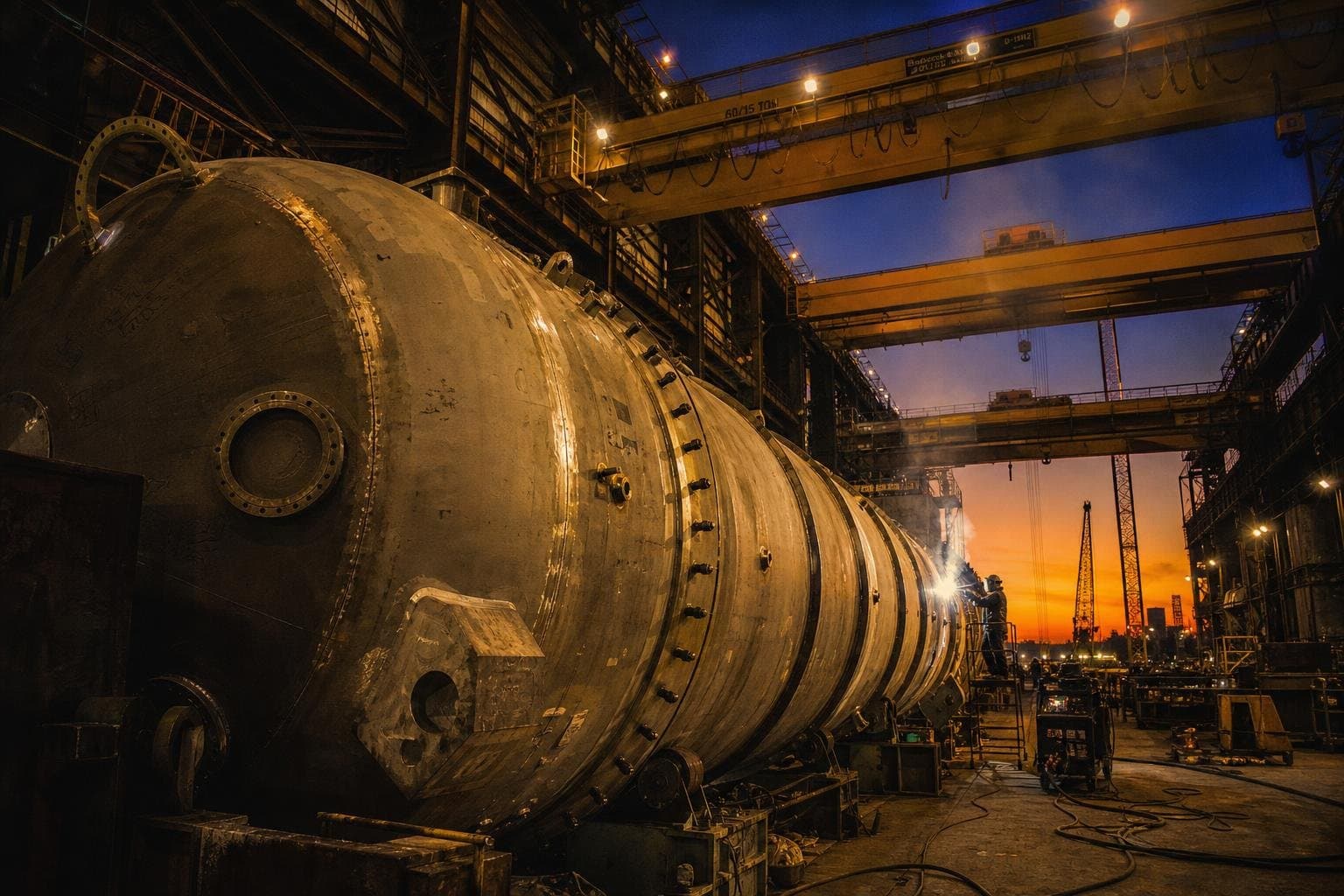
The deeper constraint is physical. Nuclear construction requires specialized forgings, pressure vessels, reactor coolant pumps, and control systems that have extremely limited global manufacturing capacity. The United States largely dismantled its nuclear supply chain during the 40-year construction drought that followed Three Mile Island. Rebuilding it takes time that no executive order can compress. You can streamline a licensing review in 18 months. You cannot forge a reactor pressure vessel in 18 months if the forge shop doesn't exist yet.
This is the part of the nuclear timeline that policy acceleration hasn't touched. The NRC can approve a design in nine months. The DOE can authorize a prototype under its own process. FERC can fast-track interconnection for shovel-ready projects. But if the physical components needed to build the reactor aren't available — or if the workforce to install them doesn't exist at scale — the timeline doesn't compress. It just shifts where the delay accumulates.
The AI Demand Signal Is Making the Gap More Visible, Not Smaller
Here's the civilizational irony: the technology driving the most urgent new demand for nuclear power is also the technology helping the NRC process licenses faster. AI is simultaneously creating the problem and partially solving it.
Bloomberg's coverage this week frames the nuclear revival as a product of two forces: AI data center demand and Trump administration policy support. Both are real. The EIA has confirmed that U.S. power consumption hit its second straight annual record high in 2025 and projects further growth in 2026 and 2027, driven by AI-hungry data centers and electrification. Data center operators want 24/7 carbon-free power with guaranteed baseload — which is exactly what nuclear provides and what solar and wind cannot deliver without massive storage backing.
The demand signal is clear. The capital is available. The political environment is the most favorable in 40 years. And the bottleneck is still real, just differently located than it was five years ago.
This matters for how we think about the timeline. The old bottleneck — a slow, adversarial NRC that could take four years to complete a single review type — was a policy problem with a policy solution. Apply political pressure, reform the process, deploy AI tools, set deadlines. Done. The new bottleneck — supply chain capacity, workforce depth, and the sheer physical time required to build large engineered systems — is an industrial problem. It responds to capital and sustained commitment over years, not to executive orders or AI efficiency gains.
The IEA's work on critical minerals adds another layer: the materials required for nuclear construction (and for the broader energy transition) face their own supply chain constraints. The IEA's 2026 Global Critical Minerals Outlook tracks supply and demand for key energy minerals with medium- and long-term projections — and the picture for specialized materials is not one of easy abundance. Nuclear's supply chain problem isn't just about forgings and pressure vessels. It's about the full stack of materials required to build and fuel reactors at scale.
What Acceleration Actually Looks Like From Here
The honest civilizational accounting looks like this: the nuclear industry in 2026 is in a better position than it has been at any point since the 1970s. The regulatory environment has genuinely improved. The political will is present. The demand signal is unambiguous. Capital is chasing the sector.
But "better than the 1970s" is a low bar when the demand curve is rewriting itself in real time. AI data centers need power now, or as close to now as the grid can deliver. Nuclear's contribution to that demand — even under the most optimistic scenarios — is measured in years, not months. The plants being restarted today are the fastest path to new nuclear megawatts, because they skip the construction phase entirely. The advanced reactor designs that most excite the industry are still working through prototype demonstration before commercial deployment becomes possible.
The DOE's reactor authorization pathway is the right structural move for accelerating advanced designs — it creates a faster route to prototype testing that can inform commercial deployment without forcing novel technologies through a framework built for a different era. The NRC's AI-assisted licensing acceleration is real and should be expanded. The FERC/PJM expedited interconnection track creates a pathway for shovel-ready projects to move faster once they're ready to build.
What's missing is the industrial policy equivalent: a sustained, funded commitment to rebuilding the nuclear supply chain — the forge shops, the specialized manufacturers, the trained workforce — that would allow the permitting acceleration to actually translate into faster construction. Without that, the bottleneck doesn't disappear. It just moves to the next constraint in the chain.
Watch for three specific signals in the next 12-18 months. First, whether any advanced reactor developer moves from NRC or DOE authorization to actual groundbreaking — that's the moment when announced capacity starts becoming real capacity. Second, whether PJM's expedited interconnection track attracts nuclear projects specifically, or whether it gets dominated by gas and storage projects that can actually meet the three-year operational window. Third, whether the DOE's supply chain investment programs — which have been announced but not yet fully deployed at scale — start producing measurable increases in domestic manufacturing capacity for reactor components.
The permitting bottleneck is real, and it's moving. That's progress. But moving a bottleneck downstream is not the same as eliminating it. The future is electric, and nuclear is the baseload spine that makes it reliable. The gap between that vision and the operational megawatts on the grid is still measured in years — and the work of closing it is just beginning.


