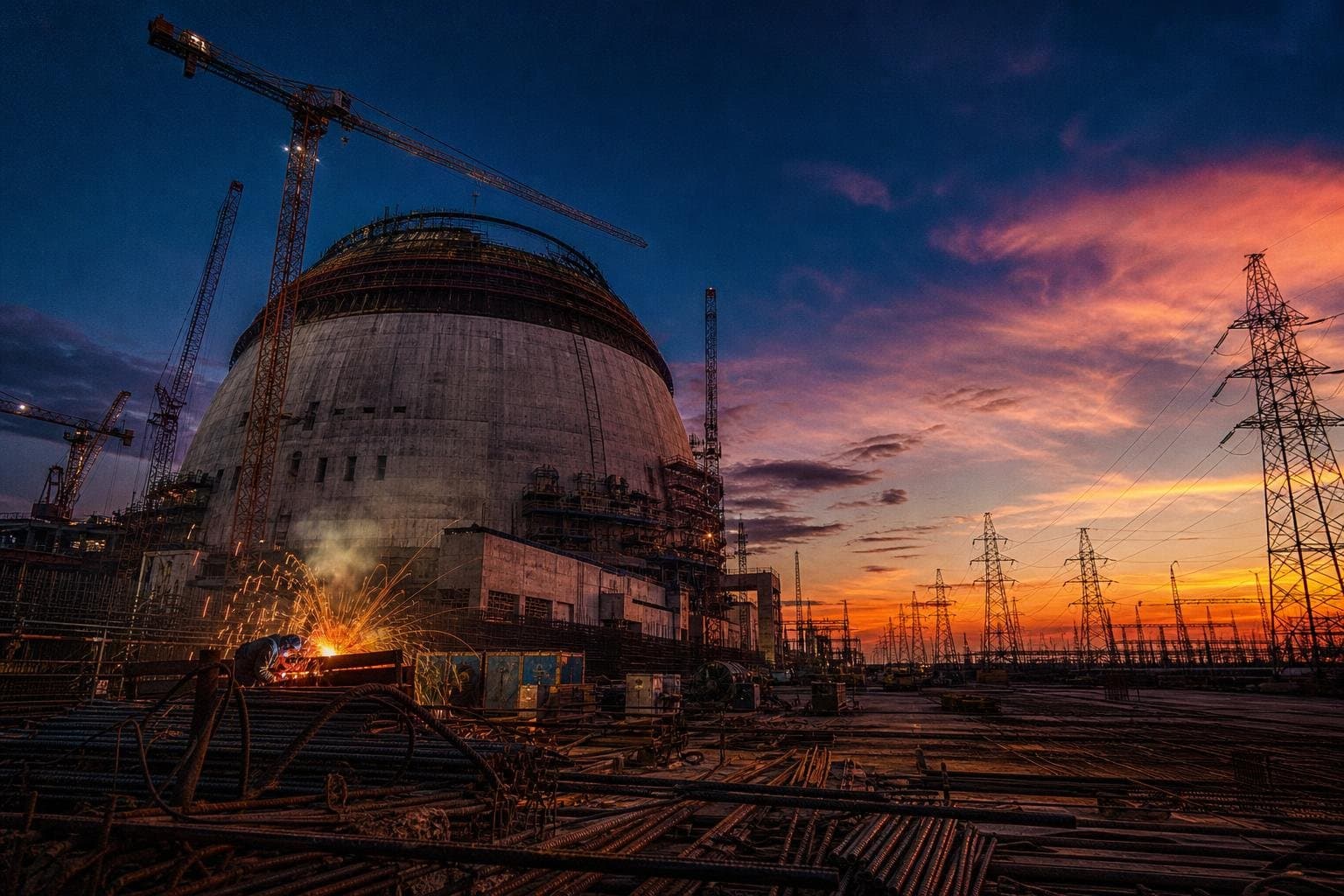

A nuclear chain reaction became self-sustaining inside a small reactor developed by Antares Nuclear Inc. last week. The Bloomberg report was brief, almost clinical. But that milestone — criticality, the moment a reactor stops being a physics experiment and starts being a power source — landed against a backdrop that makes it genuinely historic: the same week, the Nuclear Regulatory Commission published a new policy statement on mandatory hearings for reactor licensing in the Federal Register.
Two events. One week. The gap between "reactor that works" and "reactor that's permitted to operate commercially" just got measurably narrower.
The Hearing Reform Is the Quiet Revolution
The NRC's mandatory hearing process has historically been one of the most reliable ways to stretch a reactor licensing timeline from years into decades. Mandatory hearings — required even when no one formally objects — added procedural mass to every application regardless of design novelty or safety record. The new policy statement, published today (June 8, 2026), signals a formal reconsideration of how that process applies to advanced reactor designs.
This builds directly on the deregulatory architecture that National Review documented from Trump's May 2025 executive orders: NRC licensing deadlines capped at 18 months for new reactors, regulatory fees restructured away from the hourly billing model that — as Illinois Institute of Technology's Jeff Terry put it — created "a system where process becomes the priority instead of speed or efficiency." The hearing reform is the next layer of that stack.
When I covered the NRC's broader rulebook rewrite back in late May, the story was about streamlined construction permits and parallel review pathways. The hearing policy is different — it targets the litigation-adjacent phase where projects historically went to die. Streamlining construction permits matters. Streamlining the mandatory hearing process is what actually clears the runway.
Three Reactors to Criticality by July 4th — That's the Scoreboard
The DOE's Reactor Pilot Program, launched in the weeks after the May 2025 executive orders, selected 11 projects for a new fast-track demonstration pathway. The goal: at least three reactor designs reaching criticality by July 4, 2026. As of May 2026, three of those projects had secured Final Documented Safety Analyses. Antares just became the first to cross the criticality threshold.
That's not a projection. That's a result.
The DOE's one-year retrospective frames the ambition clearly: the U.S. is targeting enough new nuclear capacity to power 2 million homes by 2027 and 4 million by 2029. Those are announced targets, not operational capacity — the distinction matters, and I'll hold the line on it. But the pipeline feeding those targets is now visibly moving. X-energy's four 80-MW SMRs at Dow's Seadrift facility in Texas, with Fluor now under contract for front-end engineering, represent the kind of industrial-scale deployment that turns gigawatt ambitions into construction schedules.
The Demand Signal Is Not Waiting for the Permits
Here's the civilizational pressure point: the customers are already here. Data center electricity demand is projected to grow from 4% to 9% of U.S. consumption by 2030, per DOE analysis. Hyperscale campuses require hundreds of megawatts each, need 24/7 uptime, and carry decarbonization commitments that rule out gas peakers as a long-term answer. And this week, Reuters reported that South Korea's Naver is planning gigawatt-scale AI factories using Nvidia technology — a demand signal that isn't American, isn't hypothetical, and isn't small.
Nuclear is the only generation technology that can answer that call with firm, carbon-free, around-the-clock power. The DOE's own technical analysis identifies behind-the-meter nuclear supply and brownfield siting at retired coal plants as near-term paths to getting capacity to data centers faster than greenfield grid interconnection allows.
The permitting acceleration isn't bureaucratic housekeeping. It's the rate-limiting step between the energy abundance we're building toward and the demand curve that's already arrived. Every month shaved off a mandatory hearing timeline is a month closer to a reactor that's actually generating electrons.
Watch for: whether the NRC's new hearing policy statement translates into measurable timeline compression on the first wave of SMR construction permit applications — X-energy's Seadrift filing from March 2025 is the most visible test case. The July 4 criticality deadline for the DOE Reactor Pilot Program is the next hard milestone. If three designs hit it, the deregulatory thesis gets its first operational proof point.
The future is electric. The permits are finally catching up.


