



This Week in Voltage
The permit that nobody thought would come — at least not this fast — just landed.
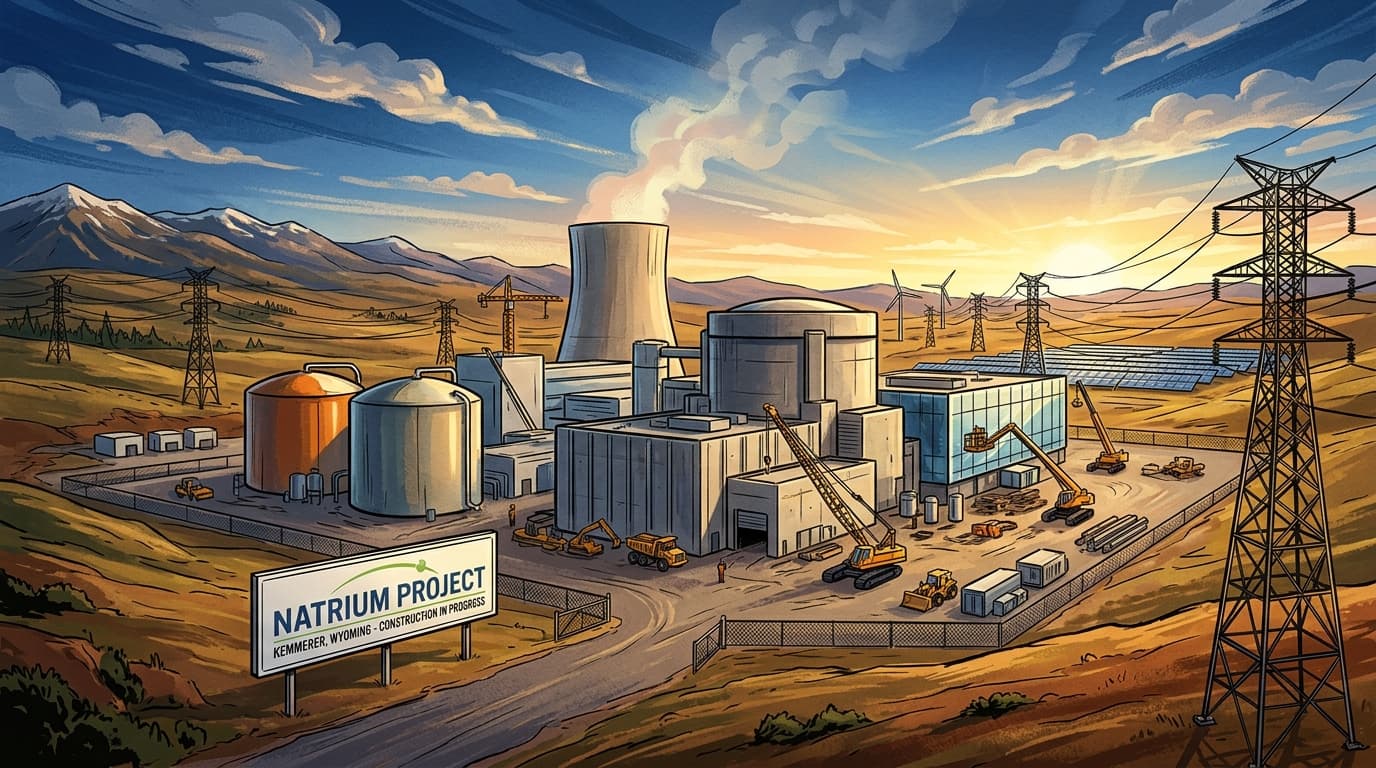
The U.S. Nuclear Regulatory Commission issued a construction permit for TerraPower's Natrium reactor in Kemmerer, Wyoming. First-ever NRC construction permit for a commercial non-light-water reactor. Full stop. The agency completed its safety review ahead of schedule and 11 percent under budget — a sentence that has almost never been written about nuclear permitting in the modern era.
This is what regulatory momentum looks like when it actually moves.
Deep Charge: The Nuclear Renaissance Isn't Hype Anymore — It Has a Permit
The case for nuclear baseload has always been theoretically airtight: carbon-free, dispatchable, dense, reliable. The problem was that "theoretically" was doing a lot of heavy lifting. Decades of cost overruns, regulatory paralysis, and political whiplash turned nuclear into a punchline for anyone who'd watched Vogtle's budget double.
Kemmerer changes the argument's texture. TerraPower's 345-megawatt Natrium design — a sodium-cooled fast reactor with molten salt energy storage — isn't a paper reactor. It has a site, a permit, and non-nuclear construction already underway since June 2024. The NRC reviewed it in roughly 20 months and came in under budget. That's a proof point for the regulatory pathway, not just the technology.
Why does this matter for baseload abundance? Because the AI electricity demand surge is exposing exactly what intermittent generation cannot provide. BCG projects a potential 80-gigawatt gap between data center power demand and reliable round-the-clock generating capacity by 2030. Solar and wind don't close that gap — they widen it, because data centers need firm power at 3 a.m. on a still January night, not just when conditions cooperate.
The hyperscalers know this. Amazon, Google, Microsoft, Meta, and three others just signed the White House's Ratepayer Protection Pledge, committing to fund new generation capacity and grid upgrades for their own facilities — without passing costs to residential ratepayers. That's a structural signal: the biggest electricity buyers on the planet are now on the hook to source their own firm power. Nuclear is the only zero-carbon technology that fits that job description at scale.
The renaissance isn't a vibe. It's a construction permit, a 80-GW demand gap, and seven hyperscalers suddenly very motivated to find baseload that works.
By the Numbers
- 345 MW — Natrium reactor's rated electric output
- ~80 GW — projected U.S. data center power shortfall by 2030, per BCG
- 11% — how far under budget the NRC completed its Kemmerer safety review
- 7 — hyperscalers signed to the White House Ratepayer Protection Pledge (Amazon, Google, Meta, Microsoft, OpenAI, Oracle, xAI)
- 40+ years — how long it had been since the NRC docketed a commercial non-light-water reactor application before TerraPower's
What We're Fighting For
Kemmerer Unit 1 won't power a city by itself. But it will do something more important: prove the construction pathway for a generation of advanced reactors that don't exist yet at commercial scale. Watch for TerraPower's nuclear construction commencement timeline — that's the next milestone that separates "permitted" from "built."
Every civilization that has climbed the energy ladder has done it on the back of dense, reliable power. We're at the moment where the next rung either gets built or gets debated for another decade. Wyoming just picked a side.