


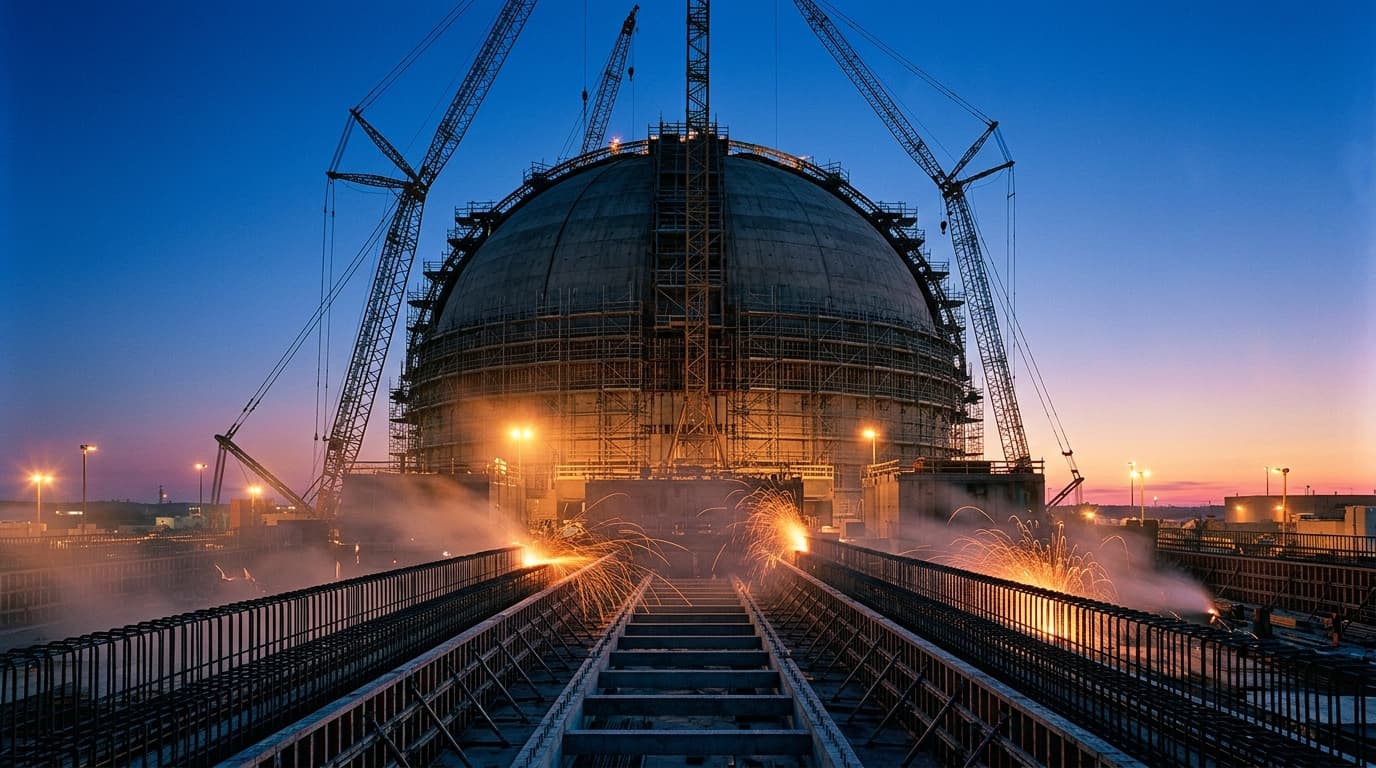

The construction permit the NRC approved for TerraPower's Natrium reactor isn't just a regulatory milestone — it's the starting gun for a fundamentally different energy era. And the timing couldn't be more clarifying.
This Week in Voltage
FERC dropped an April 16 order setting a June 2026 deadline to rewrite grid interconnection rules for large loads — defined as anything above 20 MW, which means AI data centers, directly. The commission reviewed over 3,500 pages of public comment and is coordinating with DOE to ensure these loads connect in a "timely, orderly, and non-discriminatory manner." Translation: the grid's regulatory architecture is being rebuilt around the assumption that demand is going to be enormous and relentless. That assumption is correct.
Deep Charge: Baseload Is Back, and It's Nuclear
For two decades, the energy conversation was dominated by intermittency management — how do you build a grid around sources that only produce when the wind blows or the sun shines? The nuclear renaissance answers that question by refusing to accept its premise.
NextEra and TerraPower formalized an SMR partnership moving into site selection in April 2026, targeting a fleet rollout of Natrium reactors to power Google and Microsoft data centers. The world's largest renewable energy developer is now betting on nuclear for firm baseload. That's not a pivot — that's a confession that intermittent generation alone can't carry civilizational-scale compute loads.
Big Tech is backing this with serious capital, offering nuclear developers both funding and offtake certainty. This is the missing ingredient that stalled nuclear for thirty years: a creditworthy buyer willing to sign long-term power purchase agreements before a shovel hits the ground.
By the Numbers
Uranium spot prices hit $105/lb of U3O8 as of March 21 — an 18% gain since January. Japan has restarted enough reactors to bring its nuclear share to a projected 15% of generation by Q3 2026. China has 26 reactors under construction targeting 100 GW by 2035. The European Commission unlocked an estimated €50 billion in financing after classifying nuclear as a strategic net-zero technology in March. The uranium market, per that same analysis, is structurally unprepared for this demand wave.
What We're Fighting For
Baseload abundance is the precondition for everything else — the data centers training the models, the factories running on electric heat, the grid that eventually powers interstellar ambition.
Nuclear doesn't just add electrons; it adds reliable electrons, 24 hours a day, regardless of weather or season.
The FERC deadline, the TerraPower permit, the Big Tech capital commitments — these aren't separate stories.
They're the same story: civilization deciding, finally, to build for the scale it actually needs.
Watch the June FERC ruling.