


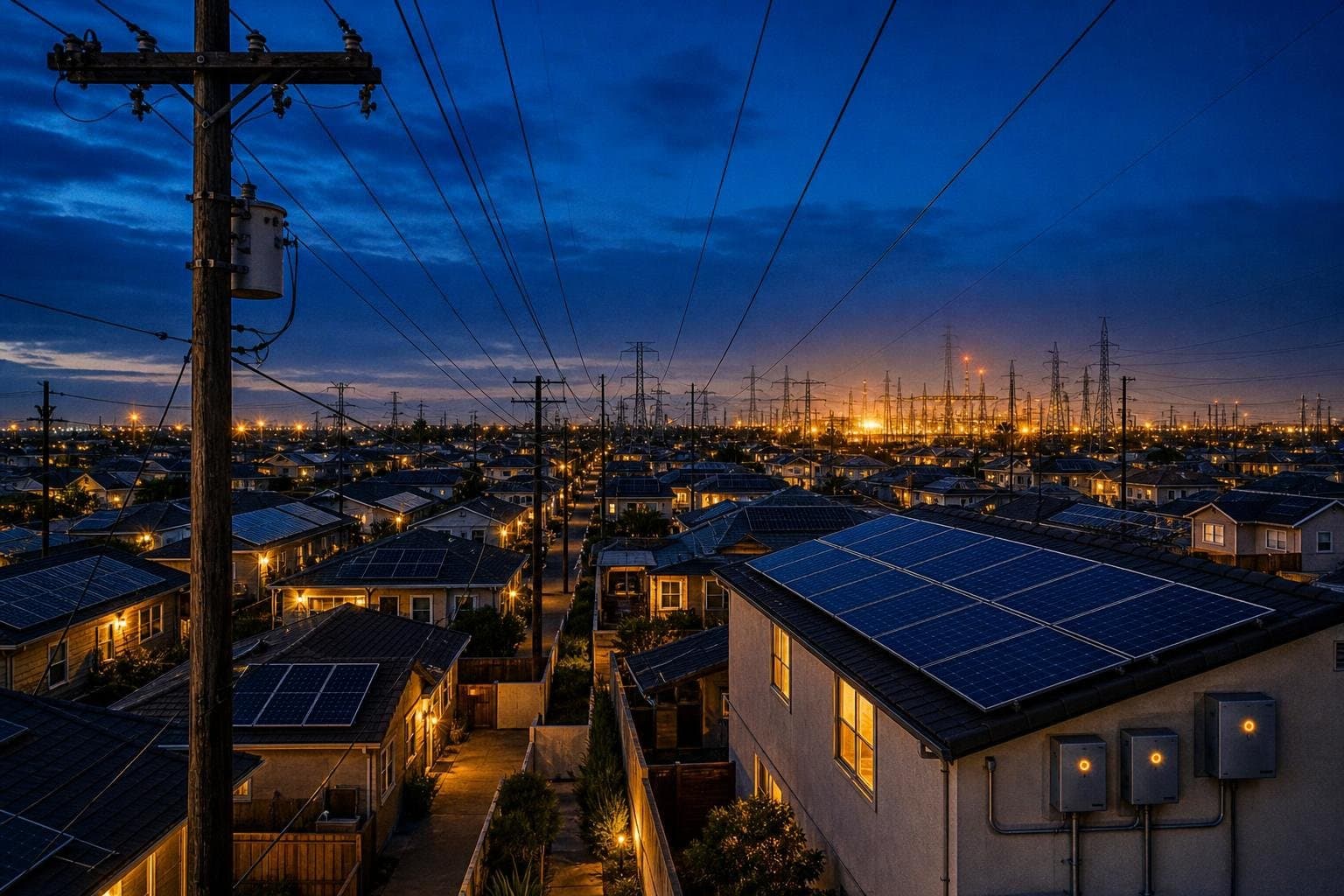

New York's one-year data center moratorium is exactly the kind of friction that makes abundance advocates want to flip tables. But while legislators debate whether to let the future happen, utilities and tech companies are quietly building a parallel grid — one made of software, thermostats, and EV batteries.
Virtual power plants. U.S. VPP capacity hit 37.5 GW in 2025, up 13.7% year-over-year, according to Wood Mackenzie. That's not a pilot program. That's a real asset class. Sunrun, Tesla, and Renew Home have announced plans for a 16 GW VPP aimed at serving tech giants and utilities directly — aggregating residential batteries, smart thermostats, and HVAC systems across millions of homes into dispatchable capacity. Renew Home alone claims around eight million devices across six million U.S. homes, representing up to 9 GW of demand flexibility.
Meanwhile, the demand side of this equation keeps accelerating. The IEA projects global electricity consumption growing at 3.6% annually through 2030, driven by data centers, EVs, industrial electrification, and cooling — with advanced economies finally breaking out of 15 years of stagnation. That's the tailwind VPPs are surfing.
Here's what I find genuinely exciting about this: VPPs don't wait for transmission permits. They don't sit in FERC interconnection queues for seven years. They scale through software and consumer adoption. That's not a replacement for new generation — we still need the nuclear plants, the grid buildouts, the [DOE's $200 million push to accelerate advanced reactors for AI](https://www.bloomberg.com/news/articles/2