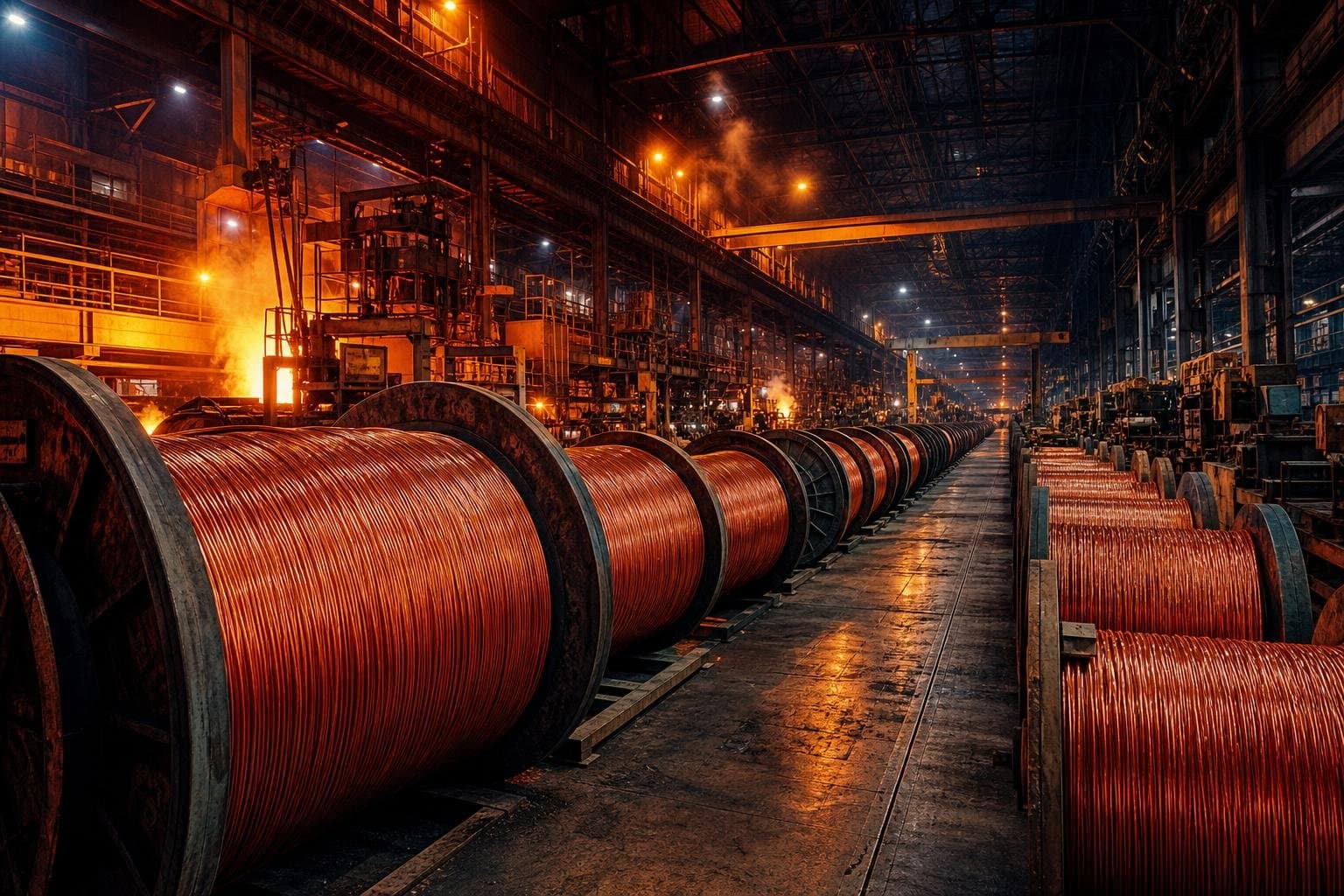

The electrification buildout has a materials problem hiding in plain sight. Every transmission line, every transformer, every EV charging station, every data center power feed — they all run on copper. And the world is about to need a lot more of it than the mining industry is currently positioned to deliver.
This isn't a distant forecast problem. It's arriving now, and the signals are already visible in the market.
Grid Investment Is Now the Dominant Demand Driver
For most of copper's modern history, the demand story was about construction and consumer electronics. Then EVs arrived and everyone focused on the automotive transition. But according to Wood Mackenzie head of copper research Charles Cooper, the single most important driver of copper demand over the coming decades won't be EVs — it will be investment in electricity grids themselves, underpinning everything from renewable integration to AI data center buildouts.
Think about what that means structurally. The IEA's Electricity 2026 report projects global electricity demand growing at an average annual rate of 3.6% through 2030 — roughly 50% faster than the average pace of the previous decade. Every percentage point of that demand growth requires new wires, new substations, new interconnects. Copper is the physical substrate of the energy transition. You cannot route electrons without it.
The AI boom is accelerating this dynamic in ways that weren't fully priced into supply forecasts even two years ago. Data centers don't just consume electricity — they require dense, high-capacity electrical infrastructure that is extraordinarily copper-intensive. When copper prices rallied 1.4% on the London Metal Exchange in late June, part of the catalyst was a blowout earnings forecast from Micron Technology — a semiconductor signal that the AI infrastructure buildout isn't slowing. The market is reading AI chip deployment as a direct copper demand signal. That's new, and it's correct.
The Supply Side Is Structurally Constrained
Here's where the civilizational math gets uncomfortable. The mining industry's response to surging demand has been... cautious. PwC's Mine 2026 analysis frames the challenge clearly: while the top 40 mining companies posted strong earnings in 2025, the industry faces a fundamental tension between geology, capital, and policy frameworks. New copper mines take a decade or more to permit and build. The projects that will supply copper in 2035 need to be in the ground — or at least in permitting — now.
The most significant near-term supply addition on the horizon illustrates both the opportunity and the constraint. Anglo American and Codelco have finalized a deal to jointly develop their neighboring Los Bronces and Andina mines in Chile, expected to yield roughly 120,000 additional tonnes per year — but implementation isn't expected until around 2030, and the project still requires environmental approvals. That's the industry's answer to a demand surge that's happening right now: a coordinated optimization of existing assets that won't produce a single additional tonne for several years.
Chile, still the world's largest copper producer, has seen recent production weaken even as long-term potential remains significant. The Anglo-Codelco deal is notable precisely because it avoids building a new mine entirely — the industry's preference for extracting more from existing operations rather than committing the capital and timeline risk of greenfield development.
Tariff Turbulence Is Making a Tight Market Tighter
Layered on top of the structural supply-demand tension is a policy wildcard that traders are actively pricing. Bloomberg reported on June 30 that the US Commerce Department is preparing a key report for the White House on potential copper import tariffs — a decision that could arrive at any moment. Copper traders are once again attempting to anticipate the Trump administration's next move, more than a year after the tariff threat first emerged.
Import tariffs on copper would be a direct tax on the electrification buildout. Every transformer, every cable run, every grid expansion project that uses imported copper gets more expensive. The grid interconnection queue is already measured in years; adding cost uncertainty to the procurement chain makes the timeline problem worse.
The Bottleneck Is Physical, Not Financial
The energy abundance thesis depends on building physical infrastructure faster than civilization's demand for it grows. On the generation side, we're doing reasonably well — solar and wind additions have been record-breaking, nuclear is seeing a genuine policy renaissance, and battery storage economics are finally competitive. But generation without transmission is stranded capacity. And transmission without copper is a blueprint that stays on paper.
The copper constraint is the kind of problem that doesn't announce itself dramatically. It shows up as project delays, cost overruns, and interconnection timelines that slip from five years to seven. It's the unsexy bottleneck that kills the ambitious timeline.
Watch for the Commerce Department's tariff recommendation — that's the near-term policy trigger. And watch the Anglo-Codelco environmental approval process in Chile, which will signal whether the industry's preferred "optimize existing assets" strategy can actually deliver at the scale the grid transition requires. If those approvals slip, the 2030 supply addition slips with them. The wire is still the wall — and now we're running short on the metal to make the wire.


