


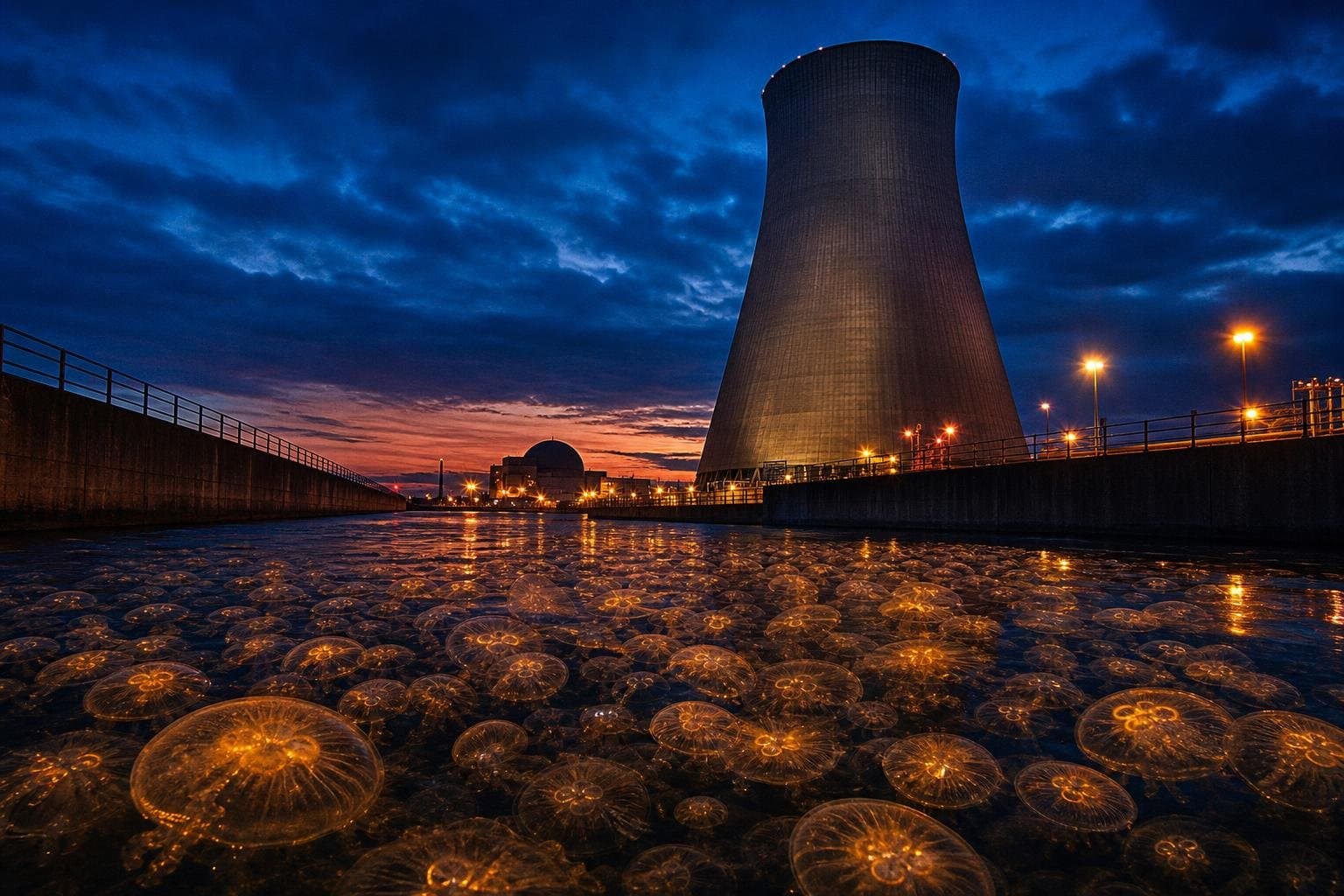

France's Gravelines plant lost three reactors to a jellyfish swarm this week. Romania is literally detonating rocks in the Danube to keep its last working reactor cooled. Two separate continents, two separate failure modes — both pointing at the same uncomfortable truth: nuclear plants are physical infrastructure embedded in physical ecosystems, and those ecosystems are getting less predictable.
At Gravelines, reactors 2, 3, and 4 went offline Monday after a massive jellyfish swarm blocked the North Sea cooling canal. Reactor 1 was throttled to 50% output as a precaution. That's a plant rated at 5.4 gigawatts total — and a significant chunk of it taken down by marine biology. EDF has since installed cameras, partnered with fishing organizations, and deployed trawling operations to monitor future swarms. Good. But the fact that this is now a recurring operational concern says something about the world nuclear is being asked to operate in.
Romania's situation is grimmer. Record-low Danube water levels have already forced one Cernavoda reactor offline, and the government was detonating rock obstructions and sinking barges to redirect river flow to the remaining unit — buying perhaps nine to ten days of additional operation. Those two reactors account for roughly a fifth of Romania's electricity production. Hydropower is also suffering from the same drought. The grid has nowhere to turn.
None of this is an argument against nuclear — it's an argument for building more of it, faster, with better cooling diversity. Closed-loop cooling systems, dry cooling, offshore siting: the engineering answers exist. What the Gravelines and Cernavoda situations prove is that water-dependent baseload — nuclear or otherwise — needs resilience engineering baked in from day one, not improvised with Navy explosives during a drought emergency.
The future belongs to civilizations that treat energy infrastructure as a serious engineering problem, not a political one. Right now, Europe is getting a crash course in what happens when you don