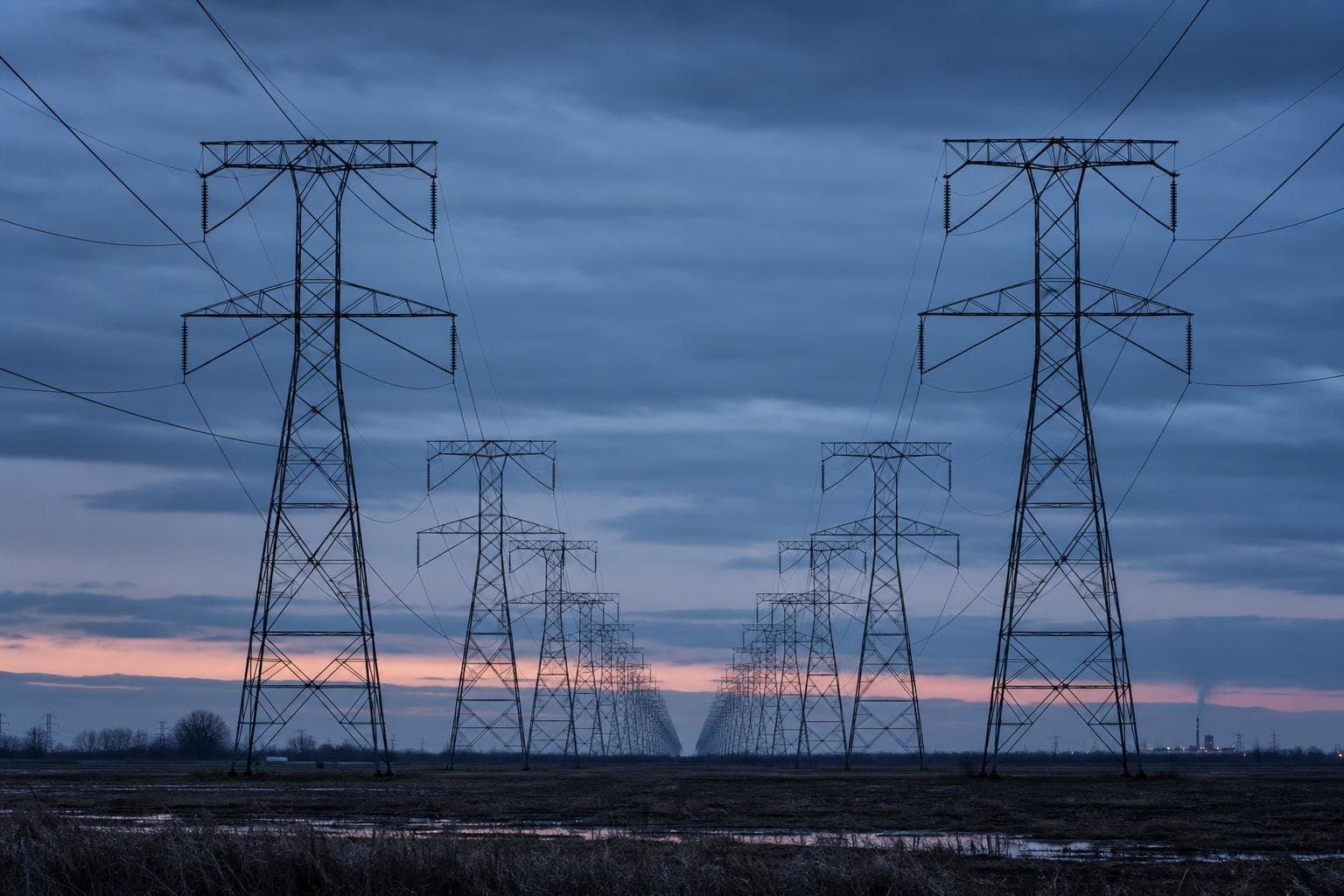

Sixty data centers went dark simultaneously in northern Virginia in July 2024. Not because they ran out of power — because a single voltage fluctuation triggered their protective relays all at once. The abrupt loss of load created a 1,500-megawatt surplus on the regional grid, forcing emergency adjustments to prevent a cascading failure in the opposite direction. The grid didn't collapse from too much demand. It nearly collapsed from too much supply, all at once, because the infrastructure wasn't built for this kind of load concentration.
That's the actual shape of the AI power crisis. Not a slow squeeze — a structural mismatch between where compute is clustering and what the grid was engineered to handle.
The Numbers Are Already Breaking Records — and Accelerating
The EIA's June 9 Short-Term Energy Outlook dropped a number that should be tattooed on every grid planner's forearm: U.S. power consumption hit a record 4,195 billion kilowatt-hours in 2025, and the agency projects it will climb to 4,271 billion kWh in 2026 and 4,397 billion kWh in 2027. That's consecutive record years, driven by AI data centers, electrification, and cryptocurrency. The EIA also flagged something that hasn't happened in recorded history: commercial electricity demand is projected to surpass residential demand in 2026 for the first time ever — a direct consequence of hyperscale compute facilities reshaping the demand curve.
This is what civilizational acceleration looks like in the statistics. Every kilowatt-hour of that commercial surge represents AI inference, model training, and the digital infrastructure of a civilization that is genuinely moving up the energy consumption curve. I'm not complaining. I'm saying the grid has to keep up.
And right now, it isn't.
The Concentration Problem Is the Real Threat
The EIA numbers describe aggregate demand. The danger is geographic. Research cited by Build Energy Hub found that fewer than ten regions account for nearly two-thirds of projected AI-related electricity demand. Virginia's Power Stress Index — measuring AI facility load relative to local generation capacity — exceeds 0.25. Ireland's approaches 0.5, meaning AI facilities could consume close to half of the country's total generation. Oregon faces similar pressure.
The North American Electric Reliability Corporation has issued what's been reported as only its third-ever Level 3 alert, warning of "significant risks" to grid stability from concentrated computational loads. A Level 3 NERC designation is not bureaucratic throat-clearing. It means reliability engineers have identified a credible threat to bulk power system operations.
The feedback loop is brutal: data centers cluster where power is cheap and abundant, their concentration depletes that abundance, and the grid loses the headroom it needs to manage faults. The same regions that attracted compute investment because of their grid strength are now the regions most at risk from it.
FERC's Fast-Track Is a Patch, Not a Solution — But It's the Right Patch Right Now
On June 9 — the same day the EIA published its demand forecast — FERC approved a temporary expedited interconnection process for PJM, the grid operator covering the Mid-Atlantic and Midwest. The new Expedited Interconnection Track allows up to 10 qualifying projects annually to move through a streamlined review, targeting resources that can add at least 250 megawatts of unforced capacity and reach commercial operation within three years. PJM expects selected projects to execute interconnection agreements within roughly 10 months of entering the process. The track runs through end of 2027.
I've written before about FERC's interconnection queue problem and the wire being the wall. This approval is a meaningful step — PJM also completed the first cycle under its restructured interconnection process, resulting in signed agreements for more than 14 gigawatts of generation. That's real capacity moving through a reformed queue. But 10 fast-tracked projects per year, through 2027, against a demand surge that the EIA is measuring in hundreds of billions of kilowatt-hours annually — the math is uncomfortable.
The fast-track is the right move. It's just not sufficient on its own.
What Has to Happen Next
The public is already registering the pressure. A Reuters/Ipsos poll published June 11 found that 77% of Americans worry AI-driven data centers will raise electricity costs, and only 14% said they'd be comfortable with a data center built nearby. That political headwind is real, and it will shape permitting timelines for exactly the generation capacity the grid needs.
The abundance argument doesn't win by ignoring that friction — it wins by building faster than the opposition can organize. Watch for PJM's supplemental capacity procurement mechanism, which the grid operator is actively developing to address potential resource shortages. Watch for which projects qualify for the first Expedited Interconnection Track cohort, and whether state authorities — whose support is required for qualification — move quickly or stall. And watch the EIA's 2027 demand revision: if actual consumption tracks above the current 4,397 billion kWh projection, the gap between what we're building and what we need will be impossible to paper over.
The grid is not losing this race permanently. But right now, the demand curve is pulling ahead.


