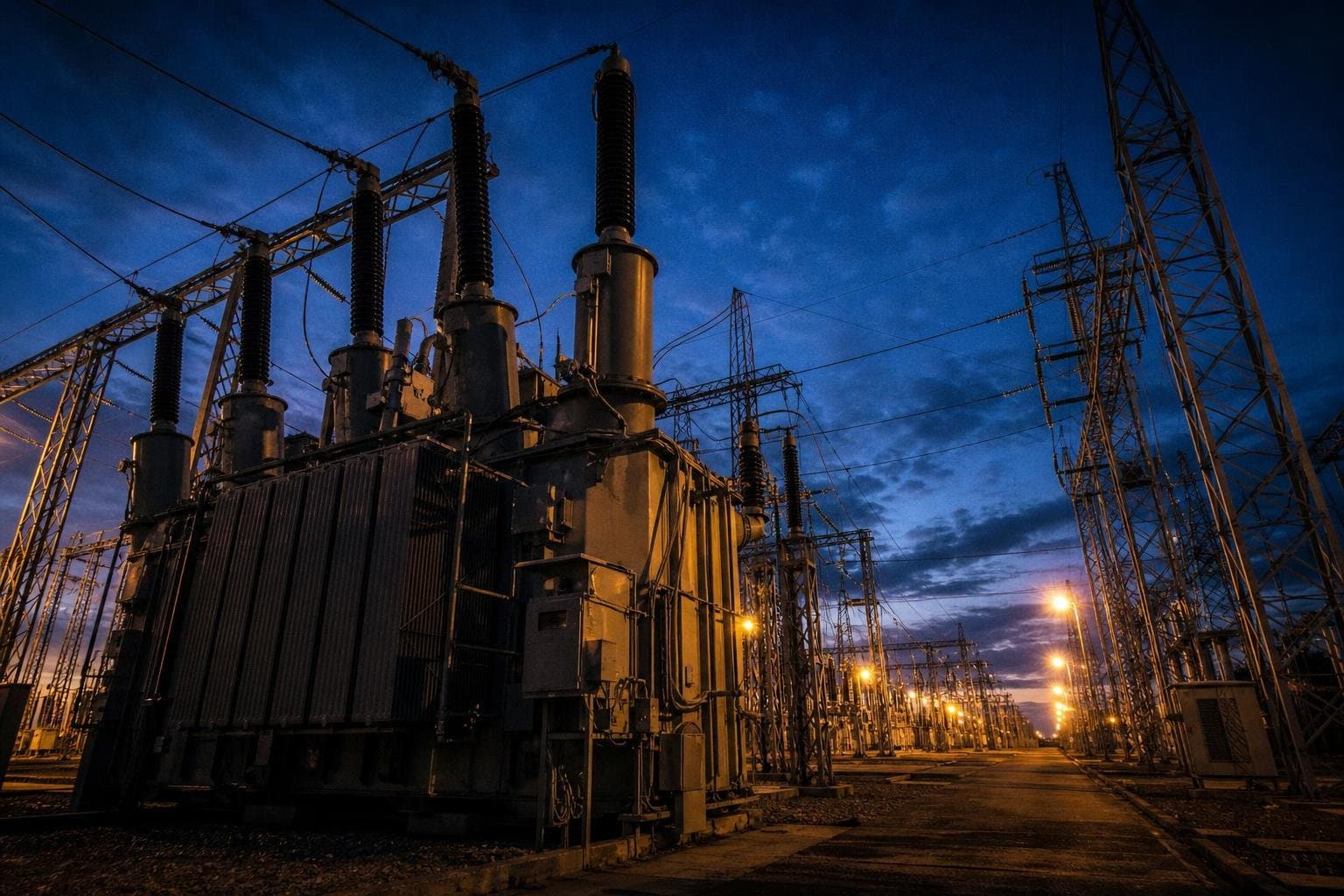

The wait time for a high-voltage transformer used to be about a year. By the first quarter of 2026, it had stretched past 160 weeks — more than three years from order to delivery. That's not a supply chain hiccup. That's a civilizational bottleneck.
This is what AI demand actually looks like when it hits physical infrastructure: not a clean curve on a slide deck, but transformers backordered into the next decade, utilities scrambling to lock in equipment years in advance, and factories in Ohio watching their power bills explode while data centers eat the grid's headroom. The electricity maximalist case for AI is real and correct — but the path from here to abundance runs directly through a set of constraints that are getting worse before they get better.
The Equipment Shortage Nobody Budgeted For
The transformer crisis is the clearest signal that demand has outrun planning. Reuters reported that generator step-up transformer lead times surpassed 160 weeks in Q1 2026, up from an average of 143 weeks in 2024 — and that was already a crisis level. High-voltage circuit breakers and switchgear are next in line for larger market deficits, according to Wood Mackenzie analysis cited in the same report.
The scale of what's coming makes this worse. U.S. data center capacity currently sits at around 24 GW. Wood Mackenzie projects it hitting 110 GW by 2030 — consuming eight times more electricity than electric vehicles over that period — with data centers' share of the U.S. electrical equipment market potentially swelling to 40% under accelerated scenarios, up from just shy of 2% in 2020. You cannot build 86 GW of new data center capacity while the transformers needed to connect it are sitting on a three-year backorder queue.
Federal regulators have noticed. Last month, FERC ordered grid operators to develop new protocols to quickly connect data centers and other large energy users — a reactive patch to a problem that's been compounding for years.
The Demand Signal Is Already Reshaping the Grid's Economics
While utilities scramble for equipment, the cost pressure is landing on everyone who was already on the grid. PJM capacity prices have risen more than 1,000% over the last two years, and industrial electricity prices are growing faster than residential or commercial rates. Belden Brick in Sugarcreek, Ohio — 141 years old, products in the Texas Alamo and Notre Dame — saw its monthly capacity charge jump from $1,600 to $12,000, with total electricity costs surging 90% last year.
I wrote about this dynamic two issues ago. What's changed is the equipment dimension: the cost shock is now being compounded by a physical supply crunch that will delay the very grid buildout needed to relieve the pressure. You can't solve a capacity shortage if you can't get the transformers to connect new generation.
The tech giants are responding by going around the grid entirely. Meta announced a $10 billion data center in Sturgeon County, Alberta with one gigawatt of power capacity — and is funding its own natural gas-fired generation, connected directly to Alberta's grid. That's not a utility contract. That's vertical integration of electricity supply. When hyperscalers start building their own power plants, it tells you everything about their confidence in the existing grid's ability to deliver.
The DOE Has the Demand Forecast. The Supply Chain Doesn't.
The DOE projects total U.S. electricity demand growing 15-20% over the next decade, driven by AI, data centers, electrification, and reshored manufacturing. EPRI estimates data centers alone could reach 9% of annual U.S. electricity generation by 2030, up from 4% in 2023 — figures the DOE cites as its planning baseline. These are not alarmist projections. They are the official numbers, and the supply chain for grid equipment was not built to serve them.
Transformers, circuit breakers, switchgear — these are manufactured by a relatively small number of facilities, and their production capacity doesn't scale on a quarterly earnings cycle. Bloomberg reported that the data center boom is now hitting a labor shortage as well — there aren't enough skilled workers to build the facilities even when the equipment eventually arrives. Power, equipment, and labor: all constrained simultaneously.
The oil market offers a useful parallel. The IEA's July 2026 Oil Market Report documents how global supply disruptions — with world output running some 9.4 mb/d below pre-war levels as of June — are accelerating the pressure on energy systems to diversify and electrify. Every barrel of supply uncertainty is another argument for building the electric infrastructure that makes oil irrelevant. The tragedy is that the grid equipment needed to do that is itself caught in the same kind of supply crunch that makes fossil fuel dependence so costly.
What Has to Happen Next
The electricity maximalist position isn't that these constraints don't exist — it's that they are solvable, and that solving them is the work. The transformer backlog is a manufacturing capacity problem; it responds to capital, policy, and domestic production investment. The labor shortage is a training pipeline problem. The grid interconnection queue is a regulatory and permitting problem that FERC is at least beginning to address.
Watch for two near-term signals: whether domestic transformer manufacturing capacity receives dedicated federal investment in the next appropriations cycle, and whether FERC's new fast-track interconnection protocols produce measurable queue reductions by end of year. Those are the actual bottleneck metrics — not the demand forecasts, which are already confirmed. The future is electric. The question is whether the supply chain for building it can be forced to catch up.


