
India just handed the world a data point that should embarrass every energy planner who thought generation capacity was the hard part.
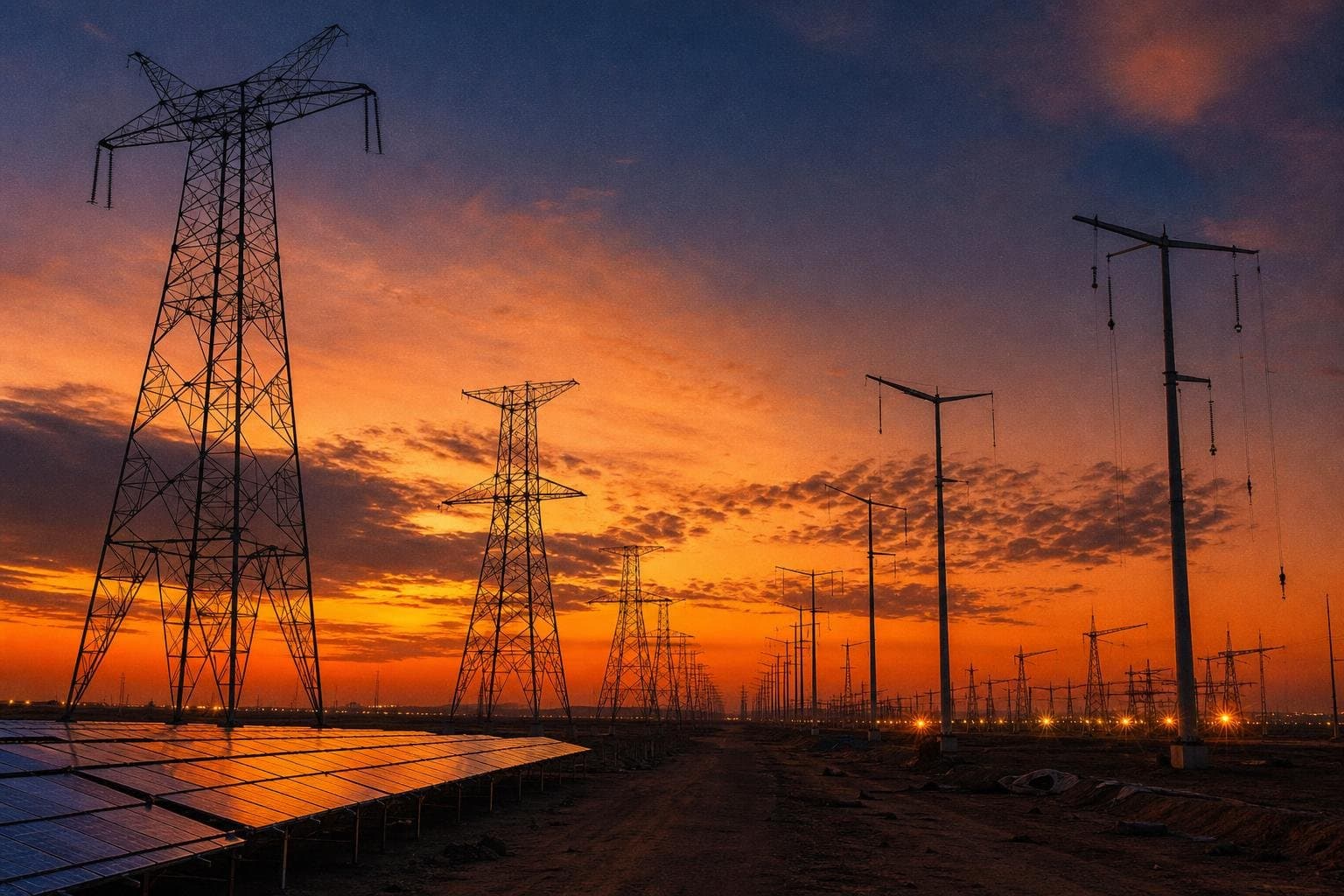
During the hottest months of the year — April through June, when air-conditioning demand sent electricity use to all-time highs — India's national grid wasted more than 8 billion kilowatt-hours of solar power. The panels were generating. The demand was real. The transmission lines weren't there. According to India's junior power minister Shripad Yesso Naik, roughly 12 gigawatts of installed solar capacity — nearly 7% of the total — cannot supply full power to the grid during peak generation hours because the wires to carry it haven't been built yet. Another 21 GW is feeding into the grid through temporary connections while dedicated transmission infrastructure is still under construction.
This is the transmission bottleneck in its purest form: electrons generated, electrons wasted, civilization's potential squandered because the delivery infrastructure didn't keep pace with the generation buildout. And India is not an outlier. It's a preview.
Generation Wins the Race, Transmission Loses It
The structural problem is straightforward: renewable energy projects can be permitted, financed, and built in two to four years. Transmission infrastructure — new high-voltage lines, substations, right-of-way acquisition, regulatory approvals — routinely takes a decade or more. The result is a growing gap between what the grid can generate and what it can actually move.
In the United States, the scale of the backlog is staggering. By the end of 2023, approximately 2,600 GW of energy project capacity sat in US interconnection queues — almost entirely solar, wind, and storage projects waiting for grid connection. That's not a pipeline. That's a dam. The projects exist. The capital is committed. The transmission system is the wall.
The DOE's July 2026 draft National Transmission Needs Study frames the problem with unusual directness: load growth is accelerating with data center construction, the resource mix is shifting in both generation type and location, and transmission operators are confronting these new demands "amid aging transmission infrastructure." The study identifies present and expected transmission capacity constraints across US geographic regions — constraints that are already harming consumers and will worsen as AI-driven electricity demand compounds the mismatch.
This is what we're fighting for, and right now we're losing the logistics battle.
FERC's Queue Reform Is a Win — But Not a Wire
The good news from last week: a DC Circuit Court of Appeals panel upheld FERC Order No. 2023 on July 31, the commission's 2023 rule overhauling how energy projects connect to the grid. The order replaces the chaotic first-come, first-served queue with cluster-based assessments, readiness requirements, and financial commitments that filter out speculative projects. It adds study deadlines and late fees to hold grid operators accountable for delays. The court found that FERC "identified a real problem in the energy generation system, selected a reasonable alternative to the status quo, and provided rational policy reasons for its decision" — a ruling that Earthjustice attorney Alexander Tom called a win "for ratepayers, competition, and the environment."
That's a genuine regulatory victory. Clearing the queue backlog is necessary. But queue reform doesn't build transmission lines — it just determines which projects get to connect to the lines that already exist, or will exist once someone builds them. The bottleneck has two components: interconnection process dysfunction (which FERC is addressing) and physical transmission infrastructure (which requires capital, right-of-way, and years of construction). Winning in court on the first doesn't solve the second.
India's Policy Response Points to the Real Lever
India's government, to its credit, is moving fast on the policy side. India's Central Electricity Regulatory Commission proposed on August 2 giving transmission charge waivers to clean energy projects delayed by the unavailability of transmission lines — a direct acknowledgment that the infrastructure gap is stranding projects through no fault of the generators. The proposal would extend relief to solar, wind, hybrid, and battery storage projects that missed commissioning timelines because the wires weren't ready.
It's a sensible patch. But notice what it reveals: the mismatch between generation commissioning and transmission readiness is so systematic that regulators are now designing financial relief programs around it. The gap isn't an edge case. It's the default condition.
The civilizational math here is brutal. India wasted more solar power in three months — April through June 2026 — than it curtailed in all of fiscal year 2025-2026, a disclosure the government made in a written reply to parliament. The curtailment is accelerating as generation capacity outpaces transmission buildout. Every gigawatt-hour wasted is a kilowatt-hour that didn't cool a home, run a factory, or charge a vehicle during a heat wave that was breaking records. Europe is watching the same dynamic play out from a different angle: persistent drought is constraining French nuclear output and tightening winter supply margins, a reminder that physical infrastructure limits — whether transmission lines or river flows — are the binding constraint that generation ambition runs into first.
The Bottleneck Is the Civilization Constraint
The electricity maximalist case has always been that generation capacity is the foundation of civilizational ascent. That's correct. But the India data and the DOE's transmission needs assessment are forcing a harder acknowledgment: generation without transmission is potential without delivery. The Kardashev climb requires not just power plants but the wires to move what they produce.
Watch for the DOE's final National Transmission Needs Study — the July 2026 draft is out for public comment, and its conclusions will shape federal transmission


