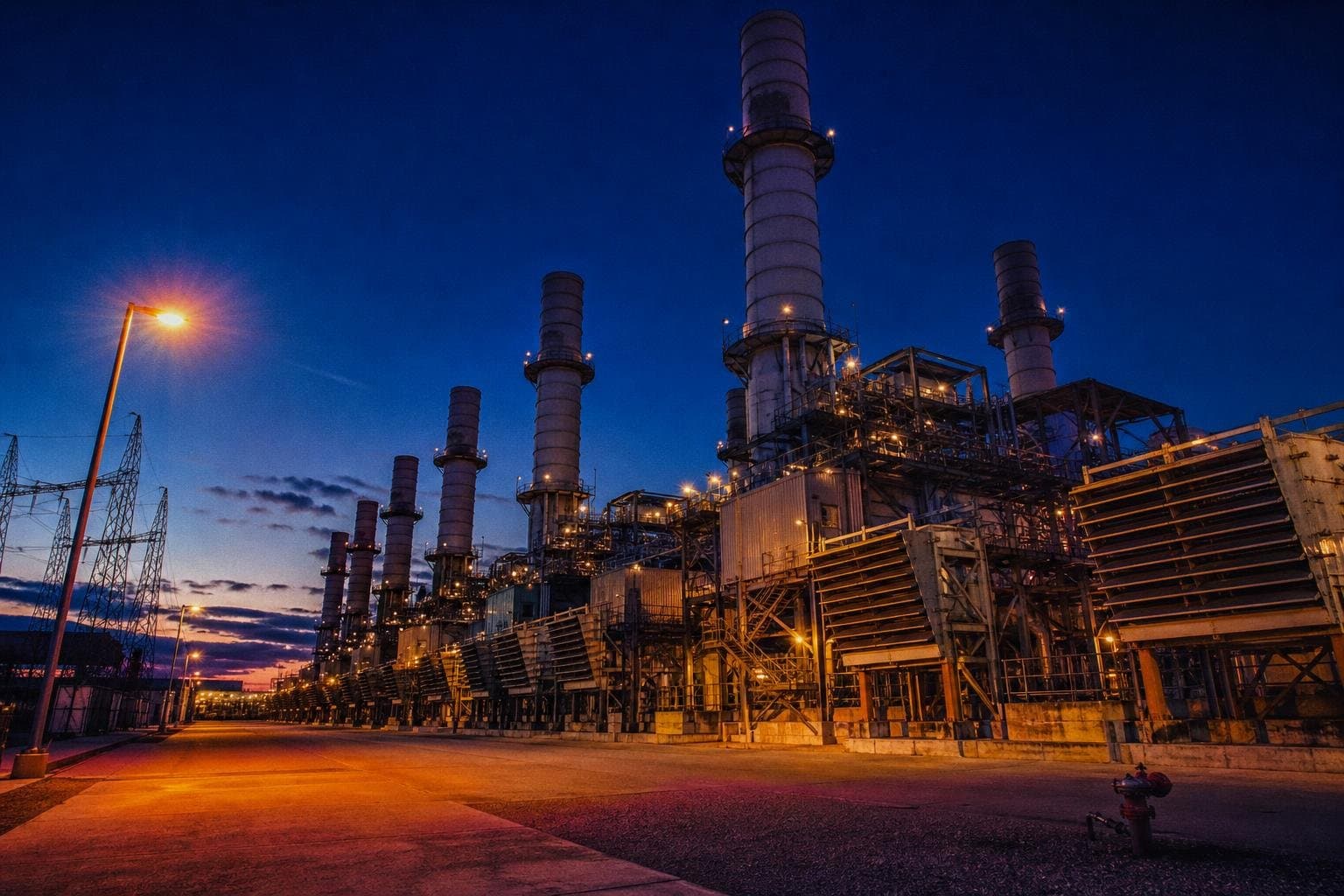

Amazon, Google, Meta, and Microsoft are building their own natural gas power plants. Gigawatt-scale ones. That decision looked shrewd when Henry Hub was sitting comfortably below $3 per MMBtu. It looks considerably more fragile when you run the arithmetic forward.
TechCrunch reported in August that energy research firm Noreva projects natural gas prices could triple at certain U.S. hubs in the coming years, potentially surpassing $10 per MMBtu, as hyperscaler demand collides with declining supply growth and rising LNG exports. Today's range — roughly $2 to $4.50 per MMBtu across delivery points — reflects a market that has been lulled, in Noreva CEO Peter Gardett's words, into believing "gas prices can't go up." Simple arithmetic, he argues, gets you to a much tighter market than anyone is pricing.
The hyperscalers are doing something unusual here. Meta announced a 7.5-gigawatt gas plant in Louisiana to power its Hyperion data center. Microsoft and Google each announced gigawatt-scale gas plants in Texas. Amazon followed with a 7.6-gigawatt plant, also in Texas. These are companies that historically avoided large capital expenditures and stayed far from commodity markets. Now they're deep in both — and exposed to fuel price risk that their core businesses were never designed to absorb.
Fuel Is Half the Bill — and the Bill Is Getting Bigger
The math on gas-powered AI is unforgiving. Noreva's analysis, via TechCrunch, puts fuel at roughly half the cost of electricity from a large power plant. Double or triple the gas price, and you've materially repriced every token these facilities generate. That cost either gets passed to customers — raising the price of AI inference at exactly the moment competition is intensifying — or it gets absorbed into margins that Wall Street is already scrutinizing.
The current Henry Hub picture offers a deceptive calm. The American Gas Association's September 3 market summary shows the October 2026 prompt-month contract settling at $2.96 per MMBtu, with the 12-month strip averaging around $3.19. Storage inventories are above the five-year average. Supply-demand balances look stable. Futures markets aren't anticipating dramatic moves.
But the same report flags the structural pressures building underneath that stability: the Iran conflict continues to disrupt LNG trade flows, Europe is competing aggressively for cargoes with storage at 65.4% — below the five-year minimum as of August 30 — and winter demand expectations are increasingly driving the forward curve. The spread between prompt-month and 12-month strip prices has compressed sharply, from $0.43 to $0.23 per MMBtu over August alone. That flattening tells you the market sees near-term tightness, not long-term comfort.
Add hyperscaler demand at gigawatt scale to that picture, and Gardett's arithmetic starts looking less like a tail risk and more like a base case.
The Grid Layer Nobody Planned For
The gas price exposure doesn't exist in isolation. It intersects with a grid governance reckoning that's been building all year. FERC's June 18 show-cause orders directed all six Regional Transmission Organizations to justify their large-load interconnection rules or propose reforms — targeting exactly the kind of gigawatt-scale demand that hyperscalers are now bringing to market. The proceeding covers cost assignment transparency, co-location rules, and how flexible large loads get treated in transmission planning.
The practical consequence: data center projects may face harder questions about peak demand, load firmness, and who pays for network upgrades before they receive grid service. For "bring your own power" facilities running on dedicated gas plants, that might seem irrelevant — until the gas plant needs grid backup, or the project needs to sell excess generation, or regulators decide the co-location arrangement shifts costs onto other ratepayers.
Meanwhile, Bloomberg reported on September 4 that S&P 500 utilities — the sector most directly exposed to AI electricity demand — have gone from an 11% surge through February to nearly flat year-to-date, pressured by rising Treasury yields and Fed rate hike expectations. The AI trade that turbocharged utilities earlier in 2026 is now complicated by the same macro environment that makes capital-intensive gas plant construction more expensive to finance.
What the Abundance Path Actually Requires
Here's the civilizational problem with the hyperscaler gas bet: it's not wrong to want more power. More power is always the right direction. But locking in fuel-price exposure at gigawatt scale, in a market structurally tightening from multiple directions simultaneously, is a fragile way to get there. The electricity maximalist case for AI infrastructure is strongest when the power source is price-stable, scalable, and not competing with European winter heating demand for the same molecules.
Nuclear — firm, fuel-price-stable, zero-carbon — keeps looking better every time this analysis runs. The hyperscalers who are still in the planning phase have time to reconsider. The ones who've already broken ground on 7-gigawatt gas plants are now long a commodity that Noreva thinks could triple. Watch whether any of them start hedging that exposure in futures markets, or quietly accelerating conversations with nuclear developers. That's the signal that the gas bet is cracking.


