
This Week in Voltage
Fermi Inc. just handed nuclear skeptics their favorite talking point — and they're wrong to use it.
The company co-founded by former Texas Governor Rick Perry went public last October at a valuation north of $19 billion, despite reporting zero revenue and zero signed customers. It had leased a site near Amarillo with plans to generate 17 gigawatts — a number so large it strains credulity even for electricity maximalists. Its CEO has now been fired, sued the company back, and the stock has fallen 84% from its peak. The 5,000-acre Texas panhandle site, grandly renamed the President Donald J. Trump Advanced Energy and Intelligence Campus, remains mostly unfinished.
The cautionary note from analyst Timm Schneider cuts to the core: "Going from zero to a 17-gigawatt AI hyper campus in one leap before they had a single tenant or a dollar of project finance — that was a lot in hindsight."
He's right. But here's what the Fermi collapse actually proves: the underlying demand is real, the capital is real, and the projects that survive will be the ones that did the unglamorous work first. Fermi didn't fail because nuclear-plus-AI is a bad idea. It failed because it was a pitch deck wearing a hard hat.
The serious builders are doing it differently.
Deep Charge: SMRs Are Rewriting the Timeline Math
Traditional large-scale nuclear plants take 10 to 20 years from conception to electrons on the wire. That timeline is a civilizational embarrassment, but it's also a regulatory artifact, not an engineering inevitability. The NRC is now moving to fix it. The agency has proposed a new licensing framework — Part 57 — specifically designed for advanced reactors, projecting accelerated licensing and deployment timelines of potentially 6 to 12 months for construction permits. That's not a rounding error. That's the difference between a project that hits the 2030 demand window and one that misses it entirely.
SMRs are the primary beneficiaries. The DOE describes them as factory-fabricated, scalable, and deployable in configurations that traditional gigawatt-class plants cannot match — sited closer to load centers, built in modular increments, and financeable without the sovereign-scale capital commitments that have historically made nuclear construction a government-or-nothing proposition.
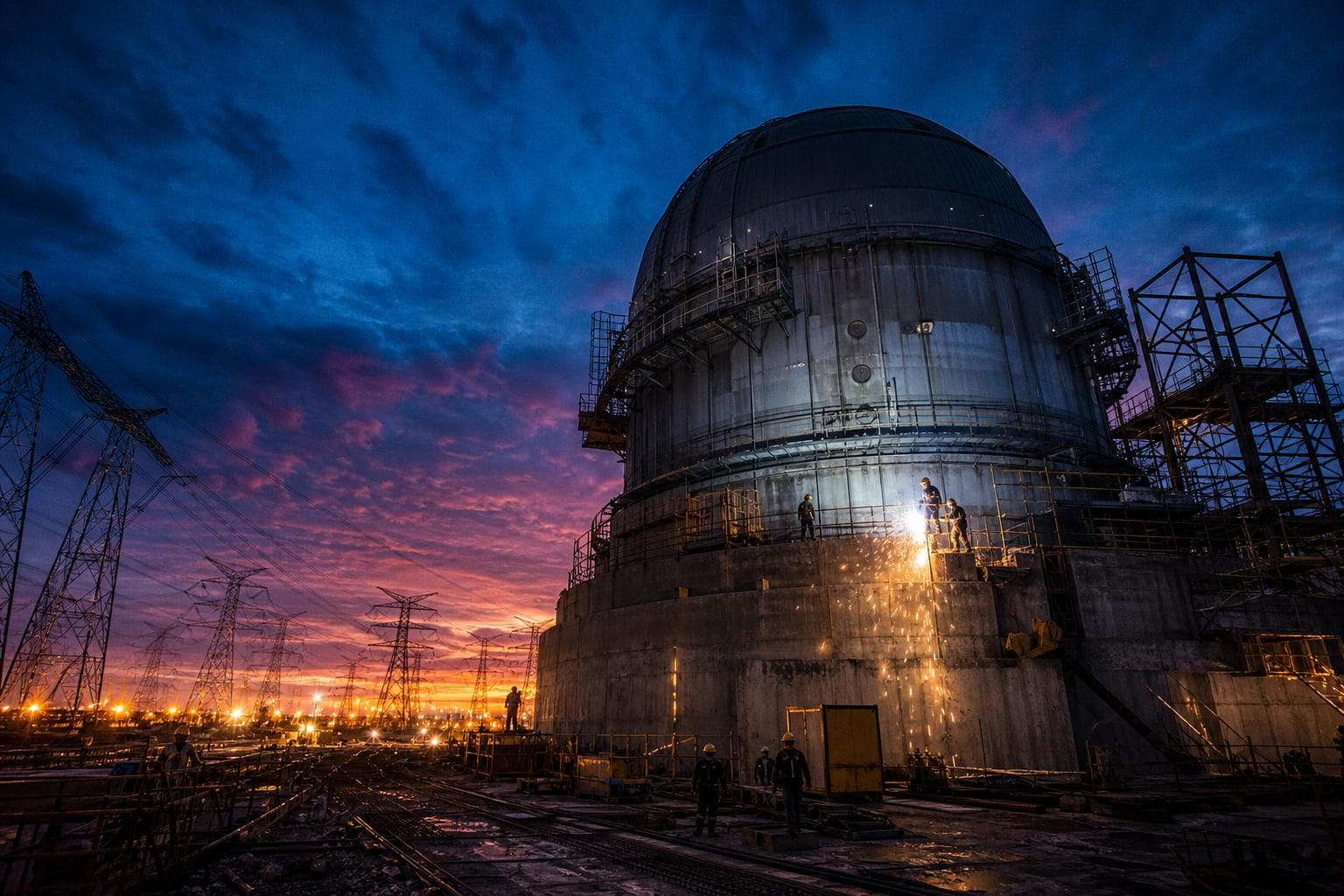
TerraPower's Natrium project in Kemmerer, Wyoming is the proof of concept in motion. The NRC granted final construction approval in March, capping five years of safety demonstrations. If the plant comes online by 2031 as planned, it will generate enough electricity to power roughly half a million homes. TerraPower has also signed agreements with Meta for additional reactors — the kind of anchor customer relationship that Fermi never managed to secure.
That contrast is instructive. TerraPower spent five years on regulatory groundwork before breaking ground. Fermi spent that time on investor roadshows. One of those strategies produces reactors. The other produces lawsuits.
The SMR permitting acceleration matters because it changes the risk calculus for every serious buyer. A 6-to-12-month reduction in licensing timelines means hyperscalers can model nuclear capacity into their 2030-2035 infrastructure plans with something approaching confidence. That's new. That's what unlocks the capital.
By the Numbers
- 130% — Projected increase in U.S. data center electricity demand by 2030, per the IEA
- 6–12 months — NRC's projected timeline reduction under the proposed Part 57 advanced reactor licensing framework
- 84% — Fermi Inc.'s stock decline from its peak, after firing its CEO and failing to sign a single customer
- $19B+ — Fermi's market cap at IPO, on zero revenue — the number that explains everything about AI energy hype
- 2031 — TerraPower's target operational date for the Kemmerer, Wyoming Natrium reactor
What We're Fighting For
The Fermi story will be used to argue that nuclear-plus-AI is a fantasy. Ignore that argument. What Fermi actually demonstrates is that the demand signal is so powerful it attracted $19 billion in capital to a company with no customers, no revenue, and apparently no functional management. That's not a failure of the thesis — that's a failure of execution inside a thesis that is absolutely correct.
The real story this week is that the NRC is accelerating its permitting framework, TerraPower is pouring concrete, and the IEA is projecting electricity demand growth that makes every serious energy builder's eyes light up. SMRs are not a future technology hedging against uncertainty. They are the mechanism by which nuclear capacity actually hits the grid in time to matter.
The future is electric. The path runs through Kemmerer, Wyoming — not Amarillo.


