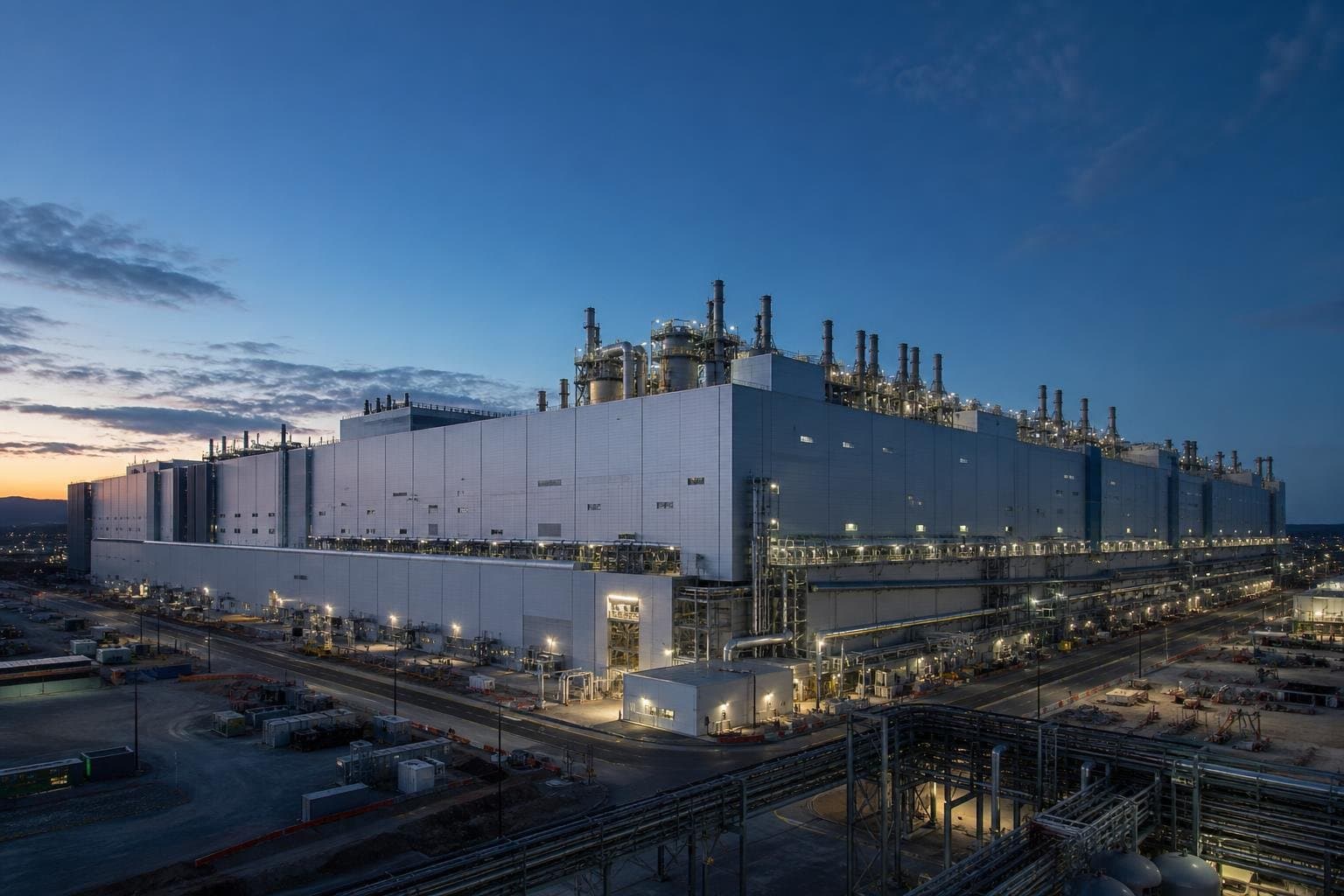

The bottleneck in AI isn't software. It isn't even chips anymore. It's the electrons required to make them.
TSMC's technology symposium in May laid out a semiconductor market roadmap that should terrify every grid planner in America, Taiwan, and Japan simultaneously: AI accelerator wafer demand jumping 11 times between 2022 and 2026, five new fabs coming online this year alone, and 2-nanometer capacity scaling at a 70% compound annual rate through 2028. That's not a demand curve. That's a vertical line drawn through every regional electricity infrastructure plan written before 2024.
We've spent two years talking about data center power demand. The harder problem — the one that's just starting to surface — is fab power demand. Data centers run chips. Fabs make them. And the energy physics of fabrication make a hyperscale data center look like a suburban office park.
Why Fabs Eat Grids Differently Than Data Centers
A data center's power draw is large but relatively predictable: servers humming, cooling systems running, the load profile shifting with query volume. A semiconductor fabrication plant operates under entirely different constraints. Cleanrooms must maintain precise temperature and humidity around the clock. Lithography tools — especially the extreme ultraviolet machines that etch 3nm and below — draw enormous continuous power loads. Process control systems cannot tolerate voltage fluctuations that would be invisible to a data center's UPS.
NVIDIA and TSMC's recently announced collaboration to deploy AI-accelerated computing across fab operations — targeting 20-50% improvements in lithography cost-effectiveness and 50x faster chemistry simulations — adds another layer: the fabs themselves are now running GPU clusters internally. The factory that makes AI chips now runs on AI chips. The power demand compounds.
This is the infrastructure reality that TSMC's power constraint framing is beginning to acknowledge publicly. Tracking commentary from large cloud providers, chip designers, and power utilities on data center electricity constraints, as Yahoo Finance noted, will indicate how urgent the power issue has become — and fab power sourcing plans, including long-term renewable contracts, are now a material strategic question, not a footnote.
The Geographic Concentration Problem Is Also an Energy Concentration Problem
TSMC manufactures 72% of global foundry output at leading-edge nodes. That concentration — one island, one company, most of the world's advanced AI silicon — is a geopolitical risk that defense hawks have been screaming about for years. But it's also an energy risk that gets far less attention.
Taiwan's grid is not built for the fab expansion TSMC's roadmap implies. Neither is Arizona's, where TSMC's U.S. fabs are under construction. Neither is Kumamoto's. These diversification fabs won't operate at commercial frontier-node scale before 2028-2030 at the earliest — which means the grid buildout required to support them is already behind schedule before a single wafer has been processed.
The Microsoft, Meta, Alphabet, and Amazon capex machine — projected at $725 billion this year, per the Wall Street Journal (via ts2.tech) — is downstream of TSMC's fab capacity. Every dollar of hyperscaler AI capex is a vote for more fab construction, which is a vote for more dedicated grid infrastructure. The chain runs: AI demand → chip orders → fab expansion → regional grid stress. We've been watching the first link. The last link is where the constraint actually lives.
Chip-Rich, Power-Poor Is a Real Scenario
Elon Musk warned in early 2026 that the U.S. may find itself chip-rich but power-poor later this year — producing more AI chips than it can actually run. That framing applies with equal force to the fabrication side. You can permit fabs. You can break ground. You can install EUV tools. But if the regional grid can't deliver the continuous, high-quality power a leading-edge fab requires, the wafers don't get made.
This is what makes fab power demand categorically different from data center demand in the grid planning conversation. Data centers have some flexibility — workloads can shift, demand response programs can shave peaks. A fab running a 3nm process cannot pause mid-etch because the grid operator called a curtailment event. The power must be there, clean and uninterrupted, or the yield collapses and billions in equipment sits idle.
The civilizational stakes here are not abstract. APAC data center capacity alone is expected to more than double to 26.1 GW by 2028, requiring an estimated $175 billion in investment. That figure doesn't fully capture the upstream fab power infrastructure required to produce the chips those data centers will run.
The grid buildout conversation needs to expand its aperture. Data centers are the visible demand signal. Fabs are the hidden one — and they're harder to serve, harder to site, and harder to power reliably. Watch TSMC's Arizona and Kumamoto power sourcing announcements over the next 18 months. Watch whether state and national grid operators in fab-hosting regions are updating their long-range transmission plans to account for fab-class loads. That's where the real constraint will surface — not in a quarterly earnings call, but in a utility integrated resource plan that nobody reads until the lights flicker.
The future is electric. The question is whether the grid gets there before the fabs do.


