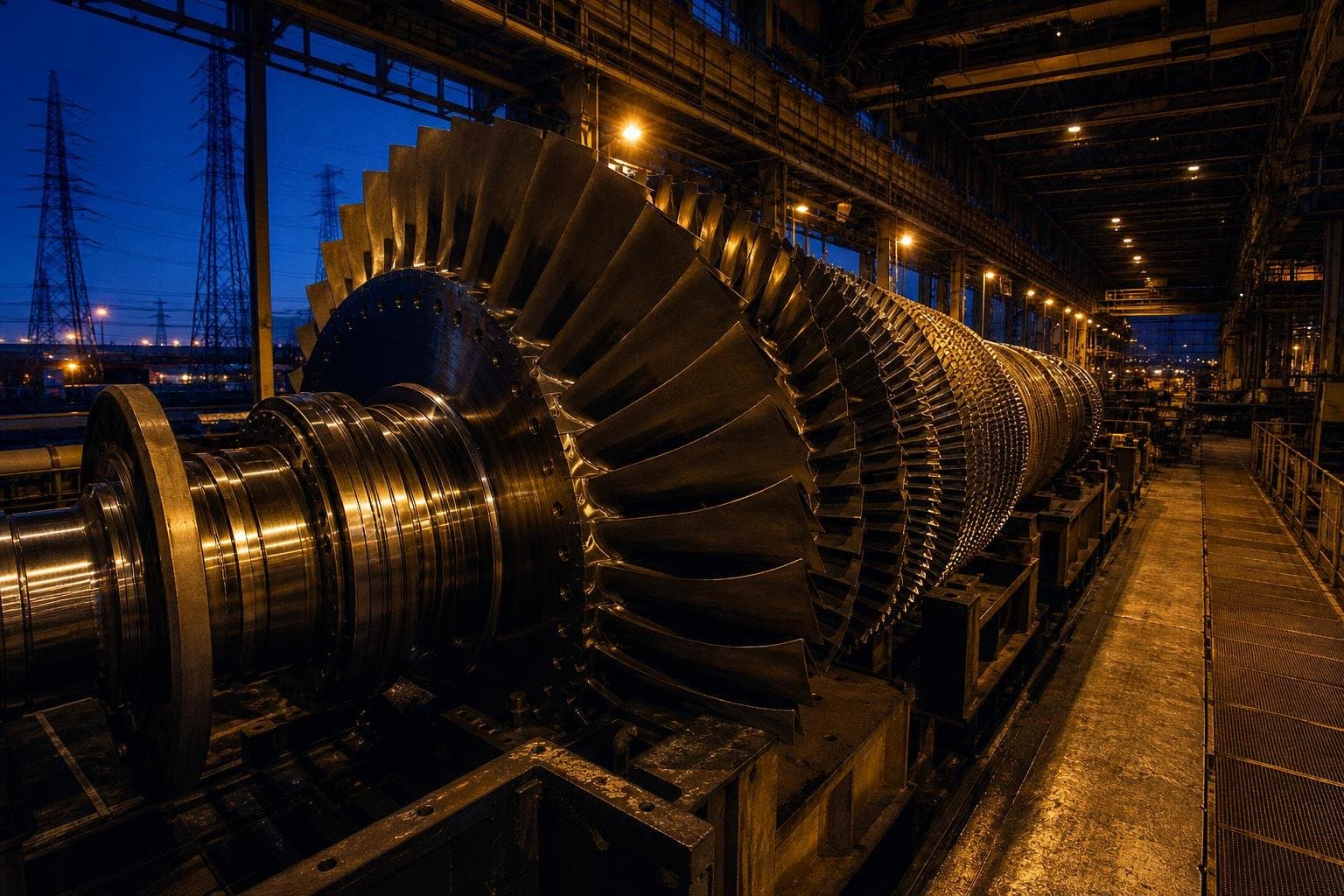

Mitsubishi Power's chief executive for Asia Pacific said the quiet part out loud this week in Singapore: order a large gas turbine today, and you're getting delivery "around 2031," according to Bloomberg. Five years. Not for a novel reactor design or an experimental fuel cycle — for a gas turbine, the most mature piece of power generation hardware on the planet. If you've been tracking this newsletter's running argument that the grid, not the chip, is the binding constraint on the AI buildout, this is the number that should stop you mid-scroll.
I've written before about the interconnection queue as the visible backlog — the 2,061 GW sitting in grid operator queues waiting on studies and agreements. That's the demand side of the problem. What Mitsubishi's CEO Akihiro Ondo is describing is the supply side: even projects that clear every permitting and interconnection hurdle still can't get the physical equipment to build the plant. This is the bottleneck beneath the bottleneck, and it's where civilizational ambition runs headfirst into a factory floor in Japan.
Three Years Just to Get a Transformer
The turbine delay is bad enough. The transformer situation is arguably worse, because transformers sit at every single node of the grid — generation, substation, distribution — not just at new gas plants. Wood Mackenzie data cited by Reuters put generator step-up transformer lead times above 160 weeks by Q1 2026, up from an average of 143 weeks in 2024, per reporting aggregated by explainx.ai. That's over three years from order to delivery, and it applies to the hardware needed to connect new generation, step voltage down for data centers, and replace aging substation equipment everywhere else. High-voltage circuit breakers aren't far behind — up to 125 weeks in the back half of 2025 from 77 weeks in 2023, per the same aggregation of Wood Mackenzie figures.
Put those two numbers next to each other — a turbine maker quoting 2031 and a transformer supplier quoting three-plus years — and you get a hardware supply chain that simply cannot clear at the rate capital wants to deploy it. Jacobs Solutions' newly released industry survey, covering 600 senior energy-sector decision-makers, found only 30% of U.S. respondents say their organizations consistently deliver major infrastructure programs on time and budget, with permitting cited as the top systemic barrier ahead of regulatory uncertainty and grid readiness, per Engineering News-Record's coverage of the Oct. 27 report. Equipment lead times compound every one of those delays rather than sitting apart from them.
Announced Capacity Is Not Built Capacity — And the Gap Is Widening
This is where I keep hammering the same distinction, because it matters more than ever right now: an announced gigawatt is not an operating gigawatt. The same ENR reporting cites Bernstein tracking 404 GW of North American data-center development against just 72.9 GW actually under construction as of August — a pipeline Bernstein estimated would take roughly 13 years to clear at the prevailing construction rate. Aterio's CEO separately told ENR that 30-40 GW of new U.S. data-center capacity gets announced monthly, but only about 7 GW enters construction and 2-3 GW enters operation. Every month, the gap between the press-release number and the steel-in-the-ground number gets wider, and equipment lead times are a direct cause, not a coincidence.
Texas is the clearest regional proof point. ERCOT is moving ahead with a $33 billion transmission expansion, including over 2,400 miles of new 765 kV lines, but that buildout won't come online until 2030 and beyond, and reserve margins are forecast to turn negative by 2028 in the meantime, Reuters reported in April. Approving the project and energizing it are two different years on two different calendars, and the equipment queue is what separates them.
What This Doesn't Mean
None of this is an argument for slowing down. It's an argument for treating transformer and turbine manufacturing capacity as a strategic bottleneck worth the same policy attention as uranium enrichment or transmission permitting — because right now it's getting less. The hyperscalers are already adapting around it: Google's roughly 1,070 MW virtual-power-plant commitment with Voltus across PJM's footprint, reported by DER Weekly, is demand flexibility bought specifically because new generation hardware can't arrive fast enough. That's a real workaround, not a substitute for new capacity — PJM activated demand response nine times through mid-October 2026, more than the entire 2015–2024 period combined, which tells you flexibility is being leaned on harder than it was ever designed for.
Watch Mitsubishi Power's next earnings commentary on order backlog and whether it's expanding manufacturing capacity to meet 2031 demand sooner — and watch whether Wood Mackenzie's next transformer lead-time update, due sometime in the next few months, shows the number still climbing or finally cresting. If it keeps climbing, every gigawatt of announced capacity you read about this year is really a claim on 2030.


