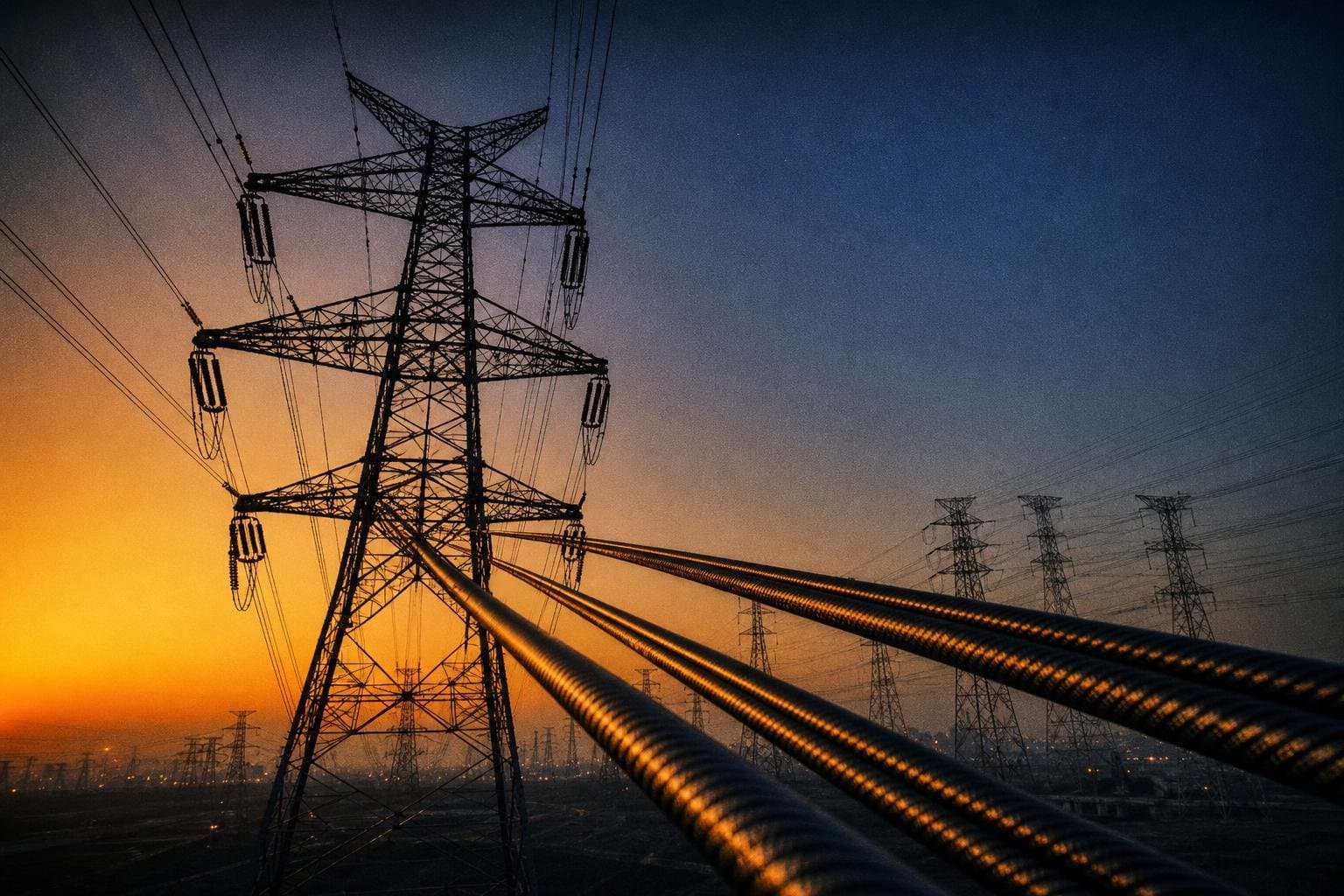

Here's the number that should stop every grid planner mid-sentence: the United States built roughly 1,500 miles of high-voltage transmission between 2022 and 2024 — total, across the entire country, over three years (Peter Kelly-Detwiler). The Department of Energy just selected projects that will reconductor or rebuild that same 1,500 miles — in a single funding round (DOE). That's not an incremental improvement. That's a civilization figuring out it's been building infrastructure at the wrong speed.
The DOE's SPARK initiative — Speed to Power through Accelerated Reconductoring and other Key Advanced Transmission Technology Upgrades — is putting $1.9 billion in federal funding behind 31 projects across 26 states, catalyzing $5.25 billion in total investment once recipient cost-share is added in (DOE; Government Market News). The headline figure DOE is touting: over 23 gigawatts of additional capacity, unlocked without the decade-plus permitting slog that kills most new-line proposals.
Announced, Not Operational — and That Distinction Is the Whole Story
Let's be precise about what just happened, because precision is what separates abundance thinking from hype. These are selected projects moving into award negotiations, not energized capacity. DOE made its selections on September 24 (Government Market News), and as of early October, award agreements were still being finalized (Tech Times). The 23 GW figure is a DOE projection for what these projects will unlock once built, not a measurement of electrons flowing today. One recipient, Eversource, is partnering with Dartmouth Engineering on a project called DREAM that will deploy dynamic line rating technology across roughly 4,000 miles of transmission in Connecticut, Massachusetts and New Hampshire — but that too is a selection for award negotiation, not a completed deployment (GlobeNewswire).
I've spent months in this newsletter tracking interconnection queues that stretch years and transmission projects that take over a decade to permit. What makes SPARK different isn't that it promises more power — every grid program promises more power. It's that the mechanism doesn't require new land, new towers, or new rights-of-way at all.
The Physics Behind the Promise
Grid-enhancing technologies work because the grid has been leaving capacity on the table for a century. Standard aluminum-conductor-steel-reinforced wire sags when it heats up, and utilities set conservative static ratings to avoid violating ground-clearance safety limits — ratings calibrated for the hottest, stillest day of the year, applied uniformly across every other day too (Peter Kelly-Detwiler). Swap in high-temperature low-sag conductors — carbon-fiber composite or invar cores that expand at a fraction of steel's rate — and a line can run at double the temperature with less sag, carrying 50 to 100 percent more current on the same towers (Tech Times).
Dynamic line ratings go further: instead of one static number, sensors and weather models tell operators the actual real-time capacity of a line, which on a cold, windy day — when wind is wicking heat away from the conductor — can be more than double the static rating (Peter Kelly-Detwiler). Add topology flow optimization (rerouting power around congestion by opening and closing breakers) and advanced power flow controls (actively steering current from overloaded lines to underused ones), and you get a grid that behaves less like a fixed pipe and more like a managed network (DOE).
The economic case is the part that should make permitting reformers furious that this wasn't the default a decade ago: reconductoring with advanced conductors runs 50 to 75 percent cheaper than building an equivalent new transmission line, according to research from UC Berkeley's Energy Institute and GridLab cited in reporting on the program — not because the wire is cheap, but because it skips land acquisition, tower construction, and the environmental review gauntlet entirely (Tech Times).
Why This Is a Down Payment, Not the Deal
None of this substitutes for new transmission corridors where none exist — GETs enhance what's already strung on existing towers, they don't conjure paths across mountain ranges or state lines that current infrastructure doesn't already traverse. DOE itself frames SPARK as reducing reliance on new corridors, not eliminating the need for them (Government Market News). And the market sizing around this technology category — global GET spending projected to reach $2.9 billion in 2026 and grow at a 13.5% CAGR through 2033 (Persistence Market Research) — is a forecast, not a track record.
What to watch: whether DOE's award negotiations convert into signed agreements before year-end, and whether Eversource's DREAM deployment across its three-state footprint produces the first operational dynamic-line-rating data this program generates. That's when "announced" becomes "measured" — and when we find out if America just found a shortcut to the grid headroom the AI boom is demanding, or just a very well-funded pilot program.


