


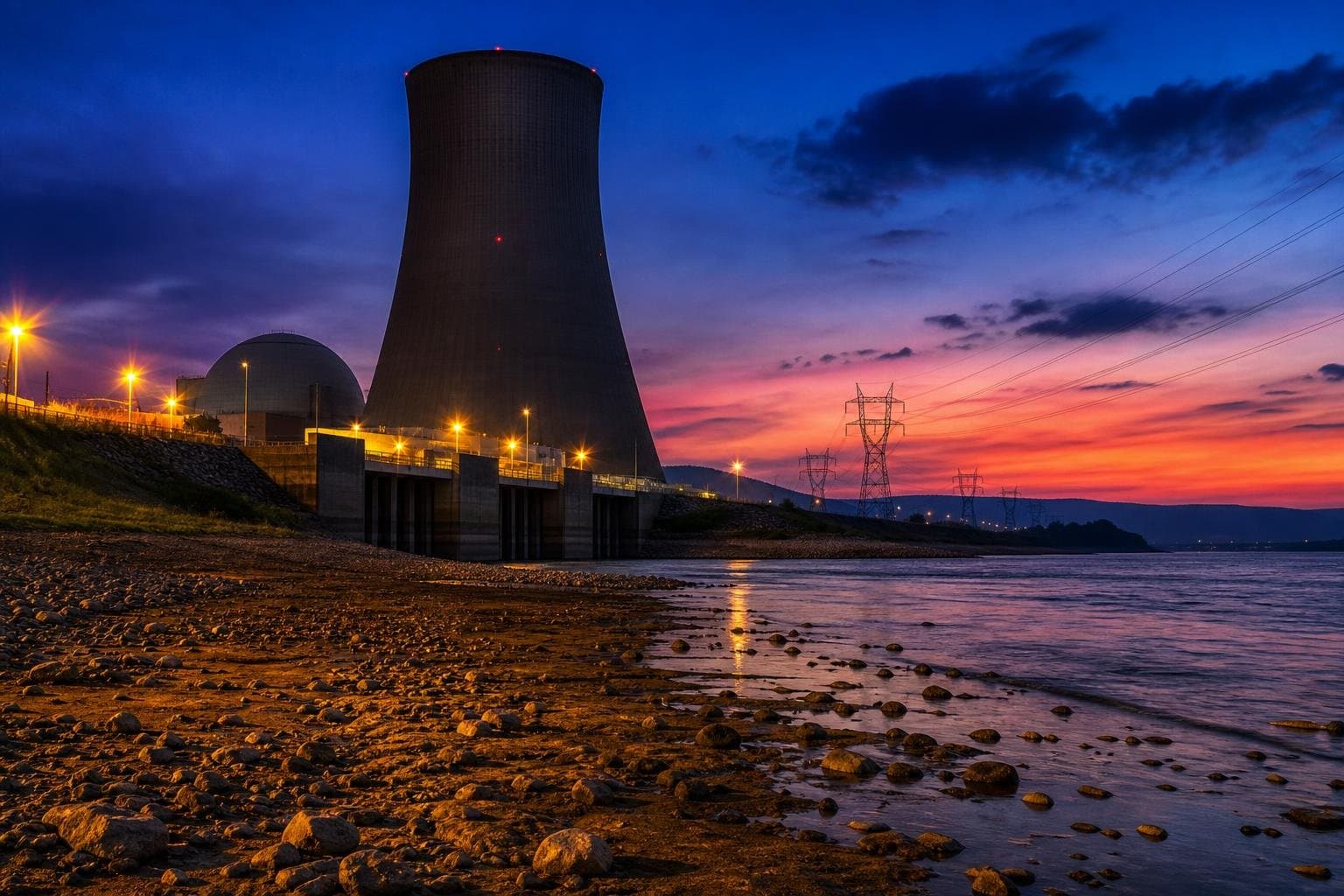

The Paks story isn't over. Hungary's Prime Minister announced the restart of the plant's Block 3 reactor after emergency measures — including an underwater barrier constructed in the river — helped Danube levels recover. That's genuinely good news. But one reactor coming back online doesn't close the civilizational argument this drought has opened. Downstream, Romania is still fighting the same battle: its Cernavoda plant remains shut, the country has declared a state of emergency throughout August, and its National Committee for Emergency Situations has approved emergency Danube dredging, groyne construction, and reservoir releases from the River Olt to try to push enough water toward the plant's cooling intake to restart operations at all.
Two countries. One river. A shared vulnerability that no amount of reactor engineering can fully engineer away.
The Demand Curve Doesn't Care About Droughts
I wrote about the Danube's threat to nuclear resilience back in late July and again in early August. What's changed isn't the physics — it's the timing. The IEA's Electricity 2026 forecast projects global electricity demand growing at an average annual rate of 3.6% through 2030, with advanced economies accelerating after fifteen years of stagnation. Data centers are a named driver. That demand curve is not going to pause while Central Europe waits for rain.
This is the tension that electricity maximalism has to reckon with honestly: the path to abundance runs through physical infrastructure that has physical dependencies. Water is nuclear's hidden fuel — I've argued that before — and the Danube crisis is proving it in real time, not in a modeling scenario. The answer isn't to abandon nuclear; it's to build the redundancy, the interconnection, and the cooling diversity that a serious civilizational energy strategy demands. Emergency dredging and rock barges are heroic improvisation. They are not a grid strategy.
Meanwhile, Europe's data center developers are already voting with their site selections — moving hyperscale facilities an average of 175 kilometers from major cities in search of cheaper power and faster grid connection. The demand is relocating toward available electrons. The question is whether the electrons will be there when the next drought hits.
Watch for Romania's timeline on Cernavoda restart — that's the real indicator of how deep this crisis runs. A fast return means the emergency measures worked. A prolonged outage means the Danube problem is structural, and every river-cooled reactor in Europe needs