


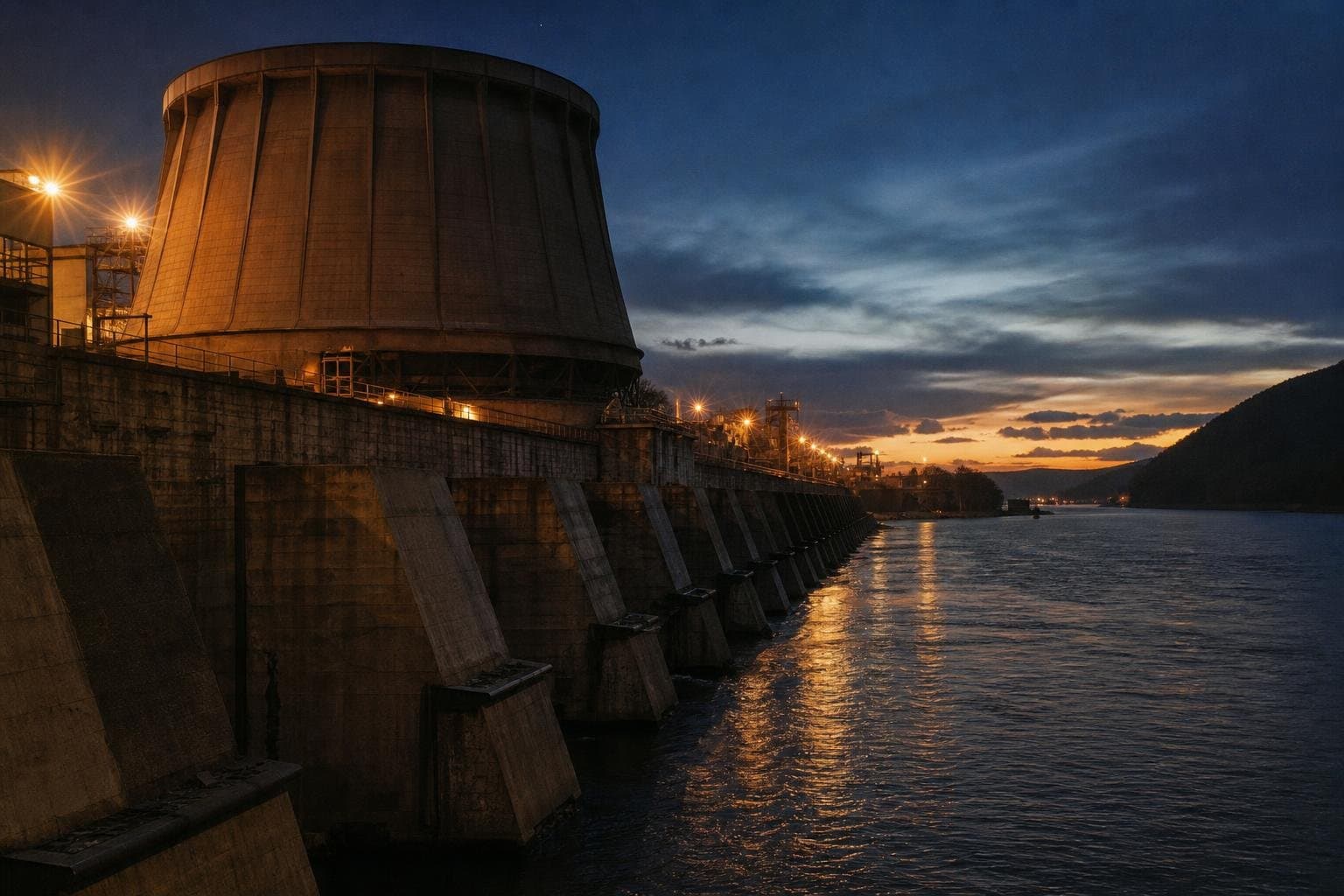

Romania's military just detonated rock formations in the Danube River to redirect water flow toward the Cernavoda nuclear plant. That's not a metaphor — that's a literal military operation to keep a reactor online during a drought emergency.
Meanwhile, Hungary's Paks plant — which supplies nearly half the country's electricity — shut down entirely for the first time in 44 years as the Danube hit record lows. The economic damage estimate: $316 million to $632 million, and that's before counting the knock-on effects on a Hungarian economy that was already underperforming.
I wrote about the Danube situation last week. What's sharpened since then is the design implication.
The nuclear renaissance conversation is almost entirely about permitting timelines, fuel supply, and capital costs. Those are real bottlenecks. But the Danube emergency is surfacing a constraint that gets almost no attention in the buildout debate: cooling water. Light-water reactors — the dominant global design — are thermally coupled to rivers, lakes, and coastlines. When those water sources fail, the reactor fails. Climate-driven drought doesn't care about your interconnection queue position.
This is exactly why the next generation of reactor designs matters beyond just cost curves. Closed-loop cooling systems, air-cooled designs, and molten salt reactors that operate at higher temperatures with different thermal management profiles aren't just engineering curiosities — they're climate resilience infrastructure. The Danube crisis is a preview of what happens when you build civilization-scale power infrastructure on assumptions about hydrology that are now being revised in real time.
China approved eight new nuclear generating units last week, with