


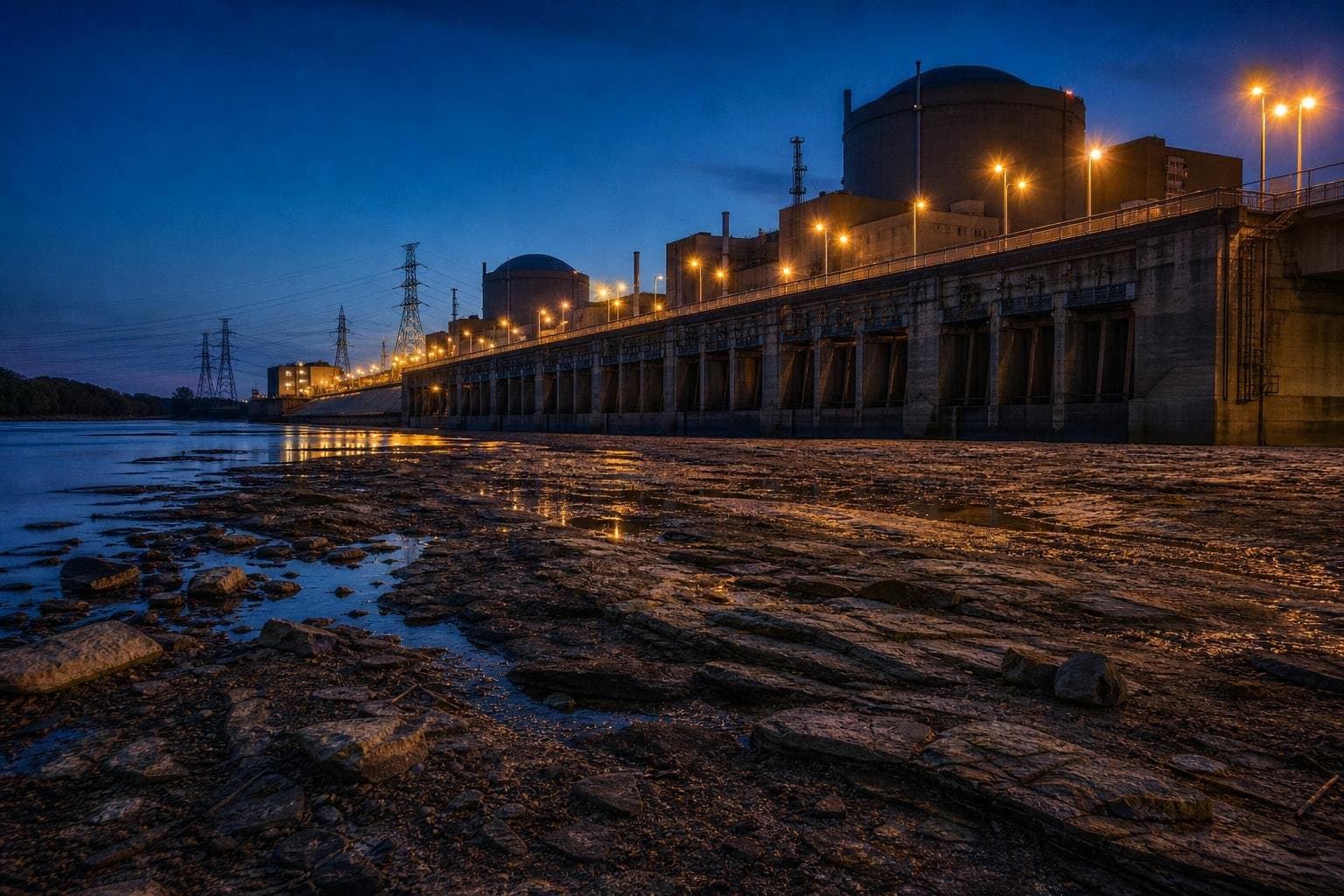

Hungary's Paks nuclear plant — four Russian-built reactors, 2 gigawatts of total capacity — was running below 50% this week and facing a full shutdown by Thursday or Friday. The culprit: the Danube hit record low water levels, starving the plant of cooling water.
This is the kind of story that gets filed under "weather disruption" and forgotten. It shouldn't be.
Paks generates roughly a third of Hungary's electricity. The country has import capacity of 3,600 to 3,800 megawatts that could theoretically cover a full shutdown — but that's a contingency, not a plan. The government is already compiling lists of large industrial consumers whose power could be curtailed in an emergency. That's rationing language, not abundance language.
The deeper issue is siting. Once-through river cooling is a 20th-century design assumption baked into plants that will run for decades into a 21st-century climate. The Danube isn't the only river running low. This is a recurring vulnerability across European nuclear and thermal generation — and it's one the next generation of reactor designs needs to solve structurally, not patch with emergency import agreements.
Meanwhile, the demand picture keeps moving in one direction. The IEA projects global electricity demand growing at 3.6% annually through 2030, with data centers, EVs, and industrial electrification all pulling harder on grids that were engineered for a different era. And on the supply side, NextEra and Brookfield just announced a $100 billion data center campus in Kentucky anchored by a new 2-gigawatt gas plant — because the grid can't deliver what hypersc