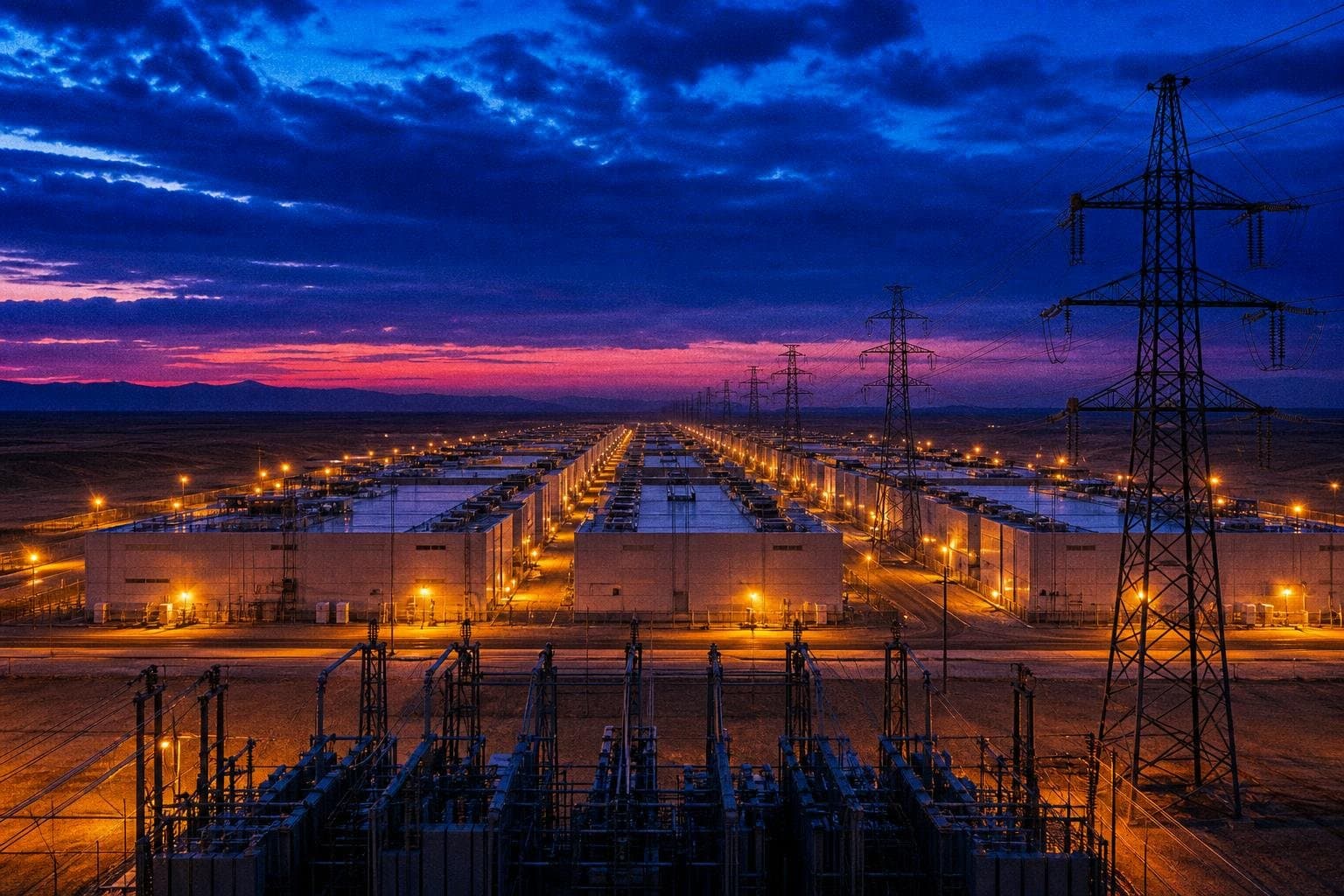

Somewhere in Northern Virginia, a hyperscale data center campus is drawing enough electricity to power a mid-sized city. Then another one goes up next door. Then three more. The grid operator didn't plan for one of them. It certainly didn't plan for all five.
This is the clustering problem — and it's the most underappreciated structural challenge in American energy right now. The conversation about AI and electricity demand tends to focus on aggregate numbers: how many gigawatts will data centers consume by 2030, how many nuclear plants do we need, how much transmission must we build. Those are real questions. But they obscure a more immediate and more disruptive reality: AI compute is not spreading evenly across the country. It's concentrating in specific regions, overwhelming local grid infrastructure, and forcing a fundamental rethink of how electricity markets are planned, priced, and governed.
The physics of clustering are unforgiving. You can't average your way out of a localized capacity crisis.
Why AI Compute Clusters — and Why That's a Grid Emergency
The economics of hyperscale AI infrastructure push hard toward geographic concentration. Fiber connectivity, existing power infrastructure, skilled labor pools, land availability, tax incentives, and proximity to cloud customers all create self-reinforcing agglomeration effects. Northern Virginia, Silicon Valley, Phoenix, Dallas, Atlanta — these aren't random choices. They're the product of decades of infrastructure investment that makes each successive data center cheaper and faster to bring online than it would be somewhere else.
The energy consequences of this logic are severe. AI-focused hyperscale data centers now operate at power densities of 60–100 kW per rack, compared to 2–5 kW per rack in older facilities. That's not a marginal upgrade — it's a complete reimagining of what a building connected to the grid actually demands. And when dozens of these facilities cluster in the same transmission zone, the local grid faces a demand signal it was never designed to handle.
The scale of the coming load is staggering. U.S. data center power demand is projected to reach 134 GW by 2030 — nearly tripling estimates from just a few years ago. That projection is a national aggregate. The regional reality is far more concentrated, and far more urgent.
Bloomberg NEF analyst Derrick Flakoll has noted that regions due to host over 60% of the nation's projected data-center power demand in 2035 are precisely the ones most affected by FERC's recent interconnection orders. That statistic deserves to sit with you for a moment: more than half of America's AI electricity demand, concentrated in a handful of regional grids. Whatever those grids can or cannot do in the next decade determines whether the AI buildout proceeds on schedule or stalls.
The Bottleneck Has Moved — and Most People Haven't Noticed
For years, the narrative was that interconnection queues were the primary obstacle. Projects waited years just to get studied, let alone approved. That was true, and grid operators have been working to fix it. PJM — the largest U.S. grid and the nation's de facto data center capital — overhauled its interconnection process, replacing its first-come, first-served structure with a cluster-based review system intended to reduce backlog and accelerate approvals.
But here's what the queue reform advocates missed: the queue was never the only bottleneck. It wasn't even the biggest one.
According to PJM data, AI infrastructure projects entering service in 2025 took an average of more than seven years to reach operational status. Projects spent an average of more than three years reaching an interconnection service agreement — and then another four years waiting to come online after approval. The post-approval phase, the part where you actually build transmission lines and substations and energize the connection, is now the dominant constraint.
"That confirms what we have been trying to emphasize — the issues outside of the queue are the biggest obstacle we face to bringing projects online," PJM senior manager of external communications Jeff Shields told Data Center Knowledge.
Transmission buildouts, substation capacity, and strained supply chains. That's the real wall. And it's a wall that gets higher with every new hyperscale campus that announces it's breaking ground in the same transmission zone. Each new project doesn't just add its own load — it compounds the infrastructure requirements for every project around it. The clustering effect that makes individual projects economically rational makes the aggregate infrastructure problem geometrically harder.
Meanwhile, the power equipment market serving these facilities is expected to exceed $200 billion annually as next-generation AI factories force companies like Schneider Electric and Siemens to rethink their entire product portfolios. The capital is mobilizing. The question is whether the physical infrastructure can absorb it fast enough.
FERC's June Orders: Necessary, Insufficient, and Geographically Incomplete
On June 18, FERC issued what the Commission itself called one of the most significant actions it has taken to modernize the nation's electric markets — tailored show cause orders to all six regional grid operators under its jurisdiction, directing them to justify or reform the rules governing how data centers and other large energy users connect to the grid.
The orders are genuinely ambitious. FERC Chairman Laura V. Swett framed the action in civilizational terms: "We are setting the stage for a resilient, reliable, and forward-thinking grid that empowers communities and safeguards consumers by transforming the way large energy users access the grid." The Commission's goals include requiring large loads to pay for the generation and transmission upgrades they need (protecting other ratepayers), mandating consideration of grid-enhancing technologies that may be faster and cheaper than conventional upgrades, and creating flexible transmission service arrangements that reduce peak demand and associated infrastructure costs.
The co-location provisions are particularly significant. By enabling smaller and more flexible transmission tariffs for loads co-located with their own generation, FERC is effectively acknowledging that the traditional model — utility builds infrastructure, data center plugs in — cannot scale fast enough for the AI moment. This is regulatory recognition of what the market has already figured out.
But the geographic gap in these orders is glaring. Texas, Georgia, and Arizona — three of the most active data center markets in the country — are not covered by FERC's rules, because they operate outside the six RTOs under FERC's jurisdiction. ERCOT, which manages Texas's grid, operates independently. Georgia Power and Arizona Public Service are vertically integrated utilities in states with different regulatory structures.
This means the FERC orders, however aggressive, address only part of the clustering problem. The regions they cover will get faster interconnection studies, better cost allocation, and more flexible tariff structures. The regions they don't cover will continue operating under whatever rules their state commissions and utilities choose to apply — which may or may not be adequate for the scale of demand coming their way.
The Private Grid Gambit: Rational Escape, Systemic Risk
Faced with multi-year interconnection timelines and uncertain grid capacity, the largest hyperscalers have reached an obvious conclusion: build your own power plant.
The "behind-the-meter" power movement has become a full-scale industrial shift. By constructing utility-scale generation directly adjacent to their compute facilities, tech companies bypass the public grid entirely — no interconnection queue, no transmission upgrade cost allocation, no waiting for a substation that won't be built for four years. Electricity goes straight from generators to server racks. Projects that would take seven years through the conventional process can potentially come online in months.
From an individual operator's perspective, this is completely rational. From a grid planning perspective, it's a slow-motion crisis.
When hyperscalers exit the public grid, they take their load — and their potential demand-response flexibility — with them. The grid loses a customer that could have helped balance supply and demand during peak periods. The infrastructure costs that would have been shared across the customer base either don't get built (leaving the grid weaker) or get built anyway and allocated to remaining customers (raising rates for everyone else). The clustering problem doesn't disappear when hyperscalers go behind the meter — it transforms into a stranded-cost problem for the utilities and ratepayers left behind.
There's also a resilience question that the private grid advocates tend to understate. Behind-the-meter generation is only as reliable as the fuel supply and maintenance regime of the operator running it. The public grid, for all its inadequacies, has redundancy and interconnection that a private campus plant does not. When a private generator fails at 3 a.m. during peak AI inference load, the question of where backup power comes from becomes very urgent very quickly.
What Regional Grid Planning Has to Become
The clustering problem demands a different kind of grid planning — one that starts from the geographic reality of AI compute concentration rather than historical load growth patterns.
PJM's reformed interconnection process, with roughly 220 GW of proposed projects in its next interconnection cycle, is a data point worth sitting with. That's not a queue — that's a civilizational demand signal. The question is whether the transmission and substation infrastructure can be planned and built at a pace that matches it.
FERC's requirement that grid operators consider grid-enhancing technologies — advanced conductors, dynamic line ratings, power flow controllers — is the right instinct. These technologies can increase the capacity of existing transmission infrastructure faster and cheaper than building new lines. In a world where new transmission takes a decade to permit and construct, GETs are the near-term unlock that buys time for the longer buildout.
The deeper structural answer is that regional electricity markets need to treat hyperscale data center clusters the way they treat large industrial loads: as anchor customers whose demand profile shapes long-term infrastructure investment, not as passive consumers who show up after the grid is built and expect to be served. That means earlier engagement, longer-term power purchase commitments, and willingness to pay for the transmission capacity that makes clustering possible without breaking the grid for everyone else.
The future of AI compute runs through the future of regional electricity markets. Every GPU cluster, every inference farm, every training run at civilizational scale depends on whether the grid in Northern Virginia, Phoenix, or Atlanta can actually deliver the electrons when the models need them. FERC's June orders are a start. The behind-the-meter buildout is a workaround. Neither is a solution.
Watch for how each of the six RTOs responds to FERC's show cause orders over the coming months — those compliance filings will reveal which grid operators are serious about accelerating large-load integration and which are going to fight for the status quo. That's where the next chapter of this story gets written.


