
The assigned topic — a lithium supply crunch delaying battery storage buildouts — is directionally real, but the sources don't confirm a specific acute crunch event this week. What they do confirm is something more structurally interesting: lithium demand is on a trajectory that makes supply adequacy a genuine long-term constraint, grid operators are already scrambling for storage alternatives, and the timing pressure is intensifying fast. That's the story worth telling.
Lithium demand is set to rise more than threefold by 2040. Not double. Not grow significantly. Threefold, according to the IEA's Global Critical Minerals Outlook 2026 — the strongest growth rate of any critical mineral in the agency's Stated Policy Scenario. Energy technologies are the dominant driver: EVs, battery storage, renewables, and electricity networks. The IEA is not known for hyperbole. When they call lithium's demand trajectory the steepest in the critical minerals complex, that's a number worth sitting with.
Meanwhile, the grid operators who need battery storage most aren't waiting for 2040. They need it now.
PJM Is in Crisis — and Batteries Are Part of the Answer It Can't Fully Access
PJM Interconnection, which serves 67 million Americans across 13 states and Washington, D.C., is facing what FERC Chairwoman Laura Swett called a "grave legitimacy crisis" last week. The AI-driven data center boom has overwhelmed PJM's capacity planning assumptions. FERC has given PJM until the end of September to produce a reform package — or face federally imposed changes.
The Trump administration's frustration runs deeper. Bloomberg reported that the White House is so concerned about PJM's ability to ensure adequate electricity supplies at reasonable prices that it's considering breaking the grid operator apart entirely. That's not a regulatory nudge. That's a civilizational stress signal.
Battery storage is one of the tools that could help PJM manage peak demand spikes and integrate the renewable capacity already sitting in its interconnection queue. But here's the bind: the minerals that make grid-scale lithium-ion batteries possible are subject to the same supply concentration risks that the IEA has been flagging for years. Critical mineral prices rebounded sharply in 2025 and early 2026, with base metals including aluminum, copper, and tin rising roughly one-third between January 2025 and April 2026. Lithium's trajectory is driven by tight supply conditions meeting accelerating demand — exactly the setup that makes buildout timelines slip.
The cost pressure lands on ratepayers. Ratepayer advocates from Delaware, Illinois, Maryland, and Ohio filed with FERC on July 17 arguing that the agency's framework for connecting data centers to the PJM grid fails to address who pays for the network upgrades those connections require. Every upgrade embedded in a transmission owner's revenue requirement while cost allocation rules remain unsettled is another bill landing on households — not on the hyperscalers driving the demand.
The Alternative That's Been Here Since 1930
Here's what the electricity maximalist in me finds genuinely exciting about this moment: the constraint on lithium-ion storage is forcing a serious reexamination of a technology that predates the transistor.
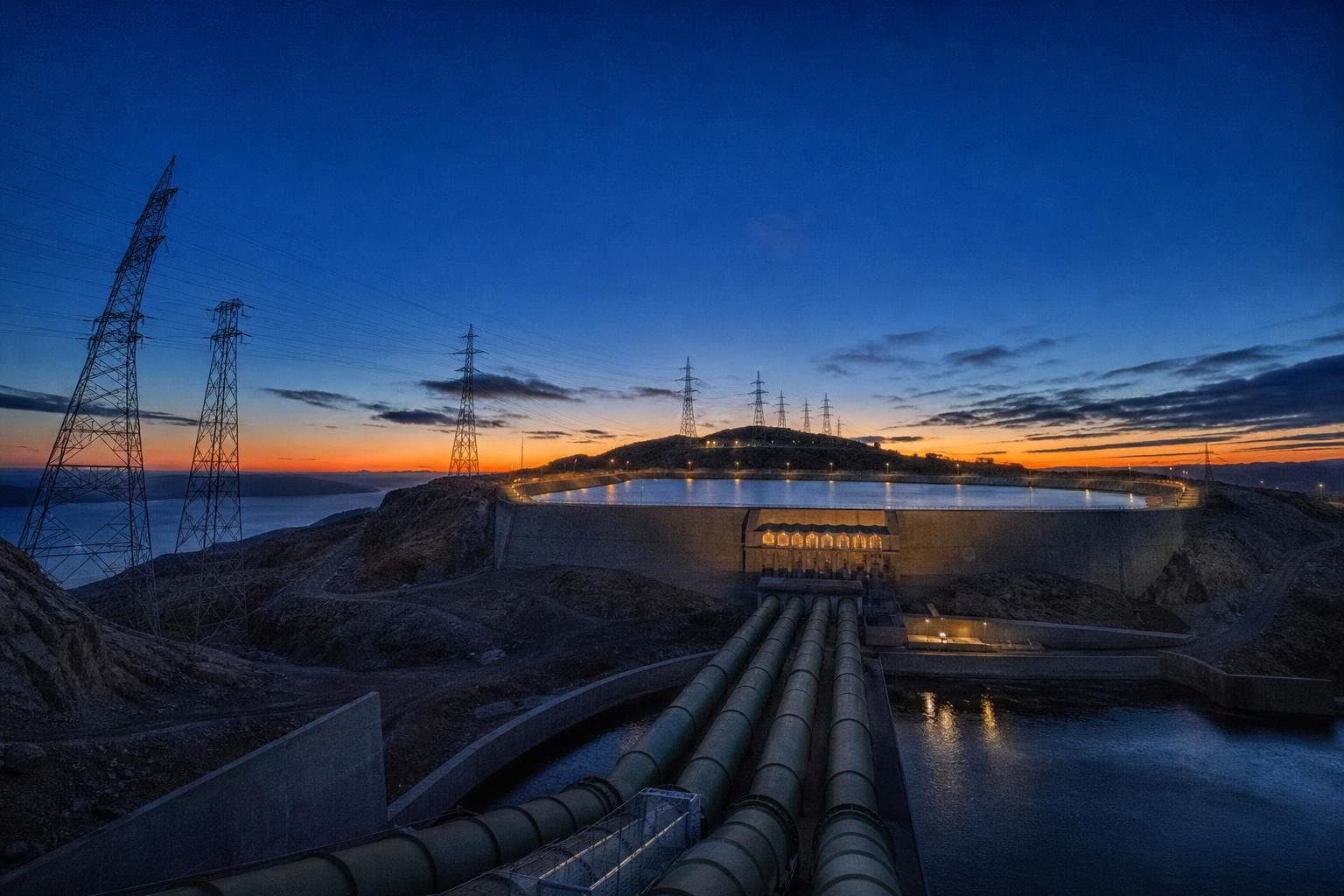
Pumped storage hydropower currently accounts for 88% of all utility-scale energy storage in the United States, according to the DOE's 2024 Hydropower Market Report. America has 43 PSH plants operating today, and the DOE estimates the country has potential to more than double its current PSH capacity through new additions. PSH requires no lithium, no cobalt, no rare earths — just elevation differentials, water, and civil engineering. The first installations appeared in Italy and Switzerland in the 1890s. The United States has been running PSH since 1930.
This is the kind of thing that makes conservation-first thinkers nervous, because PSH requires significant land and water infrastructure. But for electricity maximalists, that's a feature. Building large physical infrastructure is the point. Civilization-scale energy storage should look like civilization-scale construction.
The catch is time. PSH projects take years to permit and build. They can't solve PJM's September deadline. They can't absorb the data center demand wave that's already arrived. But they can be part of a diversified storage portfolio that doesn't depend entirely on a mineral supply chain that the IEA is already flagging as a structural constraint through 2040.
What the September Forum Actually Decides
The FERC forum scheduled for September isn't just a governance meeting about PJM's board structure. It's effectively a forcing function on every storage technology in the pipeline. If PJM can't demonstrate an adequate capacity plan, FERC will impose one — and the storage mix that plan relies on will have real procurement consequences for lithium-ion manufacturers, PSH developers, and long-duration storage startups alike.
Watch for three things: whether FERC's September package addresses cost allocation for data center transmission upgrades (the issue ratepayer advocates raised in July), whether PJM's capacity auction reforms include explicit storage procurement targets, and whether the IEA's next critical minerals update revises its lithium supply adequacy assessment upward or downward.
The grid's demand problem is real. The minerals constraint is real. The alternatives exist but take time to build. That tension — between the urgency of now and the physics of construction — is what the next decade of electricity infrastructure actually looks like.


