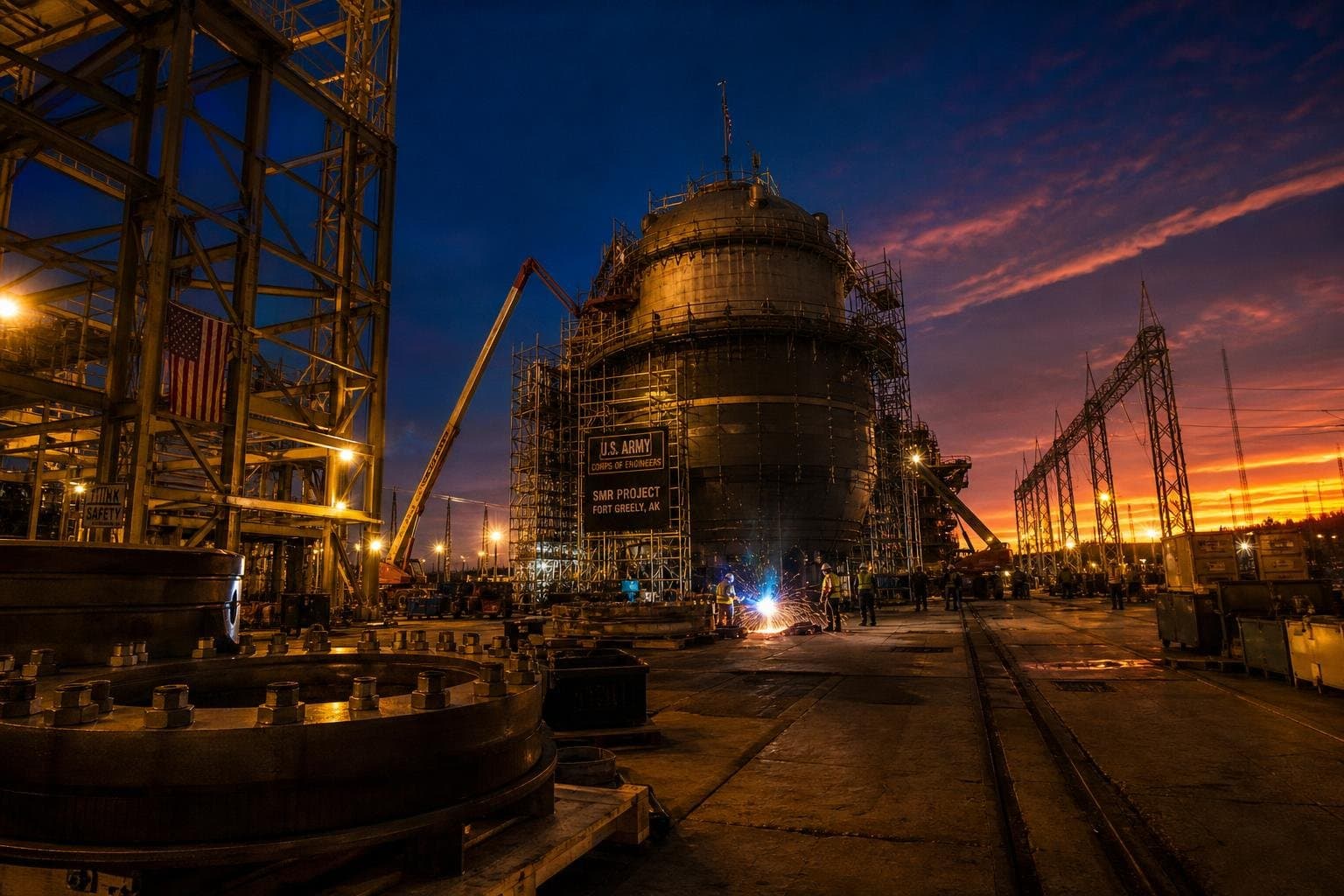

The U.S. Army doesn't do speculative investments. When it awards up to $2.2 billion across five companies to own, construct, and operate nuclear microreactors at military bases from New York to Texas, it's not placing a venture bet — it's de-risking a technology stack that private capital has been circling for years. That announcement, combined with global nuclear investment topping $4.5 billion across 81 companies in 2026 so far, tells you something important: the SMR moment has moved from roadmap to capital deployment.
This is what we're fighting for. Not the promise of distributed nuclear power — the actual construction of it.
The Demand Signal That Made This Inevitable
The physics of AI data centers created this moment. A single hyperscale data center can consume as much electricity as 50,000 homes, and U.S. data centers consumed more than 4% of total national electricity in 2023, with projections suggesting that fraction could reach 9% by 2030. Meanwhile, global electricity demand is forecast to grow 3.6% in 2026 and accelerate to 3.8% in 2027, driven by data center expansion alongside EVs, heat pumps, and industrial electrification.
The IEA's framing — "the dawn of the Age of Electricity" — is not marketing copy. It's a load forecast.
Data centers have a specific problem that makes them uniquely suited to SMRs: they cannot tolerate intermittency. Variable renewables, however cheap at the margin, cannot guarantee the continuous stable power that prevents server failure. Energy Intelligence notes that SMRs are particularly well-matched to this demand — their size resembles legacy coal and gas units, their lower water use gives them flexibility for inland siting, and they can be placed closer to centers of demand rather than requiring long transmission runs. That last point matters enormously in a grid where interconnection queues are already measured in years.
The tech giants figured this out. Meta has signed agreements with Vistra, TerraPower, Oklo, and Constellation Energy, making it one of the most significant corporate purchasers of nuclear energy in the U.S. Amazon Web Services has partnered with Talen Energy at the Susquehanna nuclear station in Pennsylvania — the first facility came online in 2024, a second building opened earlier this year — and is separately working with Energy Northwest to bring advanced SMRs online near the Columbia Generating Station.
These are operational commitments, not letters of intent.
The Army Unlocks the Demonstration Problem
Here's what has kept SMRs in perpetual "promising technology" status: no commercial operating experience in the United States. Every private investor underwriting an SMR project is pricing in first-of-a-kind risk. The Army's Janus Program changes that calculus.
Five companies will be awarded up to $2.2 billion total over five years to own, construct, and operate more than 20 microreactors at military installations — contingent on hitting performance milestones. Army officials were explicit that these are not meant to be Army-specific designs. The goal is to push advanced reactor designs beyond experiments and prototypes into years of actual power generation. Jeff Waksman, principal deputy assistant secretary of the Army for installations, energy and environment, called it the "spear tip" of the transition.
That framing is exactly right. A reactor that has run reliably at Fort Bragg for three years is a fundamentally different commercial proposition than a reactor that exists only in NRC filings. The Army is, in effect, subsidizing the demonstration phase that private capital cannot easily fund on its own — and doing so with milestone-based payments that align incentives correctly.
The DOE has been running a parallel track. The Reactor Pilot Program, created under President Trump's May 2025 executive orders, selected 11 projects to fast-track commercial licensing, with three designs having secured a Final Documented Safety Analysis as of May 2026. The goal was at least three reactor designs reaching criticality by July 4, 2026. The licensing pathway has been streamlined. The authorization process has been revised to reduce review timelines.
The regulatory bottleneck that killed the last generation of nuclear ambition is being actively dismantled.
The Supply Chain Is the Next Constraint
None of this is without friction. Energy Intelligence flags the central tension: the rapid influx of new projects could overload a nuclear supply chain already struggling with shortages in qualified workers, components, and manufacturing capacity. The same investment wave that funds SMR development also competes for the specialized steel forgings, pressure vessels, and licensed welders that existing plants need to keep running.
This is the civilizational math that abundance advocates have to take seriously. Demand is accelerating faster than supply chains can respond — which means the next constraint after permitting and capital is manufacturing throughput. Watch for announcements on domestic fuel cycle investment and component manufacturing capacity over the next 12 months. That's where the 2026 nuclear story gets written.
The future is electric, and it runs on baseload. The Army just put $2.2 billion behind that thesis. Private capital, at $4.5 billion and climbing, is right behind it.


