
Twelve gigawatts of AI data center capacity was announced for 2026. Only about 5 GW is under active construction. The rest — billions of dollars in planned infrastructure, the physical substrate of the AI revolution — sits stalled. Not because demand evaporated. Not because the money ran out. Because the grid isn't there.
This is the story of the infrastructure race to 2030, and why the most important constraint on civilizational acceleration right now isn't compute, isn't capital, and isn't political will. It's a transformer sitting in a Chinese factory, a grid interconnection queue measured in years, and a substation that won't be energized until 2029.
This Week in Voltage: The 7 GW Capacity Crisis Lands
The numbers are stark. According to Bloomberg reporting confirmed by multiple industry trackers, nearly half of all U.S. data centers planned for 2026 have been canceled or delayed. Of 12 GW of AI data center capacity announced for this year, only about 5 GW is under active construction. The $650 billion hyperscaler spending cycle — Microsoft, Google, Amazon, Meta, and the Stargate consortium — has not adjusted downward. The ambition is intact. The physics is not cooperating.
Forbes reported the same pattern: many U.S. data centers announced for 2026 have been delayed or canceled outright, and the reason isn't wavering demand — it's that the physical prerequisites for powering them don't exist yet.
Deep Charge: Three Bottlenecks, One Civilizational Chokepoint
The 7 GW shortfall isn't one problem. It's three problems stacked on top of each other, each with a different timeline and a different fix. Understanding the stack is the only way to understand what the infrastructure race to 2030 actually looks like.
Bottleneck One: The Grid Can't Keep Up With the Announcement Cycle
The asymmetry is brutal. A hyperscaler can announce a data center campus in 18 months. Getting power to that campus — new transmission lines, substation upgrades, grid interconnection approval — takes up to 60 months. That's a 42-month gap between what capital can promise and what infrastructure can deliver.
The demand trajectory makes this worse, not better. Research from Texas A&M and collaborating institutions documents how AI data centers create load patterns fundamentally different from conventional industrial customers — training runs that spike to full capacity for weeks, inference workloads that fluctuate unpredictably, and power quality requirements that stress distribution infrastructure in ways utilities haven't historically planned for. Grid operators built their planning models around predictable industrial and residential load curves. AI compute doesn't behave like a steel mill or a suburb.
The consequence: data center demand is projected to grow from roughly 4% of U.S. national electricity consumption toward 12% — a tripling of share — and the grid's long-term planning processes weren't designed to absorb that kind of step-change from a single sector in a single decade.
Bottleneck Two: The Hardware That Nobody's Talking About
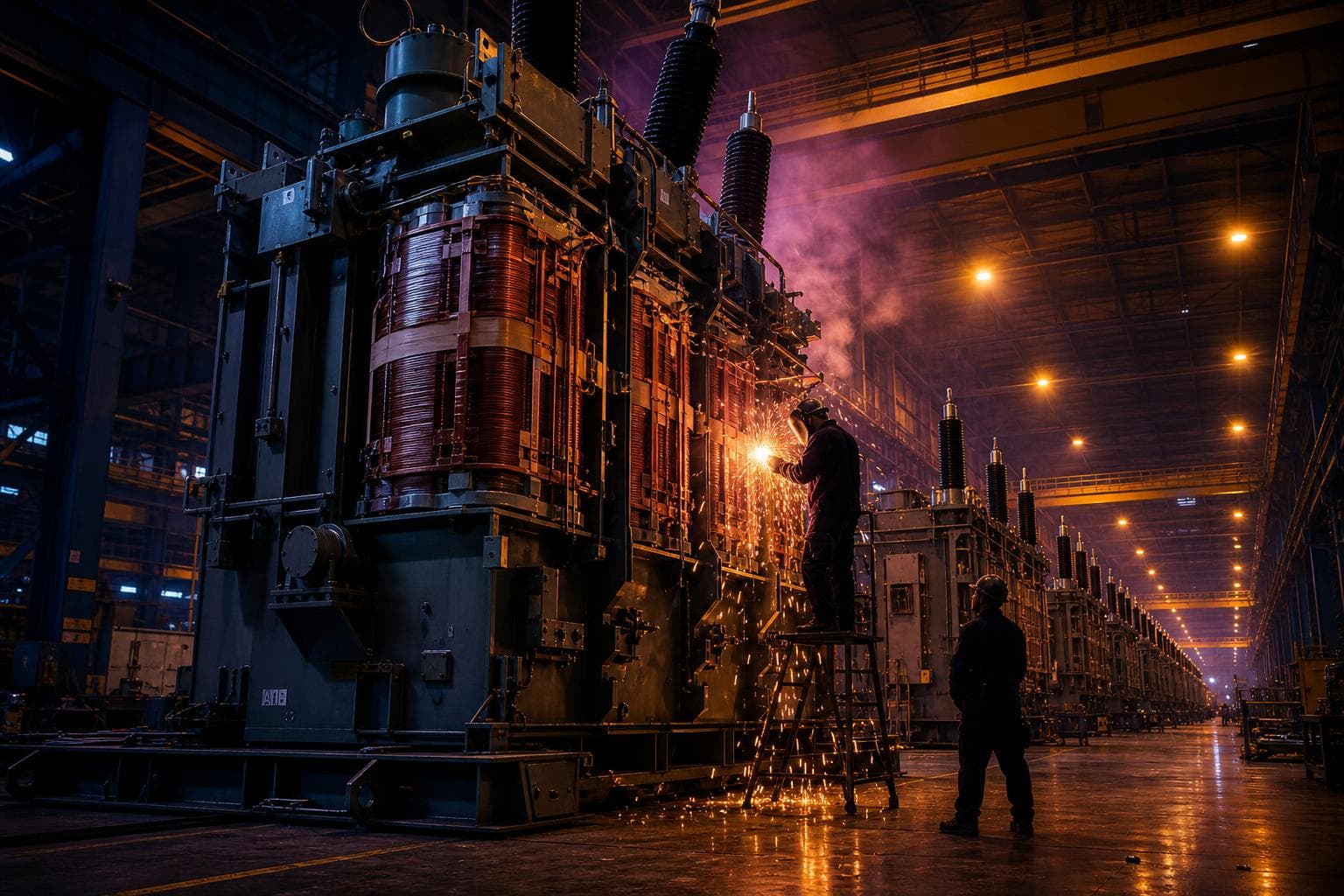
Here's the part that doesn't make the AI breathlessness coverage: the blocking constraint for many stalled projects isn't the grid itself. It's transformers and switchgear — the electrical components that connect a data center to the grid in the first place.
These components represent less than 10% of total data center construction cost, but they're 100% of the blockage. Lead times on large power transformers have stretched to two or three years. The domestic manufacturing base for this equipment is thin. And Chinese tariffs — running 15–25% on relevant power equipment — have added cost and supply uncertainty simultaneously. Reshoring transformer manufacturing will take two to three years to meaningfully change the supply picture.
This is the kind of problem that makes electricity maximalists want to flip tables. We have the capital. We have the demand signal. We have the political momentum. And we're being held hostage by a supply chain for a piece of industrial hardware that weighs 400 tons and takes 18 months to wind. The irony is almost too perfect: the most sophisticated computing infrastructure in human history is blocked by analog electrical equipment.
Bottleneck Three: Geography, Community Opposition, and the NIMBY Tax
The third layer is messier and less fixable by any single policy lever. Cancellation patterns in Virginia, Georgia, and Texas show a consistent dynamic: communities near proposed data center sites are pushing back on water consumption, noise, and local grid impacts. Virginia's data center corridor — the densest concentration of compute infrastructure on the planet — is running into transmission constraints that are partly physical and partly political. Nobody wants the new substation in their backyard.
This isn't a new problem for energy infrastructure. It's the same fight that's slowed transmission buildout for decades. But the AI boom has compressed the timeline in a way that makes the usual slow-walk of permitting and community engagement genuinely dangerous to the buildout. When you need 7 GW in 2026 and the approval process takes three years, the math doesn't work.
The Renewable Procurement Angle: PPAs Can't Solve a Capacity Problem
There's a version of this story that the clean energy world tells itself: hyperscalers are signing massive power purchase agreements for solar and wind, so the data center boom is actually accelerating the energy transition. That's partially true and mostly incomplete.
The PPAs are real. The renewable buildout they're financing is real. But a PPA doesn't solve a capacity problem — it solves a carbon accounting problem. You can sign a 500 MW solar PPA today and still not have reliable 24/7 power available at your data center site in 2027, because the transmission infrastructure to deliver that power doesn't exist yet. The Texas A&M research is explicit about this: AI training workloads require firm, dispatchable power. Intermittent renewables without storage or backup can't meet that requirement alone.
This is why the nuclear procurement wave matters so much — and why I've covered it repeatedly in this newsletter. The hyperscalers aren't signing nuclear PPAs because they've become environmentalists. They're signing them because nuclear is the only zero-carbon source that can provide the firm, always-on power that AI compute actually requires. The renewable procurement story and the nuclear renaissance story are the same story: the search for electrons that show up when you need them, not just when the wind blows.
The infrastructure race to 2030 isn't really about renewable capacity additions. It's about firm capacity — power that's there at 2 AM on a January night when a training run is at peak load. That's the constraint that's reshaping electricity markets, and it's the constraint that makes every new nuclear approval, every battery storage deployment, and every transmission line permit a civilizational event.
By the Numbers
- 12 GW of AI data center capacity announced for 2026 in the U.S.; roughly 5 GW under active construction — a 7 GW shortfall
- $650 billion in hyperscaler capital expenditure commitments that have not been revised downward despite the construction delays
- 18 months to announce and begin a data center; up to 60 months to secure grid interconnection — the 42-month physics gap that capital cannot close
- 4% → 12% projected growth in data centers' share of U.S. national electricity demand — a tripling of sector load, per grid impact research
- 15–25% tariff-driven cost increases on power equipment from Chinese supply chains, compounding transformer lead-time problems
What We're Fighting For
The 7 GW shortfall is not a story about AI hype meeting reality. It's a story about civilization-scale infrastructure hitting the limits of systems built for a slower world.
Every gigawatt of data center capacity that gets built is a node in the planetary nervous system we're constructing — the compute substrate for everything from drug discovery to materials science to the autonomous systems that will eventually let us do things in space that currently require humans in dangerous places. The stakes are not quarterly earnings. They're the pace at which our species gets smarter.
The bottlenecks are real, but they're not permanent. Transformer manufacturing can be reshored — watch for DOE supply chain investments in the next 12–18 months. Interconnection queues can be reformed — FERC's ongoing transmission rules are the policy lever to watch through the end of 2026. Battery storage is crossing cost thresholds that make firm renewable power increasingly viable — the question is whether it scales fast enough to matter before 2030.
What can't be fixed by policy or capital alone is the 42-month physics gap. The only answer to that gap is to start earlier, build more, and stop treating grid infrastructure as a cost center rather than the foundation of everything we're trying to build. The hyperscalers figured this out. The grid operators are catching up. The question is whether the permitting and manufacturing systems that sit between ambition and electrons can move at civilizational speed.
We are building the infrastructure of a Type I civilization. The transformer queue is the most mundane and most important obstacle in that project right now. Get it moving.


