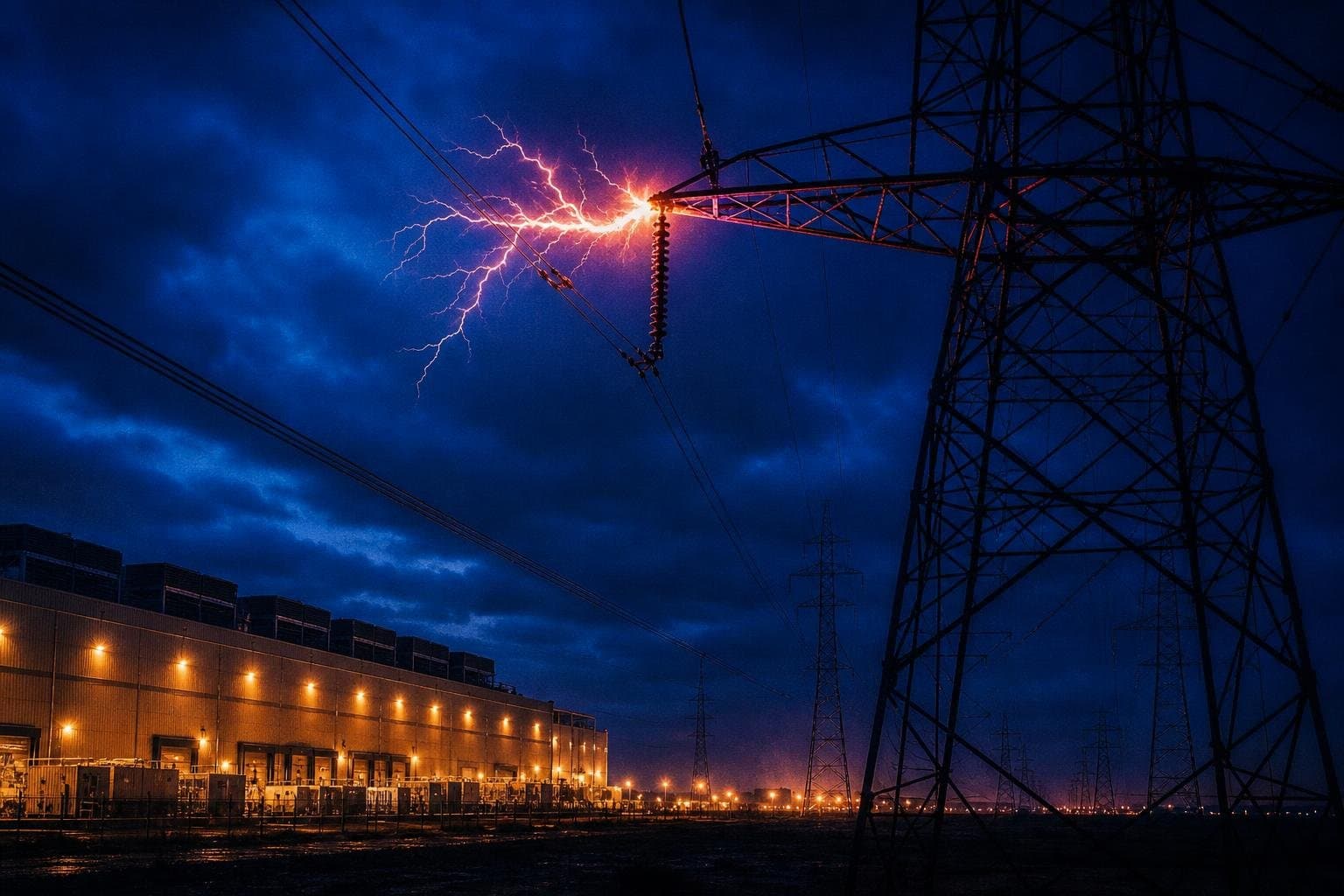

At 7:56 a.m. on July 22, a mechanical failure knocked a 230 kV transmission line offline in Northern Virginia. What happened next was unlike anything PJM had ever seen. Data centers across the Dominion zone — sensing the fault — didn't ride through it. They disconnected. Nearly 3,800 MW of computational load vanished from the grid in seconds, triggering voltage spikes and frequency swings that required emergency dispatch to contain. PJM recovered within nine minutes, well inside NERC's 30-minute standard. But the event itself — the largest large-load disconnection in PJM's history — exposed something the grid was never designed to handle: a new class of electricity consumer that behaves less like a factory and more like a school of fish, capable of changing direction in milliseconds and at civilizational scale.
This is the grid synchronization problem nobody was planning for. And it's already here.
The Physics of AI Demand Is Categorically Different
Traditional industrial electricity demand is, by grid standards, boring. A steel mill draws a predictable load. A semiconductor fab runs continuous processes. Even large commercial buildings ramp up and down gradually with occupancy and weather. Grid operators built their planning models, their frequency regulation reserves, and their interconnection standards around this kind of demand — large, yes, but relatively steady.
AI compute breaks every assumption in that model.
During large-scale model training, hundreds of thousands of GPUs power up and down on a millisecond basis — the digital equivalent of a city the size of Boston flickering half its load on and off every few seconds, as Shannon Miller of Mainspring Energy describes it. The swings aren't just fast; they're enormous. AI workloads can spike as much as 50% above a facility's design capacity — a 1 GW facility drawing 1.5 GW for a split second, according to Drew Baglino, founder of Heron Power Electronics. And the planned campuses in Texas and the Midwest aren't 1 GW facilities — some are more than five times larger, consuming on average nearly as much power as New York City.
The grid's frequency regulation systems were designed to handle demand variability measured in minutes, not milliseconds. When a gigawatt-scale load disappears without warning — as happened in Northern Virginia — the imbalance between generation and load creates immediate frequency deviation. Generators don't respond instantaneously. The inertia of spinning turbines provides a buffer, but that buffer was sized for the demand patterns of the 20th century, not for AI training runs that mobilize and demobilize the equivalent of a mid-sized city's power consumption in the time it takes to blink.
As Penn State electrical engineering professor Nilanjan Ray Chaudhuri has written, "Large AI data centers must be modeled and operated as significant parts of the power system rather than treated like ordinary commercial customers." That reframing — from customer to grid participant — is the conceptual shift the industry is only beginning to make.
The July 22 Event Is the Case Study That Changes Everything
The Northern Virginia event deserves to be studied the way aviation studies crashes: not as a failure to be minimized, but as a data point that reveals systemic risk before a worse outcome occurs.
According to Dominion's preliminary investigation, the sequence unfolded in two waves. The initial line fault caused data centers to begin transferring to backup generation — dropping 2,970 MW from the grid in the first wave. That sudden load loss caused system voltage to spike. The voltage spike then triggered a second wave: an additional 1,099 MW of data centers disconnected in response to the disturbance their own disconnection had created. PJM watched total load drop from 99,984 MW to 96,205 MW in a matter of moments.
The grid held. PJM's operators dispatched generation down, restored frequency to 60 Hz, and recovered the Balancing Authority Area Control Error within nine minutes. That's a testament to operator skill and to the headroom that existed in the system that morning. But the event revealed a structural vulnerability that headroom alone cannot fix: AI data centers, as currently interconnected, are not grid-stabilizing assets. They are grid-destabilizing ones. Their protective systems, designed to safeguard sensitive computing equipment from voltage disturbances, respond to grid faults by making those faults worse — disconnecting load precisely when the grid needs load stability most.
This is the ride-through problem. Conventional large industrial customers are required under NERC standards to ride through voltage and frequency disturbances rather than disconnect. PJM is now evaluating whether existing and future ride-through standards should apply specifically to computational loads — data centers and crypto-mining facilities — a process that began at the August 6 Operating Committee meeting. The fact that this evaluation is happening now, after the largest large-load disconnection in PJM history, rather than before it, tells you everything about how far behind the regulatory framework has fallen.
FERC and ERCOT Are Moving — But the Clock Is Already Running
The regulatory response is accelerating, and it's worth understanding what it actually covers — and what it doesn't.
On June 18, 2026, FERC issued show-cause orders to all six Regional Transmission Organizations and Independent System Operators — PJM, MISO, SPP, CAISO, ISO-NE, and NYISO — directing them to justify their current rules for large-load interconnection and tariffs or propose reforms. Grid operators had 30 days to report on generation adequacy for new large-load demand, and 60 days to justify or revise their tariffs. Both windows elapsed by September 3. The FERC proceeding addresses the right layer of the problem: not facility design, but grid process — interconnection rules, cost assignment, and the treatment of flexible large loads that can appear, disappear, or change character faster than planning models can track.
In Texas, ERCOT's Large Load Working Group met on August 21 to address overlapping challenges: ride-through performance standards under NOGRR289, a proposed Netted Networks framework for co-located load and battery storage, and NERC's emerging computational load reliability requirements. The Comprehensive Transmission Planning framework ERCOT is developing aims to integrate large-load commitments into the annual planning cycle with standardized modeling and clearer governance — a recognition that the current ad hoc approach cannot scale to the size of the demand pipeline.
But here's what the regulatory response cannot fix quickly: the physical reality of the interconnection queue. A DOE report estimated data centers consumed approximately 4.4% of U.S. electricity in 2023 and could account for between 6.7% and 12% by 2028 — a range that itself reflects how uncertain the pace of growth remains. The facilities driving that growth are being planned and financed now, against interconnection standards that were written for a different era. Reforming those standards takes years. The data centers are being built in months.
The FERC order changes the questions that future projects must answer before receiving service — requiring clearer evidence on load firmness, demand flexibility, and cost responsibility for network upgrades. That's the right framework. But it applies prospectively. The 3,800 MW that disconnected in Northern Virginia was already on the grid under the old rules.
The Damage Is Happening Inside the Facilities Too — and That Matters for the Grid
There's a second-order consequence of AI demand volatility that hasn't received enough attention: the rapid swings are destroying the equipment inside the data centers themselves, and that equipment failure creates additional grid instability.
Rapid swings in AI data centers' power demands are straining batteries, generators, and cooling systems, causing them to malfunction or wear out far sooner than expected, according to Amber Villegas-Williamson, principal consultant at the Uptime Institute. The analogy she uses is apt: over-revving an engine wears it out faster than steady cruising. A UPS system or backup generator designed for occasional use during outages is being cycled repeatedly as AI workloads surge and subside — accumulating fatigue at rates the equipment's design life never anticipated.
This matters for grid reliability because data center backup systems are load-following devices. When a facility's UPS fails or a generator trips during a training run, the facility may draw unexpected power from the grid — or disconnect unexpectedly. The July 22 event showed what unexpected disconnection looks like at scale. Equipment failures inside facilities create the conditions for more such events, not fewer.
The concern is also a potential source of wider instability in power grids already straining to keep the lights on. That's not alarmism — it's the direct assessment of industry practitioners watching their equipment degrade in real time. And it connects to a broader grid planning failure: the assumption that data centers are passive loads, drawing power steadily and predictably, is wrong. They are active participants in grid dynamics, and their behavior during disturbances can amplify rather than absorb system stress.
What the Grid Actually Needs — and What Abundance Requires
Here's the civilizational framing that matters: the path to energy abundance runs through grid stability, not around it. A 5 GW AI campus that trips offline during a fault and takes half the regional grid's frequency regulation with it is not an asset to the electricity-maximalist future — it's a liability. The compute clusters we need to reach the next order of magnitude of human capability require a grid that can actually hold them.
That means three things have to happen simultaneously, and faster than the regulatory calendar currently allows.
First, ride-through standards for computational loads need to become mandatory, not aspirational. The July 22 event demonstrated that voluntary protective settings optimized for equipment safety are incompatible with grid stability at scale. PJM's Operating Committee is working on this; NERC's computational load reliability standards are in development. The timeline needs to compress.
Second, the interconnection process needs to treat AI data centers as grid participants with bidirectional obligations — not just customers with large appetites. FERC's June 18 order moves in this direction by requiring grid operators to address load firmness and demand flexibility. The follow-through — in tariff design, in cost assignment, in operating agreements — will determine whether the framework has teeth.
Third, the energy storage and power electronics layer inside data centers needs


