


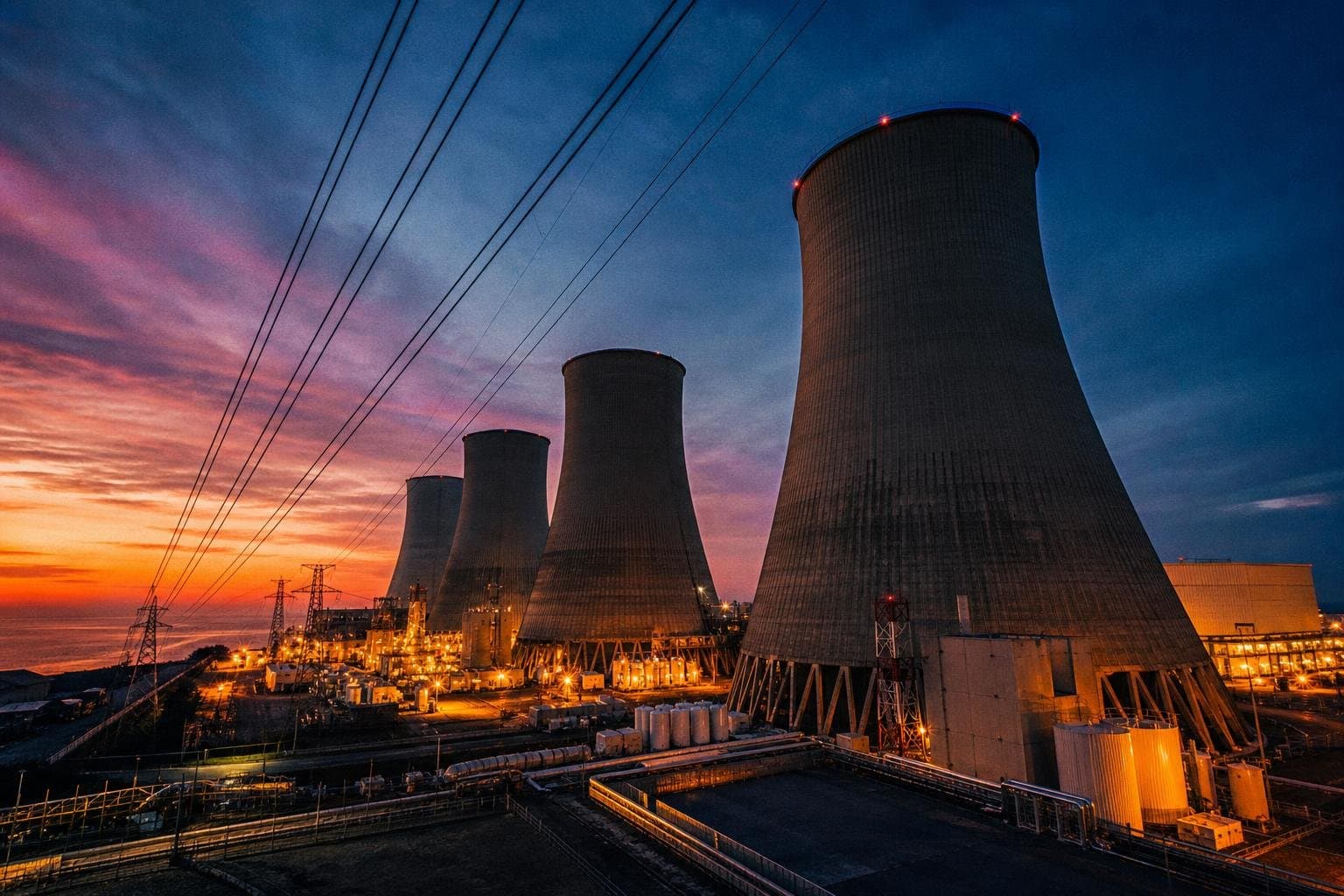

The numbers coming out of Seoul this week are staggering. South Korea's Minister of Climate, Energy and Environment told Reuters that AI-driven demand alone — from Samsung and SK Hynix factory expansions plus new data centers — will lift the country's power requirements by 25 to 30 gigawatts. To put that in reactor terms: at current South Korean unit standards, that's roughly 20 new reactors' worth of capacity. From one demand driver. In one decade.
This is what civilizational acceleration looks like when it hits a grid that's actually paying attention.
The Energy Minister Already Knows the Answer
South Korea's government hasn't officially committed to a specific reactor count — the updated long-term energy roadmap extending to 2040 is due next month — but the minister's framing was unambiguous. Nuclear is, in his words, an essential element within the power generation mix. Renewables currently cover 11% of South Korea's power needs; nuclear covers just under a third. The math on closing a 25–30 GW gap with solar and wind alone — given land constraints, grid integration costs, and the 24/7 baseload requirements of semiconductor fabs — doesn't work without nuclear at the center of it.
The demand signal is also accelerating faster than planned. Projects originally scheduled for completion around 2045 have been pulled forward to the early 2030s, per Reuters. That's not a policy adjustment — that's a supply chain emergency in slow motion, and South Korea is treating it like one.
Meanwhile, Massachusetts just mandated that data center developers invest in their own clean energy generation and secure local approval before touching state construction permits. The contrast is instructive: one government is racing to build the power supply its AI economy demands; another is adding approval layers to slow the demand side down. One of these strategies ends with more compute capacity. The other ends with data centers relocating to grids that said yes.
South Korea's 79% public support for new nuclear plants — per a state-run poll of 2,000 respondents cited by Reuters — is the political permission structure that Western governments keep saying they can't build. Seoul built it. Now watch what they do with it when the October roadmap drops.