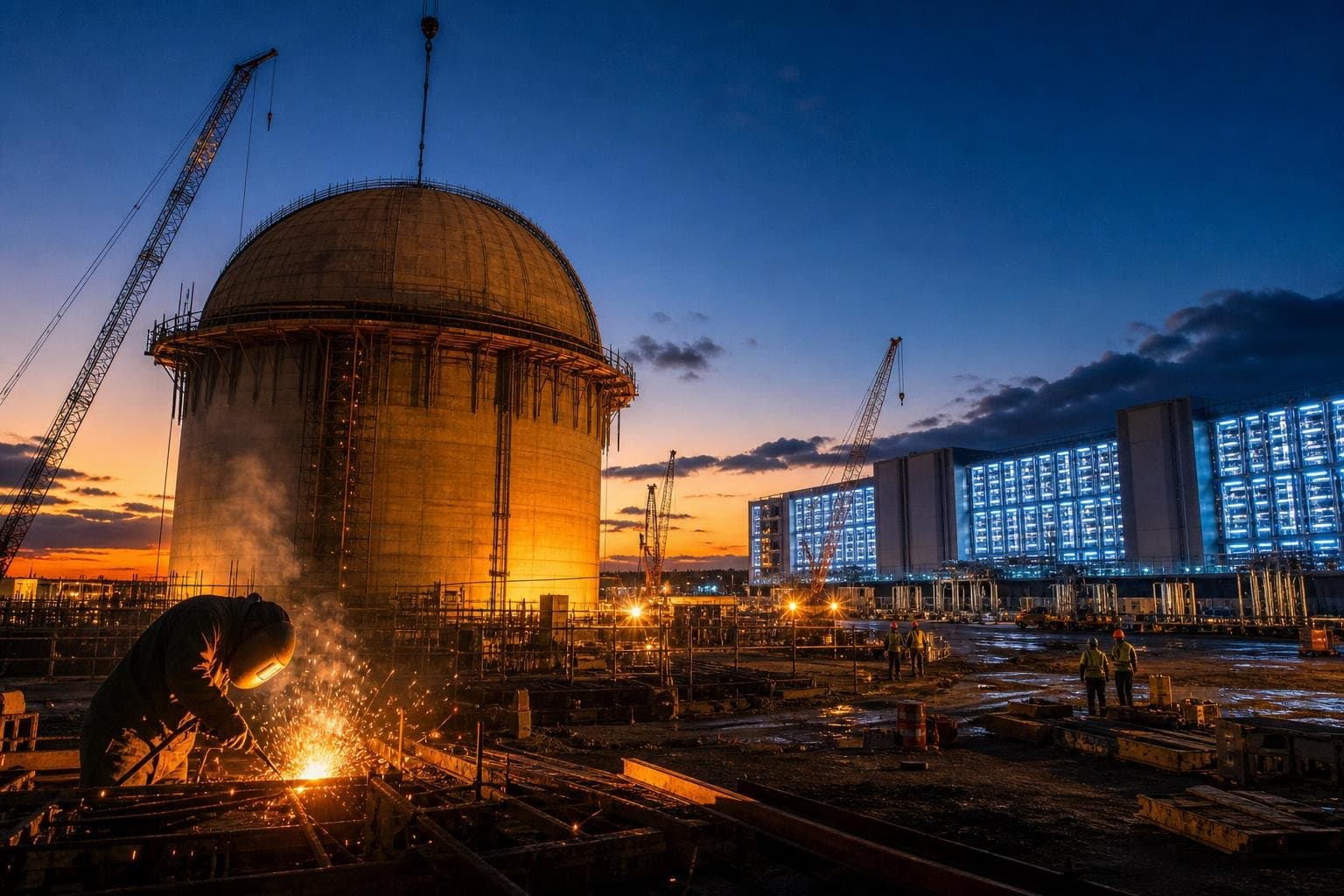

The transmission queue is a graveyard. Projects wait five, six, seven years for interconnection approval while data centers burn through capital and AI compute sits idle. Rabobank's May 2026 analysis put the structural mismatch in brutal terms: grid interconnection timelines run 36 to 84 months, while data center build cycles run 12 to 24 months. That gap is not a scheduling inconvenience. It is a civilizational bottleneck.
Small modular reactors are the answer that bypasses the question entirely.
The Transmission Problem Is a Siting Problem in Disguise
Here's what the grid debate usually misses: the reason transmission is a bottleneck is that large-scale generation has always been built far from load centers. Coal plants near fuel sources. Hydro near rivers. Wind in the plains. You build the generation where the resource is, then you build thousands of miles of wire to move the electrons to where people actually live and work.
SMRs break that logic. The NRC's own characterization of advanced reactors notes their "smaller footprint, allowing them to be built closer to local grids on an accelerated timeline." Typically generating around 300 megawatts, they can site directly adjacent to industrial load — a data center campus, a semiconductor fab, a manufacturing complex — and deliver power without touching the bulk transmission system at all. No interconnection queue. No FERC filing. No seven-year wait.
This is what "distributed nuclear" actually means. Not smaller reactors scattered randomly across the countryside. Reactors sited at the load, purpose-built to serve specific customers, eliminating the transmission problem by eliminating the need for transmission.
The Regulatory Unlock Is Happening Now
The deployment thesis only works if the licensing pathway exists. Until recently, it didn't — not at the speed the market requires.
That's changing fast. Reuters reported in May that the NRC is fast-tracking three major regulatory reforms to comply with a May 2025 executive order mandating new reactor design approvals within 18 months. One proposed rule would create an expedited pathway for designs already tested under DOE and Department of Defense pilot programs — essentially letting developers carry their federal testing data directly into the commercial licensing process rather than starting from scratch. As Dr. Rita Baranwal of Radiant Nuclear told Reuters, the approach frees NRC staff "to focus on what is new, or in different applications, like design changes and siting considerations."
The NRC chairman himself told the Washington Examiner he believes SMRs could be operational in the U.S. by 2030. The concrete anchor for that timeline: the NRC granted a construction permit in March for the Kemmerer Power Station Unit 1 in Wyoming, a 345-megawatt SMR. Construction permits are not operational capacity — the chairman was explicit that commercial timelines depend heavily on supply chains and fuel availability, not just regulatory readiness. But a permit in hand is a different category of progress than a permit in queue.
The administration's stated target — growing U.S. nuclear capacity from roughly 100 GW today to 400 GW by 2050 — frames SMR deployment as a national industrial strategy, not a niche technology bet.
The Hyperscalers Are Already Building the Parallel System
Meanwhile, the private sector isn't waiting for the regulatory calendar. Rabobank's analysis found over 130 GW of behind-the-meter energy resources now proposed to serve planned U.S. data center projects — a figure that represents the largest five-year surge in U.S. power demand since the 1980s. The five largest hyperscalers are projected to spend between $745 billion and $775 billion on capital expenditure in 2026 alone.
Right now, more than 80 percent of that behind-the-meter pipeline is gas — because gas turbines can be deployed in months, not years. But gas is a speed play, not a strategy. It locks in fuel price exposure, carbon liability, and ongoing supply chain dependence. SMRs, once the licensing pathway matures, offer the same behind-the-meter siting logic with a 60-year fuel cost profile that doesn't move with Henry Hub.
The hyperscalers building parallel power systems today are laying the physical and contractual infrastructure that SMRs will eventually plug into. The question is whether the regulatory and supply chain machinery — including the fuel challenges Reuters flagged this month around advanced reactor fuel supply — can mature fast enough to make SMRs competitive with gas on deployment timelines before the behind-the-meter buildout locks in a gas-dominant architecture for decades.
That's the race. Not SMRs versus the grid. SMRs versus gas, in a sprint to own the behind-the-meter power market that hyperscalers are building right now.
Watch the NRC's 18-month design approval clock — it started ticking in May 2025. If the first approvals land on schedule, the siting conversations with hyperscalers start in earnest. That's when the transmission bottleneck stops being a constraint and starts being irrelevant.


