
This Week in Voltage
The same week Holtec announced it's targeting 2036 for four SMR-300 units at the retired Oyster Creek site in New Jersey — a 1,360 MW campus on land that already has transmission rights, cooling infrastructure, and a nuclear-trained workforce nearby — Antares Nuclear closed a $470 million raise to deploy tiny reactors at US military bases by 2028. Two announcements, same week, separated by orders of magnitude in scale. Both are called SMRs. Both are solving the same underlying problem from completely different angles.
That's the story. And it's bigger than either headline suggests.
The Interconnection Queue Is the Real Enemy
Before we talk about what SMRs can do, we need to be precise about what the grid cannot do. US grid interconnection queues have swollen past 2,600 GW of waiting projects, with average wait times stretching toward five years and withdrawal rates as high as 80% for projects that simply give up. Wholesale power prices near hyperscale data center clusters have reportedly surged by as much as 267% in some regions. Global data center electricity demand is projected to double by 2027, with AI workloads responsible for the majority of that growth.
I've written about the interconnection queue as a capital decision and about how AI compute geography is breaking regional grids. The through-line in both pieces: the bottleneck isn't generation capacity in the abstract. It's the combination of where power gets generated and how long it takes to connect new sources to the places that need them.
This is where the SMR thesis gets genuinely interesting — and where the hype often gets ahead of the hardware.
The conventional large nuclear plant argument is straightforward: 1,000+ MW of always-on, carbon-free power, dispatchable on demand, immune to weather. The problem is that large plants require large sites, large transmission buildouts, and large regulatory timelines. Oyster Creek's proposed 1,360 MW SMR campus sidesteps some of this by reusing a site that already has transmission rights, cooling infrastructure, and decades of nuclear operational history. That's the smart play. But 2036 is still a decade away, and the AI compute buildout is happening now.
The distributed SMR argument is different in kind, not just degree.
Distributed Nuclear Matches Distributed Compute — In Theory
The DOE's official SMR framework describes advanced SMRs as ranging from tens of megawatts up to hundreds of megawatts, with "relatively small physical footprints, reduced capital investment, ability to be sited in locations not possible for larger nuclear plants, and provisions for incremental power additions." That last phrase is the civilizationally important one. Incremental power additions. You build what you need, where you need it, when you need it — and you add more as demand grows.
This maps almost perfectly onto how AI compute is actually being deployed. Hyperscalers aren't building one monolithic data center campus and calling it done. They're building distributed clusters across dozens of regions, each with its own power procurement challenge. Every major AI hyperscaler — Microsoft, Google, Amazon, and Meta — has now signed at least one nuclear power agreement specifically to secure electricity for AI data centers, with the four companies collectively committing to more than 13 separate deals totaling close to 10 GW of nuclear capacity.
Google's deal is the most structurally relevant here: a commitment to up to 500 MW across six to seven SMR units with Kairos Power, with the first reactor targeted for 2030. That's not one big plant. That's a fleet — distributed across multiple sites, sized to match specific load requirements, with each unit representing an incremental commitment rather than a multi-billion-dollar all-or-nothing bet.
Amazon's approach goes further. Alongside its expanded offtake agreement with Talen Energy for nearly 2 GW from the Susquehanna plant, Amazon led a $700 million investment round in X-energy to develop up to twelve gas-cooled Xe-100 SMR units. Twelve units. The logic is explicit: if you're building data centers across twelve different geographies, you want power sources that can follow the compute, not the other way around.
This is the decentralization thesis in its strongest form. The grid was built for centralized generation flowing outward to distributed load. AI compute inverts that model — the load is now the organizing principle, and generation needs to follow it.
The Military Proof-of-Concept Nobody Is Talking About Enough
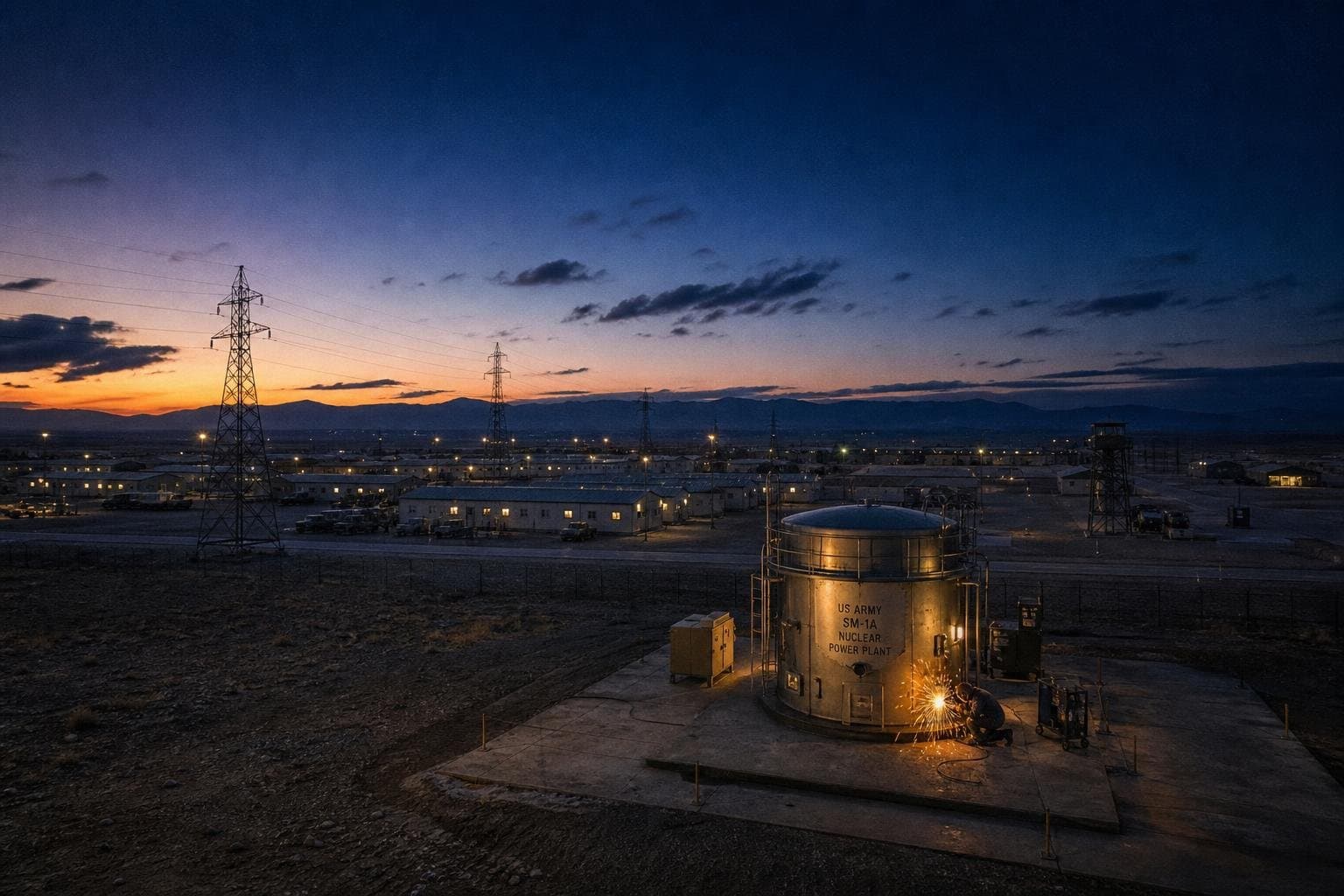
The Antares Nuclear raise deserves more attention than it's getting as a pure grid story. $470 million — $370 million in equity and $100 million in debt, co-led by Paradigm and Caffeinated Capital — targeting deployment to US military installations by 2028. Military bases are, in energy terms, the world's most demanding distributed power customers: they need always-on reliability, they can't depend on civilian grid connections that might be disrupted in a conflict scenario, and they're often located far from major transmission infrastructure.
If Antares can actually hit 2028 deployment — and that's a significant conditional, given that no SMR design has yet achieved commercial operation in the United States — military installations become the proving ground for distributed nuclear at scale. Every operational hour at a forward base is data. Every maintenance cycle is a learning curve compressed. The military has historically been the fastest path to commercial technology maturation in the US, from GPS to the internet to advanced materials. Nuclear is next.
The geopolitical dimension reinforces this. The US-Japan-South Korea trilateral SMR Memorandum of Cooperation signed at the NATO Ankara Summit on July 8 explicitly frames SMR deployment as a security asset, not just an energy asset. Secretary Rubio said the quiet part at the podium: "One of the most important issues in the world today, as we're reminded of even now with events happening in the Straits of Hormuz and in other places, is energy security." The MOC commits $10 million in new US funding to the State Department's FIRST Program and targets Indo-Pacific partner nations first. The BWRX-300 — a 300 MWe water-cooled reactor built on GE Vernova Hitachi's NRC-certified ESBWR design — is the vehicle, with the first unit under construction at Ontario Power Generation's Darlington site in Canada, targeted for completion by end of the decade.
Nuclear is geopolitical infrastructure now. The paperwork is catching up to the physics.
The Honest Accounting: What SMRs Still Can't Do
Here's where I have to be straight with you, because the hype is real and the timelines are not.
No SMR design has achieved commercial operation in the United States. The DOE notes that light water-cooled SMRs under NRC licensing review "will likely be deployed in the late 2020s to early 2030s" — and that language reflects the optimistic scenario, not the baseline. The NuScale/UAMPS project at Idaho National Laboratory, which was the furthest along of any US SMR program, was cancelled in late 2023 after cost projections escalated beyond what the municipal utility partners could absorb. That's not a reason to abandon the technology. It is a reason to be precise about what "announced" means versus what "operational" means.
Holtec's Oyster Creek project is classified as a "Development Phase" deployment opportunity in its own securities filing, conditional on state and local support, financing, and equity partner arrangements. 2036 is the target. Targets move. The 1,360 MW figure is announced capacity, not operational capacity.
Google's Kairos Power deal targets a first reactor in 2030. Amazon's X-energy commitment covers up to twelve units — "up to" is doing significant work in that sentence. Meta's portfolio of agreements across TerraPower, Oklo, Vistra, and Constellation hedges across nearly every major reactor technology in development, which is smart portfolio construction but also an implicit acknowledgment that nobody knows which designs will actually reach commercial operation first.
The DOE's data center resource hub frames the challenge correctly: "Energy addition, including an increase in reliable, dispatchable generation resources, is required to ensure projects come online quickly and responsibly." Quickly is the operative word. SMRs are the right answer to the distributed nuclear question. They are not yet a fast answer.
The Civilizational Bet Worth Making Anyway
None of the honest accounting above changes the fundamental argument. The grid was designed for a world where electricity demand grew predictably, in roughly the same places, at roughly the same rate. That world ended when AI compute became the fastest-growing load category in the history of the electric grid.
The DOE's AI Action Plan is explicit that "the nation that leads the AI race controls technological advancements, economic development, and military power." You cannot lead the AI race without leading the energy race. And you cannot lead the energy race with a grid architecture built for 1970s load patterns.
Distributed SMRs — sized at tens to hundreds of megawatts, sited where compute clusters actually are, incrementally expandable as demand grows — are the correct architectural response to distributed AI compute sprawl. The Antares military deployment, if it hits 2028, proves the operational model. The Kairos/Google deal, if it hits 2030, proves the commercial model. The Holtec/Oyster Creek campus, if it hits 2036, proves the utility-scale model. Each one is a rung on the ladder.
The civilizational bet isn't that any single SMR project succeeds on schedule. The bet is that enough of them succeed, fast enough, that the US builds the operational knowledge base — the supply chains, the trained workforce, the regulatory muscle memory — to deploy distributed nuclear at the speed that AI compute demands.
Watch the Antares 2028 deployment timeline closely. Watch whether Kairos breaks ground on its first Google-contracted unit before 2027. Watch the NRC's SMR licensing queue for design certifications that would unlock the next wave of projects. The decade-long buildout of distributed nuclear starts with the first operational units — and those first units are closer than the skeptics think, and further than the boosters claim.
The future is electric. The question is whether we build enough of it in


