
Riyadh's main airport has been hit four times. A Houthi strike last week set a fire at an Aramco administrative building in Dhahran. And through all of it, Saudi Arabia told OPEC it raised September output by more than 2 million barrels a day — to 8.372 million b/d — the single biggest driver behind OPEC+'s 900,000 b/d group-wide increase that month, according to Reuters. That's not the behavior of a producer in retreat. That's a kingdom that has decided the war around it is a reason to pump harder, not less.
This is the part of the energy story that gets lost in the daily Brent ticker. Everyone's watching the price — which climbed to $106.58 on Wednesday before easing, per Reuters, and was still trading near $99-108 a barrel across different benchmarks as of Monday, according to Trading Economics. But the more interesting signal is infrastructure: Saudi Arabia isn't just absorbing the Strait of Hormuz disruption, it's building around it permanently.
The Pipeline Bet Is the Real Headline
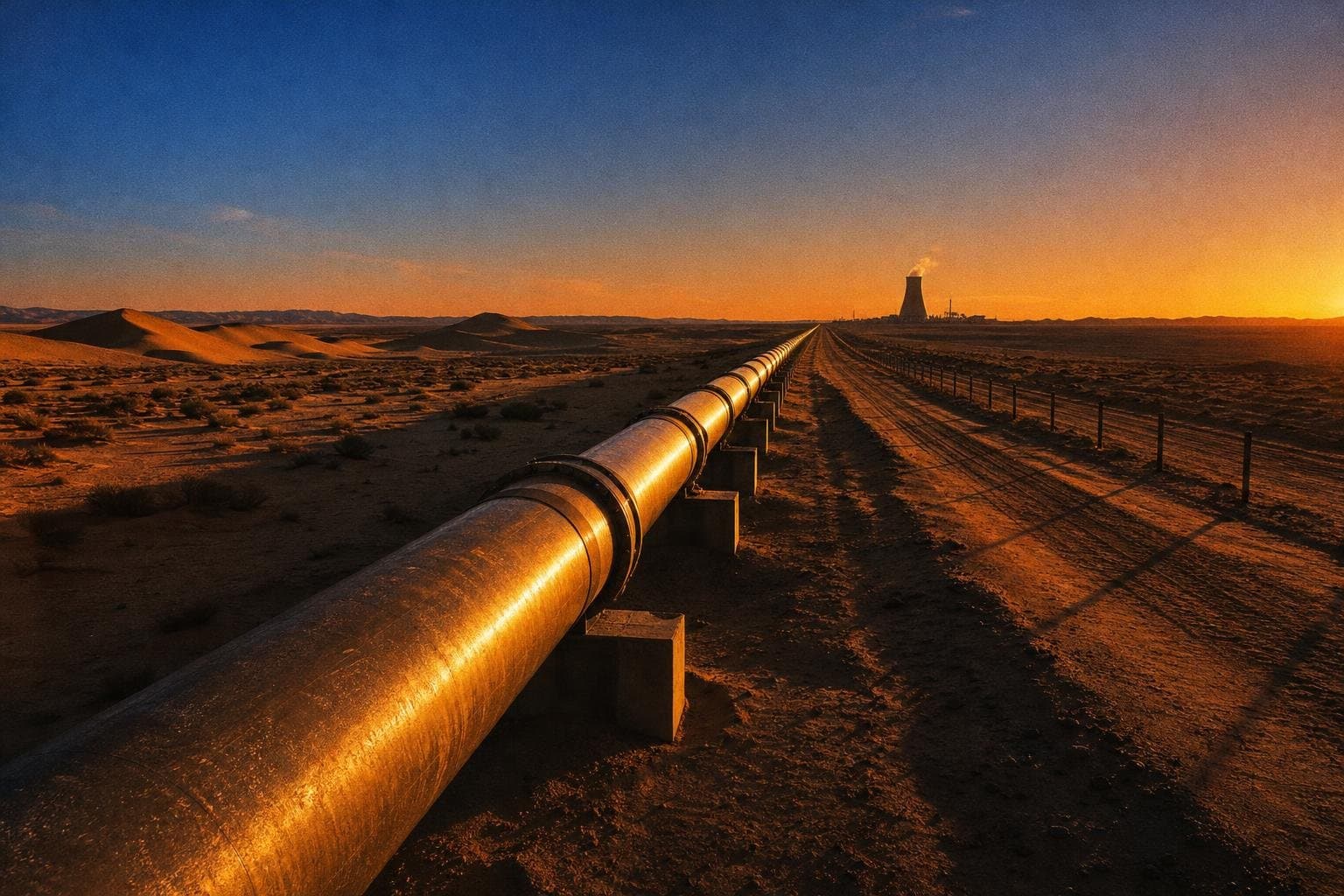
Energy Minister Prince Abdulaziz bin Salman said at the WPC Energy Congress in Riyadh that the kingdom wants to expand its cross-country pipeline network to 10 million barrels a day of capacity within two to three years — a roughly 40% jump from the current 7 million b/d ceiling on the East-West conduit that's been keeping exports flowing to the Red Sea since the Iran war began, according to Bloomberg. I want to be precise about what this is: an announced target, not built capacity. Two to three years is a long runway, and nothing about a ministerial statement at an energy congress guarantees steel in the ground on that timeline. But the intent matters. Saudi Arabia is treating Hormuz exposure as a structural vulnerability worth billions to engineer away, permanently, rather than a temporary wartime inconvenience to wait out.
That's the same logic I keep making about electrons instead of barrels. A chokepoint that one hostile actor can threaten is a liability no matter how cheap the commodity flowing through it is. The kingdom sitting on more spare capacity than anyone else in the world, per crudeoilprice.org's compilation of EIA and OPEC data, is now spending real capital to make sure that capacity isn't held hostage by geography. That's a resilience investment, and it's the exact instinct grid planners need to be applying to transmission corridors and interconnection queues at home.
Two Forecasters, Two Very Different Stories About Demand
Here's where the methodology gap actually matters for anyone trying to read where prices go next. The IEA's October Oil Market Report projects world oil demand will fall by 2.5 million b/d year-on-year in the fourth quarter and by 2.6 million b/d on average across 2026, driven largely by diesel shortages tied to the war, according to the IEA. OPEC, meanwhile, slashed its 2026 demand growth forecast by more than 70% — from 1.4 million b/d down to just 400,000 b/d — which Secretary-General Haitham Al Ghais announced at the same Riyadh congress, per Nairametrics. Read those side by side and they're not describing the same world. IEA sees demand contracting outright. OPEC sees demand still growing, just barely. Both agencies are reacting to the same war-driven diesel crunch and the same wrecked refinery margins the IEA flagged in Europe and Asia, but they're measuring different things — growth rate versus absolute year-on-year change — and conflating the two is how you end up badly wrong about where Brent goes next.
What both agencies agree on is the supply side: Gulf producers, led by Saudi Arabia, pushed global oil supply up 2.5 million b/d in September to 102.3 million b/d, per the IEA, even as North Sea Dated crude spiked to $116.89 a barrel after the September bombing of the Saudi East-West pipeline.
Why This Still Belongs in a Newsletter About Electrons
Every barrel Saudi Arabia reroutes around a war zone is a reminder of what commodity-dependent energy actually costs in flexibility. Electricity demand, by contrast, is projected to grow at a 3.6% average annual clip through 2030, according to the IEA — and nobody can close a strait to stop a transmission line from carrying power generated three states away. Watch whether Saudi Arabia breaks ground on pipeline expansion in the next construction cycle, and watch whether OPEC's demand forecasts converge with the IEA's by year-end. The gap between them right now is the market's way of admitting nobody actually knows how much longer the war premium holds.


