
This Week in Voltage
The numbers keep arriving faster than the grid can process them. Gartner projects global data center electricity consumption will hit 565 terawatt-hours in 2026 — up 26% from 447 TWh in 2025. Meanwhile, the U.S. solar industry installed 7.8 gigawatts of new capacity in Q1 2026, and solar plus battery storage accounted for 91% of all new electricity-generating capacity added in the quarter. By every conventional metric, the clean energy buildout is working. By every demand metric, it isn't keeping up.
This is the electricity abundance paradox: we are adding renewable capacity at historically unprecedented rates, and the demand curve is still pulling away from us. Not because renewables are failing — they're succeeding on their own terms — but because the civilization we are building requires something that intermittent generation alone cannot provide: reliable, dispatchable, always-on power at a scale that keeps growing faster than any forecast anticipated.
The question worth sitting with isn't whether we should build more renewables. We should, aggressively. The question is whether we've been honest about what "record capacity additions" actually means when the load curve is being rewritten by AI in real time.
The Demand Curve That Broke the Models
Start with the baseline. The EIA projects U.S. power consumption will rise from a record 4,195 billion kilowatt-hours in 2025 to 4,271 billion kWh in 2026 and 4,397 billion kWh in 2027. That's consecutive annual records, driven primarily by data centers and electrification. Commercial electricity demand is expected to surpass residential for the first time on record in 2026 — a structural shift, not a seasonal blip.
Zoom out to the global picture and the IEA's framing is even more striking. Global electricity demand is forecast to grow at an average annual rate of 3.6% through 2030, which the IEA notes will be 50% higher on average compared with the previous decade. The "Age of Electricity" is the IEA's phrase, not mine, and they're not given to bombast.
Now layer in the AI-specific signal. Gartner estimates AI-optimized servers will account for 31% of data center power consumption in 2026, and that by 2027 their power consumption will surpass that of conventional servers. The company projects global data center power demand will reach 132 gigawatts in 2026, up from 104 GW in 2025, with an estimated trajectory toward 290 GW by 2030. That's not a rounding error. That's a new civilization-scale load appearing on the grid within a single decade.
The DOE's own resource hub cites Lawrence Berkeley National Laboratory's finding that data centers consumed about 4.4% of total U.S. electricity in 2023 and are expected to consume approximately 6.7 to 12% of total U.S. electricity by 2028 — a range that reflects genuine uncertainty about how fast AI deployment accelerates. The width of that range is itself a signal: nobody's models are keeping up with the actual deployment curve.
What "Record Capacity" Actually Means
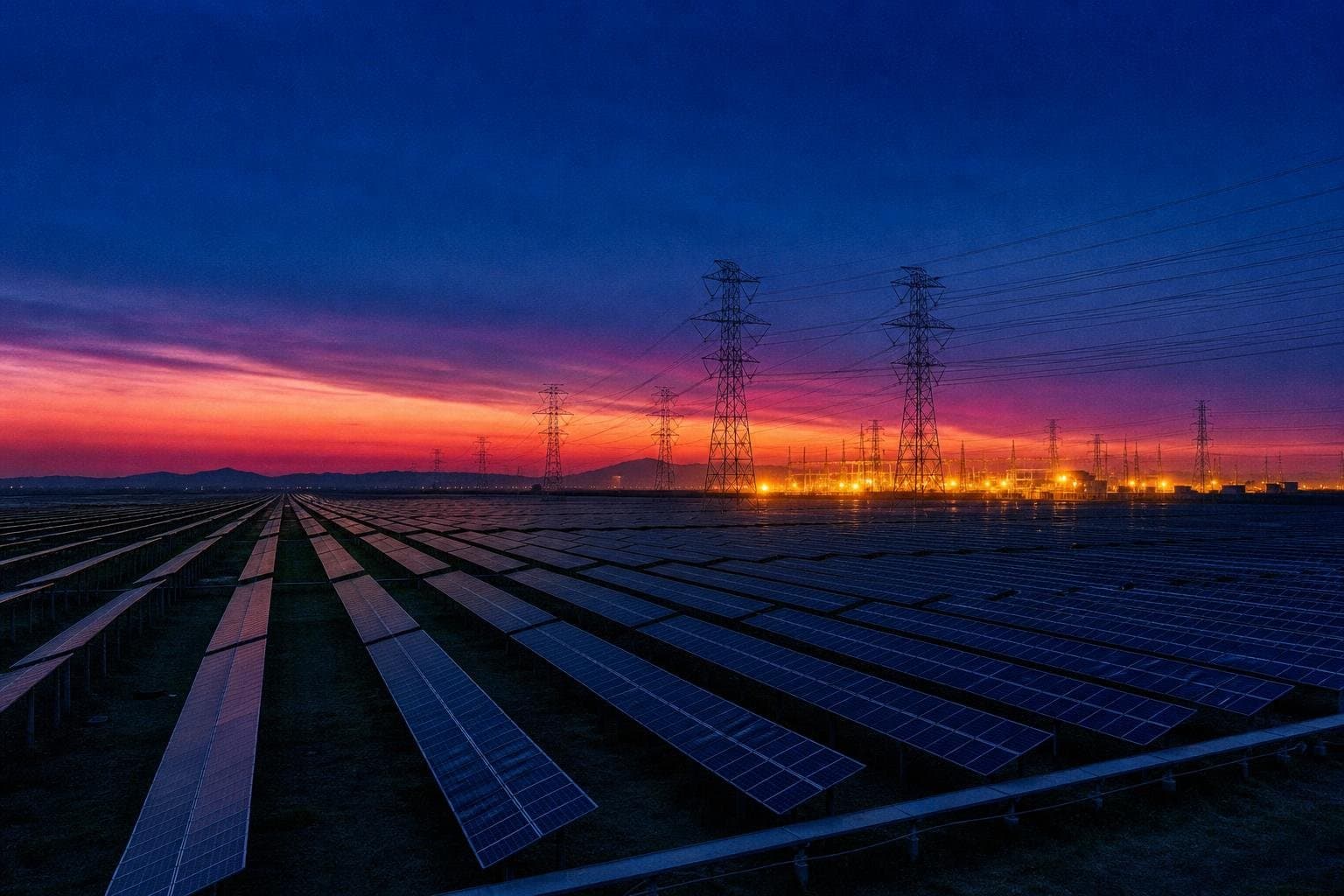
Here's where the paradox sharpens. The solar industry's Q1 2026 numbers are genuinely impressive. Solar alone accounted for 60% of all new electricity-generating capacity added in the first quarter of 2026. The SEIA projects a doubling of the U.S. solar fleet over the next five years. These are real electrons, real infrastructure, real progress.
But capacity and generation are not the same thing. A gigawatt of solar nameplate capacity produces electrons for roughly four to five hours per day at peak, and zero at night. A gigawatt of nuclear or natural gas produces electrons around the clock. When a data center signs a power purchase agreement, it needs the latter — guaranteed, dispatchable, always-on power — not a statistical average that works out over a month.
This distinction is not a critique of solar. It's a description of physics. And it's precisely why the grid interconnection queue has become the most important bottleneck in American energy infrastructure. FERC issued six "show cause" orders in June 2026 finding that major grid operators' rules for large load interconnections appeared to be inadequate, with the agency identifying five specific problem areas including cost allocation, co-location rules, and study processes for generating facilities serving large loads. FERC Chairman Laura Swett called it "historic action" — which is accurate, and also a tacit admission that the existing framework wasn't built for this demand profile.
The solar buildout is winning the capacity race. The grid governance and dispatchability challenge is a different race entirely, and we're losing it.
China's Green Power Problem Is Everyone's Green Power Problem
The most instructive case study in the demand-versus-capacity paradox is playing out in China right now, and it deserves more attention than it's getting in Western energy coverage.
China's authorities aim for renewables to supply four-fifths of the data center sector's total power consumption by 2030, up from just 11% in 2023. That's an extraordinary ambition. The problem, as industry experts told Reuters, is that AI data centers create demand profiles that are fundamentally mismatched with renewable supply characteristics. Data center peak power demand is hard to predict. AI inference workloads spike unpredictably. Grid operators are wary of taking on the added risk of matching intermittent supply to volatile demand.
Power demand from China's data centers is projected to rise by 300 billion to 500 billion kilowatt-hours between 2026 and 2030, accounting for 18% of total electricity demand growth over the period. The bottom of that range is roughly equivalent to the UK's entire annual power consumption. And the sector is described as a "poor" match for green suppliers — not because the politics are wrong, but because the load profile doesn't cooperate.
This is the global version of the same paradox. You can mandate renewable procurement targets. You cannot mandate that the sun shines when a GPU cluster decides to run a training job at 3 a.m. The mismatch between renewable generation profiles and AI load profiles is a technical reality that no policy document resolves by assertion.
The Chinese case also illustrates the geopolitical dimension. Southeast Asia's energy system, per the IEA's 2026 Outlook, is deeply exposed to Middle East supply disruptions — around 60% of the region's crude oil imports and a third of its gas imports were coming from the Middle East before recent disruptions. The regions racing hardest to build AI infrastructure are often the most exposed to fossil fuel supply volatility. That's not an argument for slowing the AI buildout — it's an argument for building the clean, dispatchable generation capacity that makes the AI buildout durable.
The Synthesis the Grid Actually Needs
So what does the abundance path actually look like, given these constraints?
The honest answer is that it requires holding two things simultaneously: aggressive renewable deployment and aggressive investment in dispatchable, firm capacity — nuclear, long-duration storage, and grid infrastructure that can actually move electrons from where they're generated to where they're consumed.
The SEIA data makes the renewable case clearly: solar and battery storage accounted for 91% of all new electricity-generating capacity added in Q1 2026, and the five-year outlook projects a doubling of the U.S. solar fleet. That buildout should continue at maximum speed. The manufacturing uncertainty around FEOC requirements and ongoing trade cases is a real constraint — the SEIA notes that solar manufacturing "remains gripped by uncertainty" — and resolving it faster would accelerate the timeline.
But the FERC interconnection orders signal something equally important: the grid's ability to absorb new capacity, both generation and load, is the binding constraint right now. FERC's show cause orders specifically flagged the need for new transmission services for flexible large loads and better study processes for generating facilities serving electrically proximate large loads. Translation: the regulatory framework for connecting AI data centers to the grid was designed for a different era, and FERC is now trying to retrofit it in real time.
Gartner's projection that data center electricity consumption could exceed 1,200 TWh by 2030 — more than double the 565 TWh projected for 2026 — means the grid has roughly four years to build the infrastructure that will determine whether the AI economy runs on clean electrons or defaults to whatever is available. That's not a long runway. The interconnection queue backlog, the transmission permitting timelines, and the nuclear construction schedules all operate on longer cycles than four years.
This is what I mean by the abundance paradox. We are not short on ambition, capital, or even renewable capacity additions. We are short on the dispatchable, always-on generation and the transmission infrastructure that converts intermittent capacity into reliable power. Record solar installations are necessary. They are not sufficient.
The Clock Is Running
Watch three specific developments in the next 90 days. First, how RTOs respond to FERC's show cause orders — the agency has signaled it will dictate solutions if grid operators fail to act, and the specificity of that threat is new. Second, whether the DOE's demand growth resource hub translates into concrete interconnection policy changes that shorten the queue for firm-power projects, not just renewables. Third, whether China's 2030 green power target for data centers survives contact with actual AI deployment timelines — if Beijing starts quietly relaxing the mandate, it will be a leading indicator of how hard this problem actually is.
The IEA's forecast of 3.6% average annual global electricity demand growth through 2030 is not a ceiling. It's a floor, built on conservative assumptions about AI deployment rates that have already been exceeded. Every quarter that the demand curve outpaces the grid buildout is a quarter where the civilization we're building runs on borrowed capacity.
Record renewable additions are what winning looks like in one dimension. The full picture requires dispatchable generation, transmission infrastructure, and grid governance that can actually handle what AI is doing to the load curve. We are building the future. We need to build it faster, and we need to build all of it — not just the parts that are easiest to announce.


