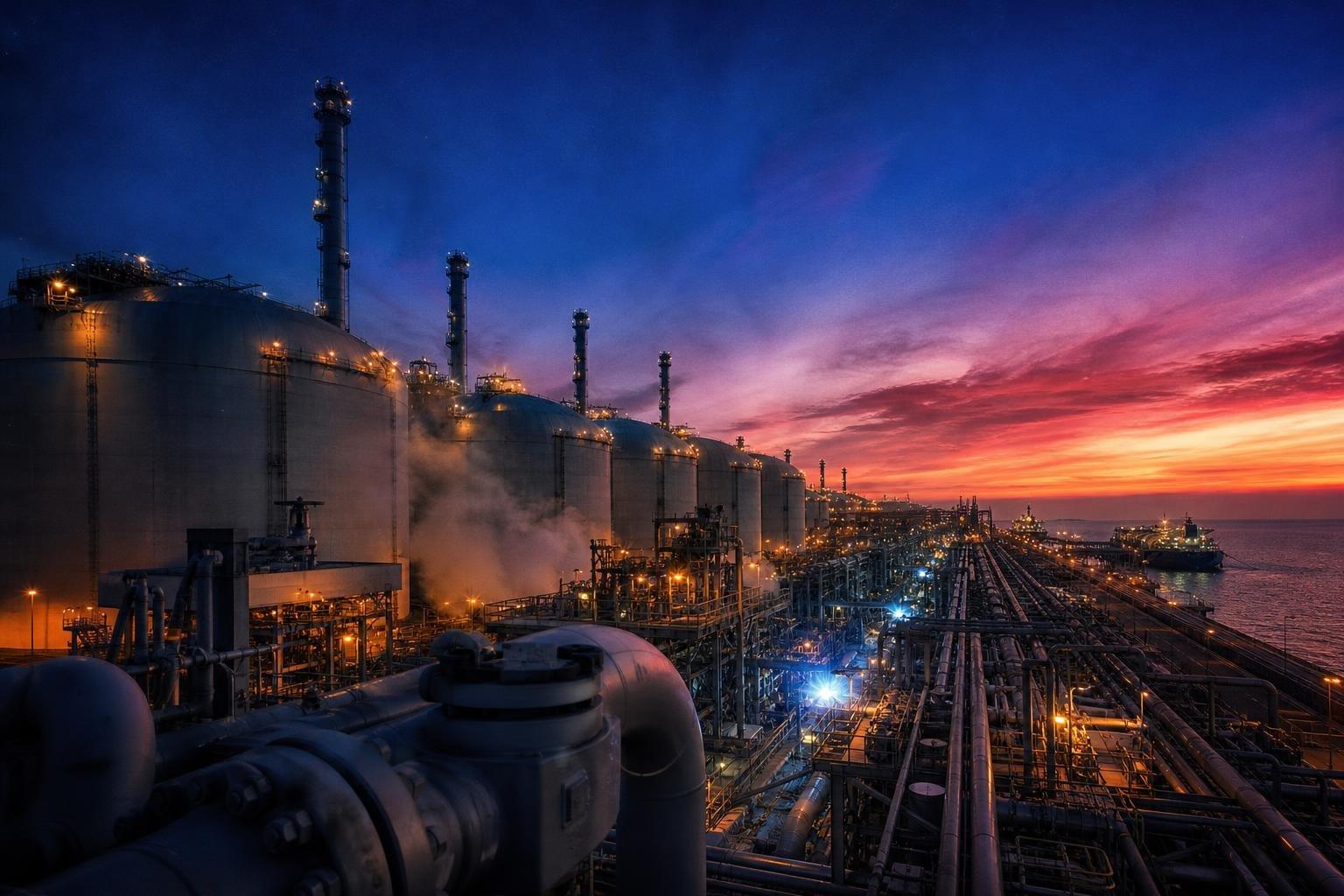

On November 7, American liquefaction terminals pulled a record 20.3 billion cubic feet of gas per day off the pipeline network to feed export ships — and held above 20 Bcf/d for three straight days (Energy News Beat). The same week, a cold snap moved into the central and eastern U.S., and December Henry Hub futures jumped nearly 13% in under two weeks to a seven-week high of $3.32 per MMBtu (Energy News Beat). Two demand sources — one domestic, one global — reaching for the same molecules at the same moment. That's not a coincidence. That's the new structure of the American gas market, and it's the structure every electricity trader, utility planner, and grid operator now has to live inside.
I've spent months in this newsletter tracking the hyperscaler-driven demand shock hitting the grid — PJM's capacity auctions, the transformer backlog, the SMR order book. But there's a second demand shock running in parallel, and it's easy to miss because it shows up in the gas market before it shows up in your electricity bill: the United States has built an LNG export machine so large that it now competes directly with its own power plants for fuel, on a nightly basis, in real time.
The Plumbing Problem Nobody Designed For
Expanded capacity at facilities including Plaquemines, which began commercial operations on its first liquefaction phase at the end of October, pushed feedgas demand to new highs just as heating season arrived (Energy News Beat). Year-to-date LNG exports are running more than 18% above 2025 levels. None of that capacity existed in a vacuum — it was built, financed, and permitted specifically because global buyers in Europe and Asia are willing to pay far more for the same cubic foot of gas than a U.S. utility is.
And they are paying a lot more. The IEA's Global Gas Security Review 2026, released November 3, put European benchmark prices at nearly $20 per MMBtu between March and October — roughly 70% above the prior year — with Asian spot LNG averaging $21.50, up nearly 80% (Oil & Gas 360). Compare that to the $3-and-change Henry Hub has been trading at domestically. That spread is the entire economic logic of the export boom in one sentence: American gas is cheap by global standards, which is exactly why the pipelines to the coast keep filling up.
The IEA's own framing in its World Energy Outlook 2026 is blunt about why this matters beyond gas traders. The Strait of Hormuz disruption has produced cumulative losses of 2.8 billion barrels of oil and 60 billion cubic meters of gas from the Gulf — the largest energy supply shock the agency has tracked, with impacts still unresolved as of November (IEA). Three-quarters of the world's population lives in oil- and gas-importing countries. When Gulf LNG volumes vanish, the slack gets pulled from wherever it's cheapest — and increasingly, that's the Gulf Coast of Texas and Louisiana.
Europe and Asia Are Already Bidding Against Each Other — and Now Against You
Europe is entering this winter with storage at its lowest level in more than a decade — 810 terawatt-hours as of November 11, roughly 20% below the ten-year seasonal average — and is pulling LNG cargoes away from Asia to close the gap (Reuters). European November imports are on track for 10.11 million metric tons, up from October but still short of what the continent took in a year earlier. Asian imports are falling as a direct consequence — down to an estimated 21.32 million tons for November from 22.81 million in October.
Layer onto that Vietnam, where LNG imports have roughly tripled since October 1 because El Niño-driven drought has gutted hydropower output and the country is burning gas to keep the lights on (Bloomberg) — 13 partial shipments received versus two a year ago. That's a national grid pivoting from hydro to imported methane in real time because the weather didn't cooperate, and it's bidding into the same global cargo pool as Europe.
Canada is racing to add its own supply to the mix: Ottawa just put C$200 million into the Woodfibre LNG terminal near Squamish, British Columbia, now about 75% complete and slated to start operations next year, explicitly framed by Prime Minister Mark Carney's government as diversifying exports away from the U.S. (Bloomberg). More liquefaction capacity coming online globally should, in theory, ease the squeeze. The IEA's own numbers suggest otherwise in the near term — it estimates cumulative global LNG supply losses of roughly 150 billion cubic meters between 2026 and 2030 from Gulf disruptions and infrastructure damage, even as non-Gulf production rose about 14% between March and October (Oil & Gas 360). New supply is arriving. It's arriving into a hole that's getting dug faster than it's being filled.
What This Actually Means for the Grid — and What It Doesn't
Here's where I want to be precise, because this is exactly the kind of claim that destroys credibility when overstated. The IEA and EIA data make clear that U.S. feedgas exports are hitting records and that global gas prices have spiked hard. What the sources in front of me do not establish is a specific, measured rise in U.S. retail or wholesale electricity prices directly attributable to LNG diversion this winter — and I won't manufacture that number.
What I can say with confidence, because the EIA's own Electricity Monthly Update shows it directly: natural gas is the fuel doing the heavy lifting on the American grid right now. Net generation rose 6.8% year-over-year in August 2026, and every region of the country saw gas generation increase compared to August 2025, with Texas the lone exception (EIA). That's the structural vulnerability in one data point: the fuel source powering most of the country's marginal generation growth is the same fuel source whose export price just became a function of fighting in the Strait of Hormuz and a drought in Vietnam.
And confusingly, the EIA's own Short-Term Energy Outlook, released November 10 — one day before the price rally started — cut its winter Henry Hub forecast by 16%, to $2.87 per MMBtu, on the logic that production growth would outpace exports and demand (Energy News Beat). The forecast and the futures market diverged within days. That's not EIA being wrong so much as it's a reminder that short-term weather and geopolitics move faster than any monthly model, and that methodology matters: EIA's domestic supply-demand balance says "loose," while the IEA's global security review says "tight into 2027." Both can be true simultaneously if you're looking at different markets with different time horizons — domestic production growth versus a globally fragmented, Hormuz-constrained LNG trade.
The Real Fix Isn't Less Export. It's More Everything.
The instinct from a conservation mindset is obvious: stop exporting so much gas, protect the domestic power fleet, insulate consumers from the global price. That's the wrong lesson. The right lesson is that any civilization whose electricity system depends on a single fungible fuel that a dozen other countries are also bidding for is a civilization with a brittle grid, full stop — regardless of whether the export terminal is in Louisiana or the drought is in Vietnam.
The fix isn't retreating from LNG exports, which are generating real economic value and strategic leverage — witness the Trump administration openly discussing a Philippine nuclear partnership and Alaska LNG cooperation in the same week as this gas rally. The fix is building enough nuclear, enough transmission, enough storage, and enough firm generation diversity that American electricity stops being a price-taker on a global commodity market every time a hydropower reservoir in Southeast Asia runs dry or a tanker gets turned back from Hormuz. Every gigawatt of reactor capacity, every battery array that smooths a winter peak, is a gigawatt that doesn't have to compete with Vietnam's drought or Europe's depleted storage caverns for its fuel.
Watch two things over the next month: the EIA's next Electricity Monthly Update on November 24, which will show whether gas's generation share kept climbing through the cold snap, and whether Europe's storage trajectory — now tracking toward a possible sub-10% floor by March, per the IEA — forces another round of cargo diversions that tighten the domestic market further. The molecules are global now. The only question is whether America's grid keeps betting its reliability on winning that auction every single winter, or starts building its way out of needing to.


