
The assigned topic — grid frequency instability driven by AI data centers — is a real engineering concern. But the sources in front of me tell a more specific, more damning story: the instability showing up right now isn't measured in hertz. It's measured in dollars. And the number is $6 billion.
That's what transmission congestion cost PJM ratepayers in just the first half of 2026 — a 43% surge from $2.1 billion in the same period a year earlier, according to Monitoring Analytics, PJM's independent market monitor. The single biggest driver: overloads on high-voltage transmission lines during stress events. The hardest-hit congestion zone: northern Virginia, home to the largest concentration of data centers on the planet.
This is what demand instability actually looks like at grid scale. Not a frequency event. A financial hemorrhage that lands on 67 million people's electricity bills.
The Transmission Lines Are Already Screaming
Here's the number that should be on every infrastructure investor's whiteboard: during the first half of 2026, the number of five-minute periods in which PJM's 500-kilovolt transmission lines hit or exceeded operating limits surged to 8,920 — up from 1,865 in the same period a year earlier. Nearly a fivefold increase in high-voltage line violations. In six months.
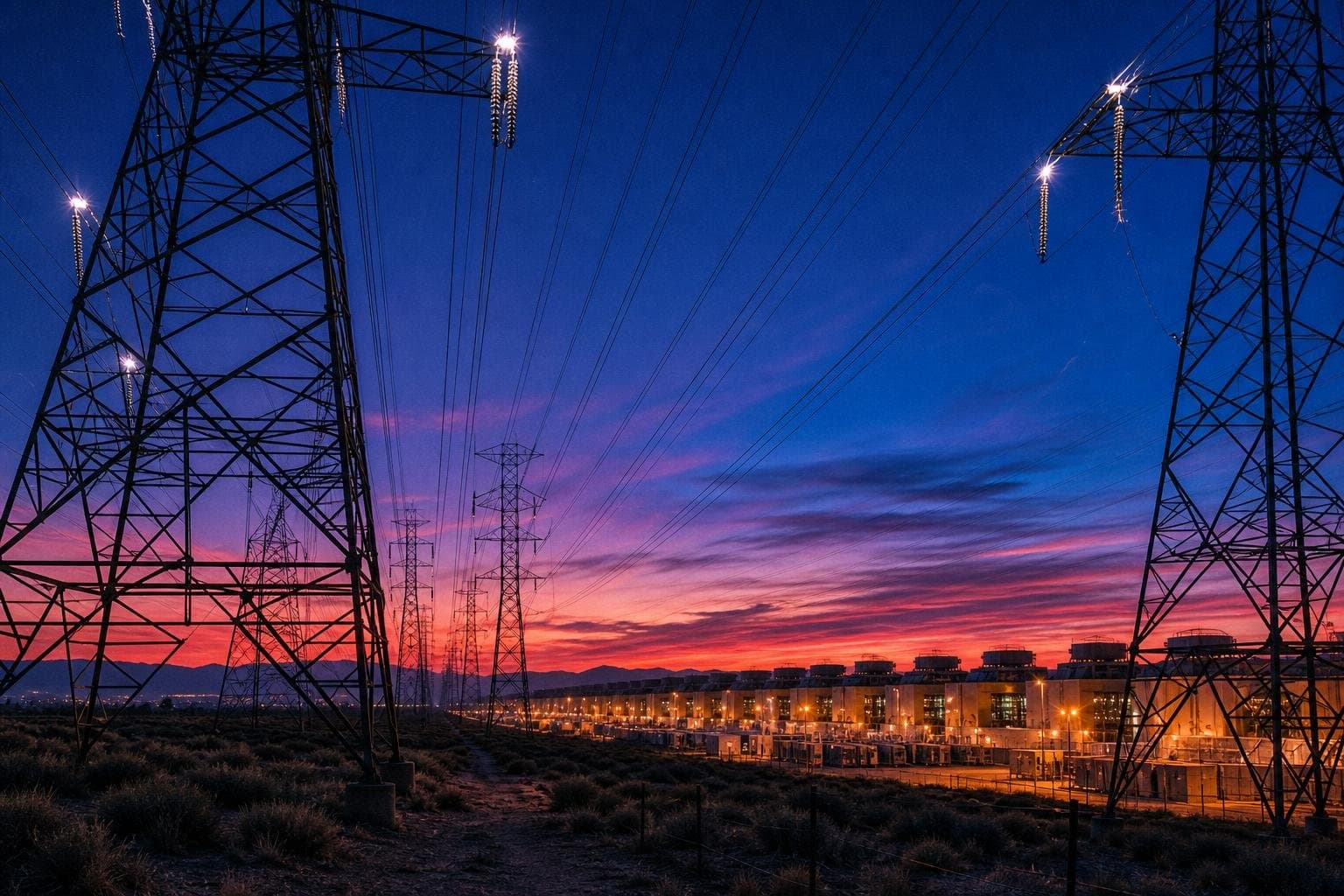
The market monitor attributes a significant share of this to the structural mismatch between where power is generated and where AI compute is consuming it. Northern Virginia's Data Center Alley is a geographic chokepoint — a massive, concentrated demand node at the end of transmission lines that weren't designed for this load profile. When a winter storm hits and demand spikes, the lines don't just get stressed. They blow through operating limits thousands of times.
PJM's real-time wholesale cost to serve electricity demand was $29.4 billion in the first half of 2026, compared to $20.4 billion in the first half of 2025. The $3.9 billion year-over-year increase in transmission constraint costs alone eclipsed the $2 billion increase in natural gas fuel costs. Let that sink in: the grid's physical bottlenecks are now a bigger cost driver than fuel.
PJM Blinks — and Files the Most Consequential Grid Rule in Years
The grid operator isn't pretending this is sustainable. PJM Board Chair Paula Conboy put it plainly in a recent letter to stakeholders: "The present trajectory of rapid load growth, tightening supply and rising capacity costs is not sustainable."
The response: PJM filed with FERC on July 31 to establish a new curtailment hierarchy under what it calls the Interim Resource Adequacy Service. Any new customer drawing 50 MW or more at a single site — read: hyperscale AI data centers — goes to the back of the line during capacity shortages, behind households and existing demand-response customers. The rule takes effect June 1, 2027 for new large loads that don't bring their own generation or secure supply.
The capacity price signal tells you everything about how bad the supply-demand math has gotten. The PJM capacity market cleared at roughly $28.92/MW-day for the 2024/25 delivery year. By the 2026/27 delivery year, that figure had reached approximately $329.17/MW-day — roughly an 11-fold increase in two years. PJM is also seeking new resources for a 6,831 MW shortfall in the 2028/2029 delivery year, with contracts up to 15 years and a maximum willingness to pay of $555/MW-day.
This is the future arriving ahead of schedule, and the grid's answer is rationing.
The IEA Already Told Us This Was Coming
None of this should be surprising to anyone who read the IEA's Electricity 2026 report. Global electricity demand is forecast to grow at an average annual rate of 3.6% through 2030, driven by data centers, EVs, industrial electrification, and air conditioning. Advanced economies — after 15 years of stagnation — are accelerating again. The IEA frames this as the "Age of Electricity." What PJM's congestion data shows is that the Age of Electricity has a transmission infrastructure problem that no amount of demand forecasting resolves on its own.
The supply-side response is real. Wood Mackenzie projects the U.S. data-center electrical equipment market to double to $66 billion by 2030. Generac alone is spending $250 million to expand factory capacity for data-center generators, with a $1.6 billion order backlog already in hand. The build-out is happening. But generators behind the meter and new transformers don't fix the transmission chokepoints that are already failing under load.
The Bottleneck Is Physical, and the Clock Is Running
I've written before about curtailment as a civilizational problem and about PJM's threat to cut data centers off the grid. What the August congestion data confirms is that the threat has moved from hypothetical to operational. The 500-kV line violations aren't a warning signal — they're a current condition, measured in five-minute intervals, happening thousands of times per half-year.
The electricity maximalist case for AI is airtight: more compute, more intelligence, more civilizational capacity. But that case requires the wires to actually carry the electrons. Right now, they can't — not reliably, not cheaply, and not at the scale the next five years demand.
Watch for FERC's response to PJM's IRAS filing before the June 2027 implementation date, and watch whether the 2028/2029 capacity shortfall procurement actually


