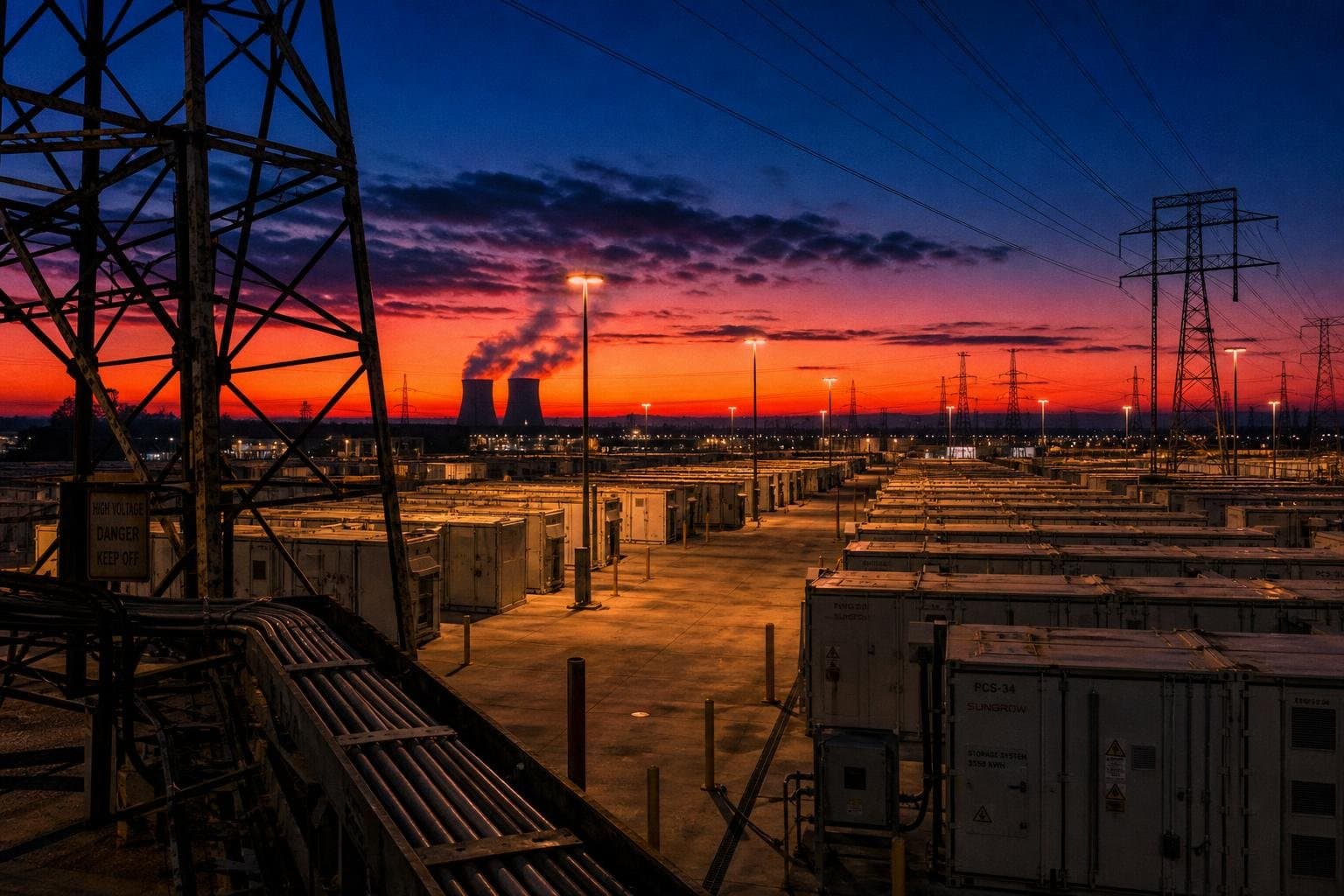

Everyone's watching the nuclear headlines. Last week it was Washington offering Constellation $5 billion to upgrade reactors for Google. But quietly, on October 31, PJM Interconnection approved two ENGIE battery storage projects — 860 megawatts in Crawford, Pennsylvania, and 800 megawatts in Morrow, Ohio — under a brand-new Expedited Interconnection Track, the fastest path PJM has ever offered a large resource to the grid (Energies Media). That's 1,660 MW, combined, slated for mid-2029. Two of the first three projects accepted under that new track are storage, not generation. If you want to know where PJM thinks the next decade of flexibility has to come from, that ratio tells you.
This is what energy abundance actually looks like on the ground: not a press release promising gigawatts someday, but a regulatory process rebuilt specifically because the old one couldn't move fast enough for the loads already showing up.
The Bottleneck Was Never "Not Enough Power." It Was "Not Enough Fast Power."
PJM built the Expedited Interconnection Track because its standard queue has been choking on backlog while data center demand climbs (Energies Media). That demand is not theoretical. PJM — which serves more than 67 million people across 13 states and D.C. — just filed a revised plan with FERC for a special March capacity auction aimed squarely at data-center load, after regulators called the grid operator's original proposal "deeply flawed" and bounced it back for a five-month delay (Bloomberg). Batteries are the resource that can thread that needle: fast to site relative to new thermal generation, able to shift output to whichever hour the grid is screaming for it.
Out west, California's grid operator just approved its own version of the same instinct. CAISO's board signed off on a Flexible Interim Load Interconnection framework on October 28, letting large loads — data centers, factories, 50 MW and up — connect to the transmission system before all the associated network upgrades are finished, accepting enforceable flexibility in the meantime (mgrid.org; Reuters). California's own planners project data center load hitting 1.8 gigawatts by 2030 and 4.7 gigawatts by 2035 (mgrid.org). CAISO must file that tariff language with FERC by November 16 — worth watching, because it's the template five other regions are being measured against under FERC's June show-cause order.
Batteries Are Becoming the Default Attachment to New Solar, Not an Add-On
The structural case for storage gets even sharper when you look at what's actually being built. The EIA reports that 16% of new utility-scale solar capacity added so far this year came co-located with battery storage, up from just 2% in 2017 — and operator plans put that share above 30% for projects slated for 2027 and 2028 (mgrid.org). In the Southwest — California, Arizona, New Mexico, Nevada — the co-location rate runs more than double the national average. The logic is simple arbitrage: hold midday solar output when wholesale prices are depressed by abundant sun, release it when prices climb in the evening ramp. That's not a subsidy story. That's batteries making solar a dispatchable asset instead of a weather-dependent one.
I'll flag the honest caveat here, because overclaiming kills trust faster than underclaiming: the EIA analysis tracks the share of solar capacity paired with storage, not the megawatts of storage itself or how long those batteries can discharge. A battery rated at 4-hour duration and one rated at 1-hour duration both count the same in that percentage. Separately, an analysis of EIA's Electric Power Monthly data by the SUN DAY Campaign notes renewable generation growth actually peaked at mid-year and eased by August — a reminder that capacity additions and delivered electricity are not the same curve, and installed megawatts of solar or wind run at full output only a fraction of the time compared with nuclear, gas, or coal (energynews.pro).
What Actually Moves the Needle From Here
None of this is abundance yet — it's the plumbing abundance will eventually run through. ENGIE's 1,660 MW won't deliver a watt until mid-2029. CAISO's framework doesn't become real until FERC rules on the November 16 filing. PJM's March auction depends on FERC approving the revised cost-allocation rules first. Real-world load data out of ERCOT already shows the gap between announced capacity and what sites actually draw — Abilene's data center cluster, for instance, is modeled at 1.2 gigawatts but has only peaked at 588 megawatts so far (Enverus). Watch that same announced-versus-operating gap close, or fail to, as PJM's expedited batteries and CAISO's flexible loads move from board approvals to steel in the ground. That's the metric that separates a civilization building its grid for what's coming from one still arguing about the paperwork.


