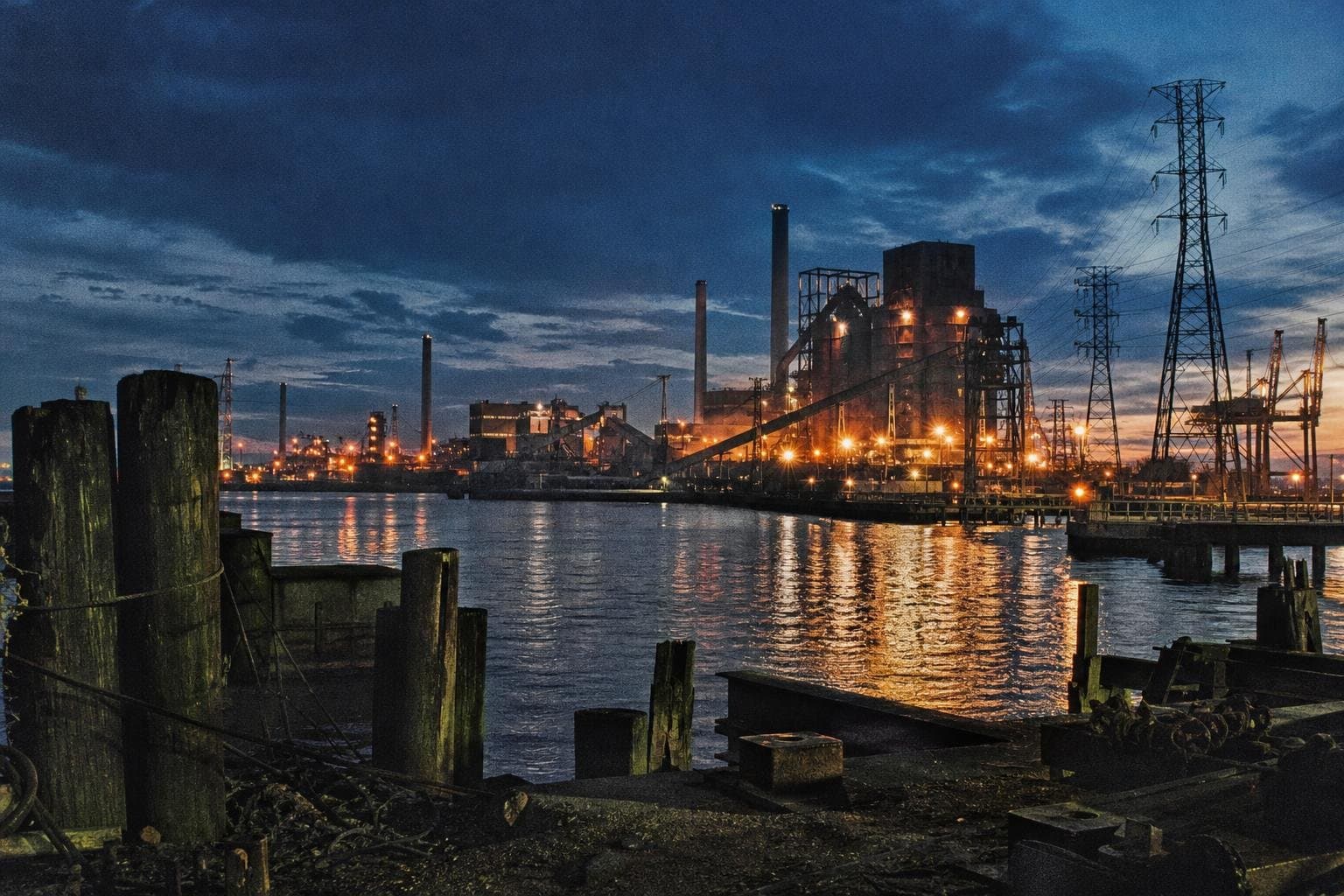

Anduril is about to build submarine components on the exact Maryland waterfront where US Wind once planned to fabricate turbine monopiles. That handoff, confirmed this week, is as clean a symbol as you'll find for where industrial capital is actually flowing in 2026 — and it isn't toward floating steel in the ocean.
Sparrows Point Just Changed Hands, and the Symbolism Is Brutal
US Wind has relinquished its lease at Tradepoint Atlantic's Sparrows Point site, where it had planned a steel fabrication plant with Spanish manufacturer Haizea Wind Group to supply its Maryland Offshore Wind Project, according to Offshore Wind. The site goes to Anduril Industries, which plans to invest $3.7 billion in a new submarine-component facility there, backed by a US Navy contract worth up to $2.9 billion, per the same reporting. The Department of Transportation had already pulled $47.4 million in federal funding for the marshalling port project as part of a broader rollback of offshore wind port support. US Wind's own CEO said the company's plans have been delayed by "legal disputes and uncertainty created by federal agencies" and that the firm is now redirecting its energy toward supporting Anduril instead.
Read that sentence again. A wind developer is now helping a defense contractor build submarines on the land it meant to use for turbine parts. That's not a pivot. That's a surrender dressed up as a partnership.
The Retreat Isn't Just American
Scotland's floating wind sector is going through its own reckoning. Industry insiders expect several flagship ScotWind leases to be handed back to Crown Estate Scotland through attrition, with backers now trying to concentrate support behind just four of the original crop of projects, according to the Scotsman. Of roughly 30 potential floating sites earmarked for Scottish waters, only a single 3GW project is actually under construction, and just three have obtained planning consent. Concerns raised with the paper include the UK government potentially favoring small modular nuclear cost curves over floating wind's.
Japan went through this first. After leading consortia withdrew from Round 1 of its offshore wind tenders — capex estimates in some cases more than doubled from initial projections — the government rolled out seven structural reforms aimed at propping up Rounds 2 and 3, per DeepWind's policy analysis. Three governments, three continents, the same story: promised gigawatts colliding with the physics of steel, vessels, and interest rates.
The Numbers Explain Why
Offshore wind's long-term cost trajectory is genuinely remarkable — global weighted-average LCOE fell 62% from $208/MWh in 2010 to $79/MWh in 2024, according to IRENA data cited by GreentechLead. But that curve bent upward again in 2024, with LCOE rising 4% as inflation and supply-chain pressure ate into efficiency gains. The regional spread is the real story: roughly $56/MWh in China versus more than $123/MWh in the United States. A representative 1 GW fixed-bottom project now runs about $5.44 billion in capex; floating projects run closer to $7.35 billion per GW, about 35% higher. A 10% capex overrun on a project that size adds $544 million — money that has to come from somewhere, usually debt, usually at today's rates.
This is what electricity maximalism runs into when it gets sloppy about which technology it's betting on. Floating wind is a legitimately audacious idea — deepwater turbines opening up ocean nobody else can touch. But audacity without a financeable cost curve is just an announcement. The capital discipline that killed Sparrows Point's steel plant is the same discipline rewarding nuclear uprates right now: Alphabet just signed a 20-year power-purchase agreement with Constellation Energy that will drive more than $4.3 billion into upgrading 11 reactors across the PJM grid, with new power arriving as soon as 2028, per Bloomberg. That's 890 megawatts of incremental capacity bolted onto plants that already exist, already have interconnection, already have a workforce. No monopile factory required.
The Grid Doesn't Care About Your Technology Preference, Only Your Delivery Date
PJM is staring at a 6.8 GW capacity shortfall for the 2028/29 delivery year, driven largely by data center load growth, and the fight over who pays for that backstop procurement is now live at FERC, with PJM required to refile its cost allocation by October 29, according to this regulatory tracker. Nothing about that deadline waits for floating steel to get cheaper. Capital is voting with its feet, and this week it voted for submarines and reactor uprates over turbine blades bobbing in deep water. Offshore wind isn't dead as an idea — it's dead as a 2026 near-term answer to the gigawatts the grid needs delivered on a schedule measured in months, not decades.


