


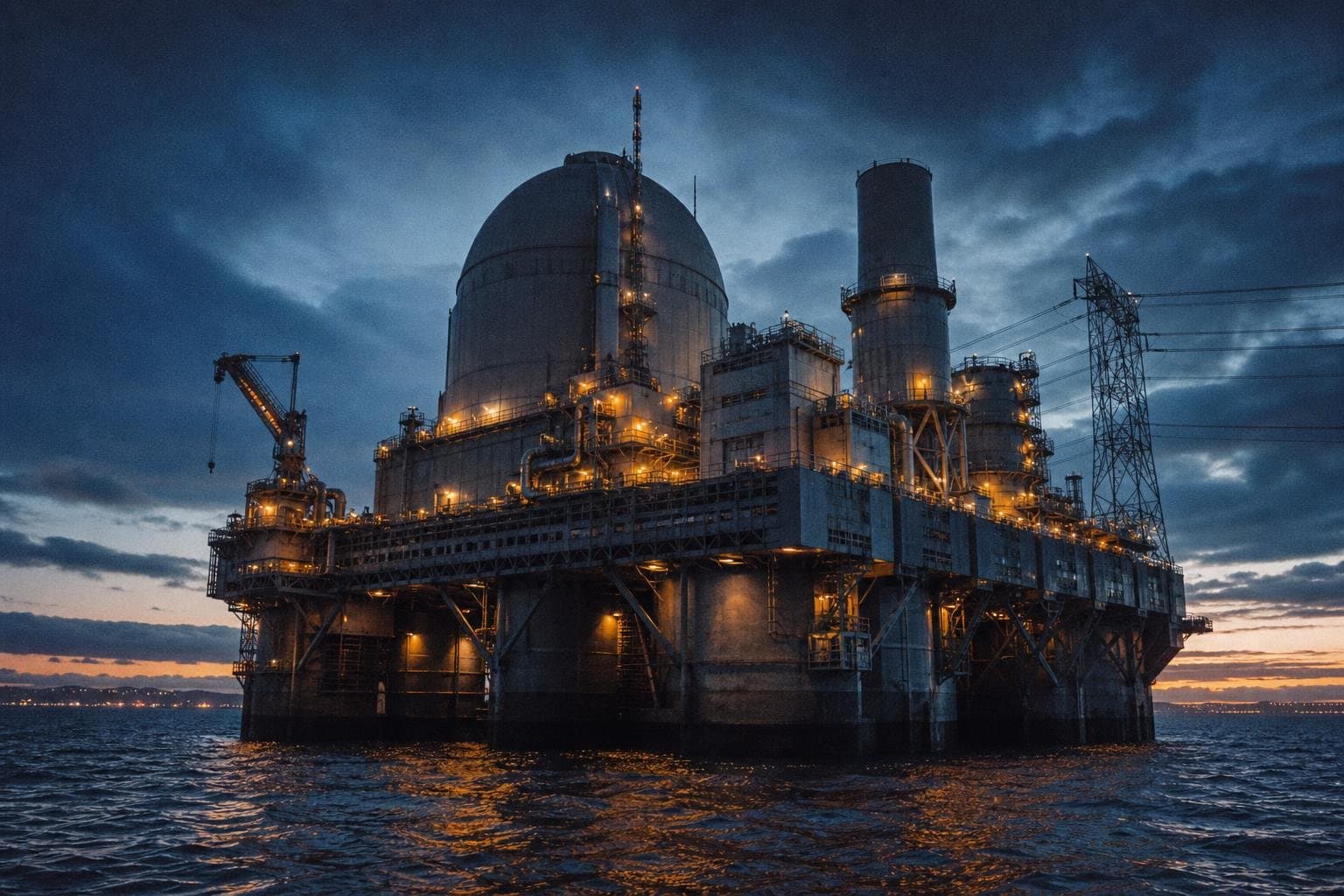

The Trump administration just announced that the Interior Department's Marine Minerals Administration and the Nuclear Regulatory Commission have signed a coordination agreement to evaluate nuclear power projects in federal waters — all 3.2 billion acres of the U.S. Outer Continental Shelf. No commercial projects are planned. No sites are selected. This is a framework for responding to industry requests, not a construction permit.
Say that clearly, because the temptation to overread this is enormous. What actually happened is two agencies agreed to talk to each other. What it signals, though, is genuinely significant.
The Demand Pressure Behind the Announcement
The administration's stated rationale is direct: Trump wants to quadruple U.S. nuclear capacity by 2050 to meet electricity demand driven by data center expansion. That target is civilizationally serious. The IEA's Electricity 2026 forecast projects global electricity demand growing at 3.6% annually through 2030 — and for the first time in three decades, electricity consumption is outpacing overall economic growth. The demand curve is real. The pressure to find new generation sites is real.
Offshore nuclear addresses a constraint that land-based SMRs can't fully solve: geography. Coastal load centers — the dense metro areas that consume the most power — sit next to federal waters, not federal land. A reactor platform anchored offshore bypasses the transmission queue problem, the permitting fights over terrestrial sites, and the NIMBY friction that has strangled onshore nuclear for a generation. Naval reactors have operated in marine environments for decades, as MMA Acting Director Matt Giacona noted in the announcement — the engineering precedent exists even if the commercial regulatory pathway does not.
The honest accounting: this is early-stage policy exploration, not a buildout. The IEA's data center electricity consumption tracking shows demand from that sector has grown sharply since 2015 and shows no sign of plateauing. The grid needs answers at scale. Offshore nuclear is one of the few concepts that could deliver gigawatt-class baseload power to coastal demand centers without fighting the interconnection queue.
Watch for whether any commercial operator — NuScale, X-energy, Kairos — files an inquiry with MMA in the next 12 months. That's the signal that this moves from policy gesture to actual pipeline. Until