
This Week in Voltage
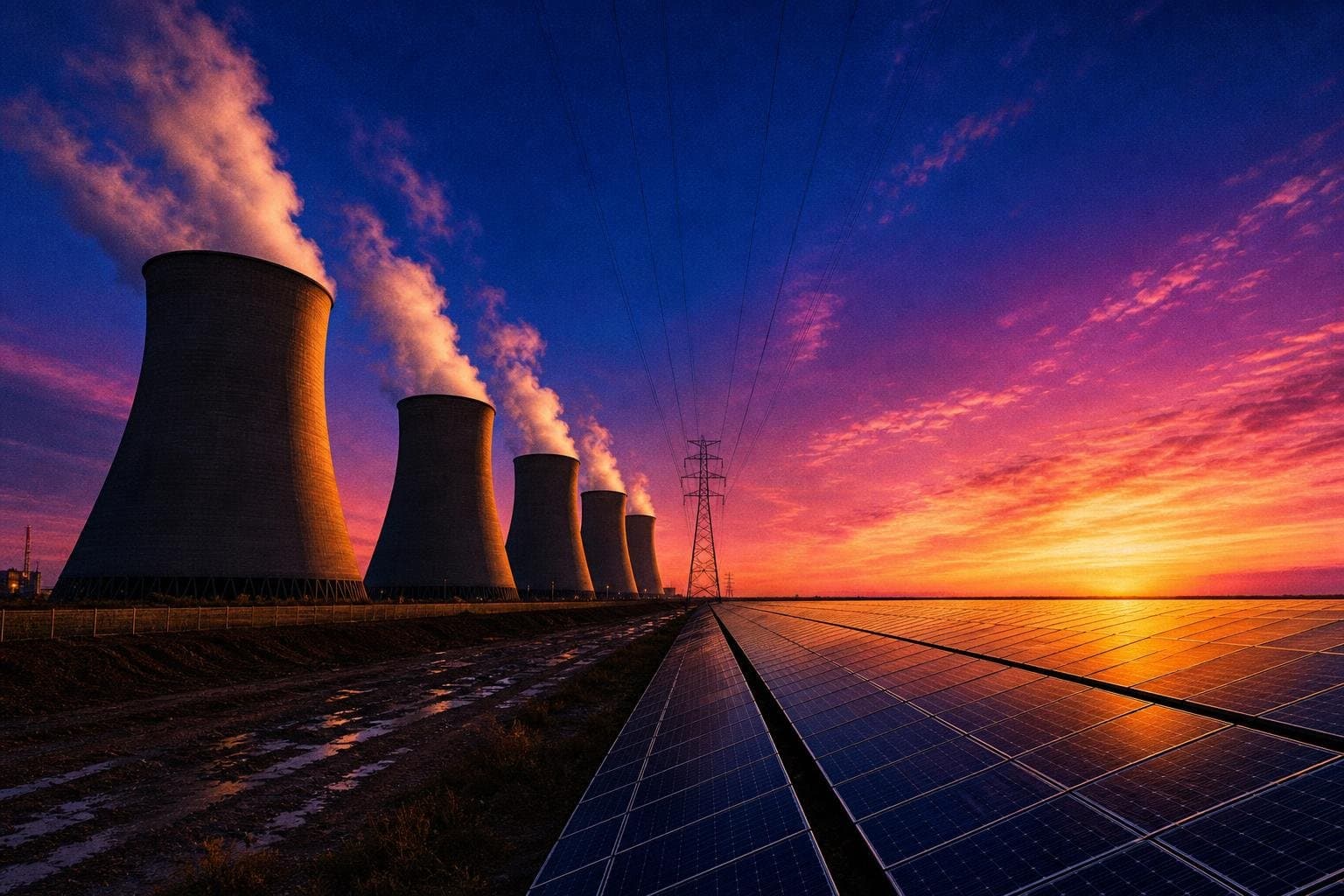
The old debate was framed as a cage match: nuclear versus renewables, baseload versus intermittency, atoms versus photons. That framing was always wrong, but now we have the data to prove it. France's nuclear fleet spent 2025 actively modulating output around European solar peaks. A new study out of Nature Communications shows nuclear-hydrogen coupling can flip reactor economics from deeply negative to solidly positive. And the IEA is forecasting electricity demand growth of 3.6% annually through 2030 — a pace 50% higher than the previous decade's average. The grid doesn't need a winner in the nuclear-versus-renewables fight. It needs both, working in tandem. The synthesis is already happening. The question is whether we're building it fast enough.
The Intermittency Problem Was Always About System Design, Not Technology Failure
Wind and solar get pilloried for intermittency as if the sun not shining at midnight is some kind of engineering scandal. It isn't. The actual problem is that grid operators historically designed around dispatchable generation — plants that run when you tell them to — and intermittent sources require a different system architecture. That architecture is now being built.
The DOE's Wind Energy Technologies Office has been explicit about this for years: wind variability adds uncertainty beyond normal load variation, but that uncertainty is manageable through integration studies, modeling, and grid services development. The office's renewable systems integration work focuses precisely on enabling wind (and by extension solar) to provide frequency and voltage support — the grid services that historically only dispatchable plants could deliver.
What's changed in the past few years is that the cost curves have moved far enough to make the system-design solution economically viable. According to Canary Media's coverage of an IRENA report, grouping wind, solar, and batteries together can already compete with the cost of building new coal or gas plants in prime locations. Onshore wind and fixed-axis solar tied for the lowest levelized cost of energy globally — around $40 per megawatt-hour — compared with roughly $100 per megawatt-hour for new combined-cycle gas. The gap between "cheap intermittent generation" and "firm 24/7 power" is closing as battery costs fall and hybrid project designs mature.
But here's the civilizational point that gets lost in the LCOE debates: even if wind-solar-battery hybrids can deliver firm power in the sunniest and windiest locations, they can't do it everywhere, and they can't do it at the scale the IEA is projecting without a dispatchable backbone. That backbone is nuclear. Not as a competitor to renewables. As their complement.
France Just Ran the Experiment — and the Results Are Unambiguous
The most compelling real-world evidence for the nuclear-renewable synthesis isn't a model or a projection. It's France, right now, operating in real time.
For most of the past four decades, French nuclear was Europe's baseload backbone — reactors running flat through the day, only reducing output at night when domestic demand dropped. That pattern has fundamentally changed. According to hourly data from the ENTSO-E Transparency Platform, analyzed by pv magazine, the average swing between midday and evening nuclear output across the April-to-September window grew from 582 MW in 2019 to 4,426 MW in 2025. That is close to an order of magnitude in six years.
Nuclear modulation in France — reactors operating below maximum capacity — reached 33 TWh in 2025, more than double the 15 TWh recorded in 2019. The fleet used to bend at night, triggered by lower domestic load. It now bends at midday and in the afternoon, triggered by high levels of European solar generation. The price signal confirms it: what used to be a midday plateau in French wholesale prices is now a midday trough, as solar floods the market and nuclear steps back.
France was a net exporter in 98.5% of hours in 2025. The system isn't breaking down under the pressure of solar intermittency — it's adapting. Nuclear is providing the flexible backbone that lets solar run at full output during peak generation hours, while standing ready to ramp back up when the sun drops. This is the synthesis in action: not nuclear instead of solar, but nuclear enabling solar to be fully utilized.
The diurnal price shape Europe had been forecasting for the late 2020s has already arrived in France. The rest of the continent is watching a live demonstration of what a high-penetration renewable grid with a nuclear backbone actually looks like. It looks like abundance.
Nuclear-Hydrogen Coupling: The Economic Unlock Nobody's Talking About Enough
The France story solves the daytime intermittency problem elegantly. But there's a harder version of the intermittency challenge: multi-day and seasonal variation, where batteries aren't sufficient and the grid needs something that can store energy across weeks, not hours. This is where nuclear-hydrogen integration becomes genuinely transformative.
A June 2026 study published in Nature Communications modeled the economics of retrofitting existing U.S. nuclear reactors with high-temperature electrolysis for hydrogen production. The findings are striking. Without policy support, retrofitting increases average net present value from approximately -$1.06 billion to approximately $240 million — a swing of over $1.3 billion per reactor. The mechanism is elegant: when renewable generation is abundant and electricity prices are low, the reactor diverts output to hydrogen production instead of selling into a depressed market. When renewable generation drops and electricity prices rise, the reactor returns to full power generation. The hydrogen produced during low-price periods can be sold as an industrial feedstock or stored for later use.
The study also found that this coupling expands flexible output by more than 115 MW for most reactors — meaningful additional dispatchability from existing assets. This isn't a theoretical future technology. High-temperature electrolysis is commercially available. The policy question is whether the incentive structures exist to make the economics work without subsidy, and the study suggests that with optimized market participation and cost reductions, they can.
This matters for the civilizational argument because it reframes nuclear's role entirely. Nuclear isn't just a baseload plant that happens to coexist with renewables. It's a flexible, multi-product energy system that can produce electricity, hydrogen, and industrial heat — shifting between products based on real-time grid conditions. A comprehensive review in Annals of Nuclear Energy published in May 2026 maps out the full architecture of nuclear-renewable hybrid energy systems, including loosely coupled, tightly coupled, and thermally coupled configurations, each optimizing energy flow for different applications: electricity, hydrogen synthesis, desalination, and industrial processes. The paper's core finding is that NRHES can improve grid stability, decrease carbon emissions, and improve economic viability simultaneously — the trifecta that standalone systems struggle to achieve.
The Hardware Is Already Being Designed for Synthesis
The theoretical case for nuclear-renewable complementarity is solid. The operational evidence from France is compelling. The economic modeling from the hydrogen integration studies is encouraging. But the most bullish signal is that the private sector is now designing hardware explicitly for the synthesis.
Blue Energy and GE Vernova have unveiled a proposed 2.5 GW hybrid facility in Texas that combines GE Vernova Hitachi Nuclear Energy's BWRX-300 small modular reactor with gas turbine generation in a single plant. The design philosophy is explicit: pair nuclear's strong baseload output with the rapid-response flexibility of gas turbines, while the nuclear component is under construction. The companies estimate their "Integrated Monopile System" approach — adapting offshore wind turbine foundation technology as reactor containment structures — could reduce construction time by as much as 93% compared with conventional nuclear builds. That claim is announced, not yet demonstrated at scale, and should be tracked against actual construction timelines. But the design intent is clear: build for a grid that needs both firm power and rapid dispatchability.
This is the hardware expression of the synthesis thesis. The industry isn't waiting for policy to mandate hybrid systems. It's designing them because the grid economics demand it.
Meanwhile, the IEA's Energy Technology Perspectives 2026 documents that the combined global market value for clean energy technologies has grown 20% annually over the past decade, reaching nearly $1.2 trillion in 2025. Even in the most conservative scenario modeled, that market value doubles to around $2 trillion by 2035. The capital is flowing. The question is whether it flows into integrated systems that solve the 24/7 problem, or into siloed deployments that leave intermittency unaddressed.
The Synthesis Is the Civilization-Scale Bet
Here's the through-line: the IEA projects global electricity demand growing at 3.6% annually through 2030, with data centers, EVs, industrial electrification, and air conditioning all pulling simultaneously. That's not a grid that can be served by any single technology. Wind and solar will provide the bulk of new generation capacity because their costs are lowest and their deployment speed is fastest. But a grid running at 60%, 70%, 80% renewable penetration needs a dispatchable backbone that can modulate around solar peaks, fill multi-day wind droughts, and provide the inertia and frequency response that keeps the system stable.
Nuclear is the only low-carbon technology that can do all of that at scale. Not because it's perfect — it's slow to build, capital-intensive, and politically fraught — but because nothing else combines firm dispatchable output with zero-carbon operation and the potential for hydrogen co-production. The France data shows nuclear fleets can already modulate around solar at meaningful scale. The Nature Communications study shows the economics of nuclear-hydrogen coupling can work. The BWRX-300 hybrid design shows the industry is building for synthesis, not competition.
The civilizational bet isn't nuclear or renewables. It's the grid architecture that lets both run at maximum output, with each covering the other's weaknesses. China is accelerating its green energy buildout with exactly this logic — solar and wind for volume, nuclear for firm power, the combination driving toward energy self-sufficiency. The countries that figure out the synthesis fastest will have the cheapest, most reliable, most abundant electricity on the planet.
Watch the BWRX-300 permitting timeline in Texas, the first operational results from nuclear-hydrogen pilot projects, and whether FERC's interconnection queue reforms — which the commission has been wrestling with all year — actually accelerate hybrid project approvals. Those three data points will tell you whether the synthesis is moving at civilization speed or bureaucratic speed. The physics is solved. The engineering is advancing. The bottleneck, as always, is governance.
The future is electric. The path there runs through both the reactor and the solar array — and the grid smart enough to use them together.


