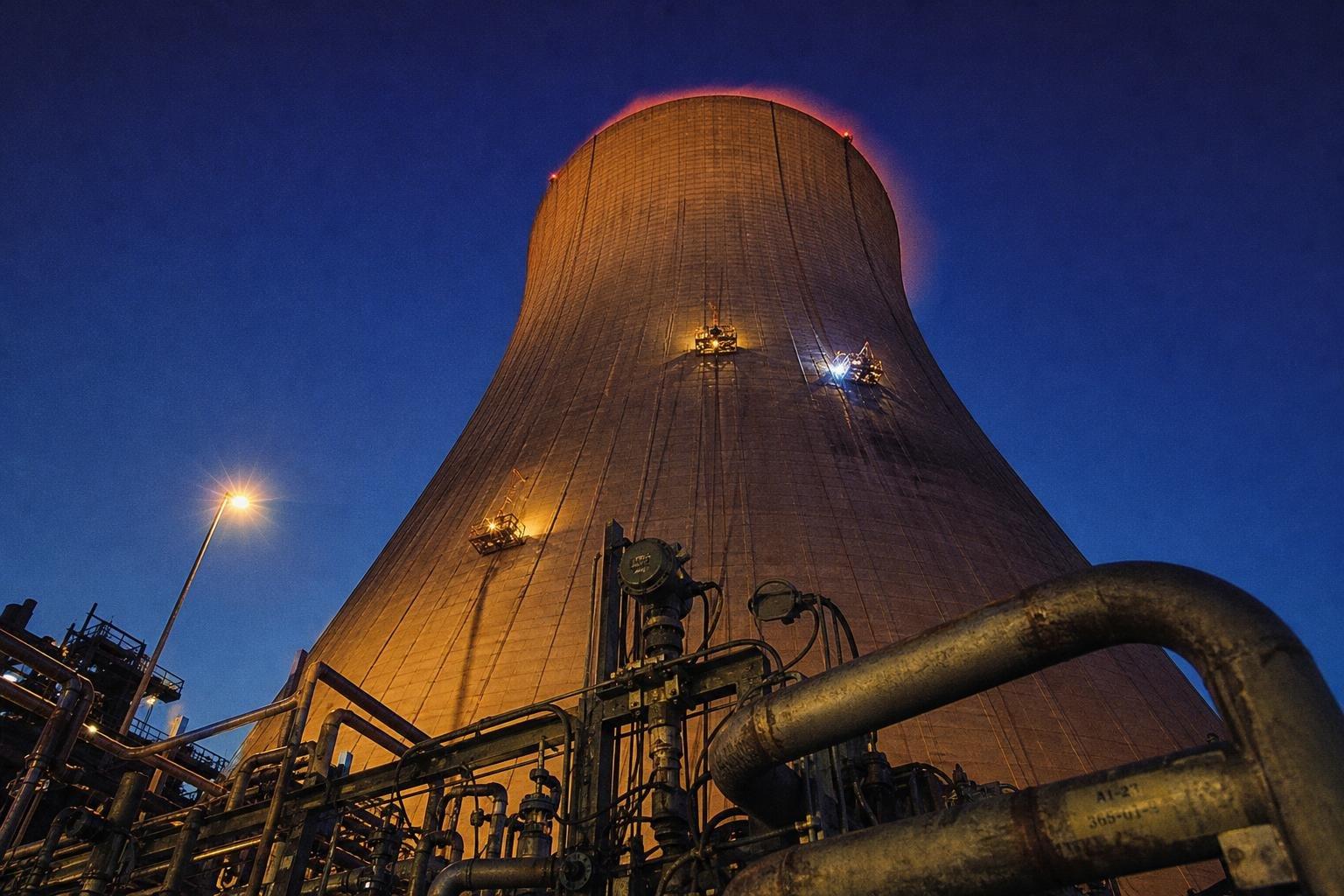

The headlines about dead nuclear plants coming back from the grave make for great copy. Mothballed cooling towers, a Hollywood-ready redemption arc, AI as the savior that finally justifies firing the reactor back up. It's a good story. It's just not the story the data supports right now.
What's actually happening across the US nuclear fleet in late 2026 is less cinematic and more consequential: utilities are not resurrecting shuttered plants, they're extracting more megawatts from reactors that have been running the whole time. That distinction matters enormously if you're trying to figure out how fast the grid can actually absorb the AI power crunch — and it's where the real capital, the real timelines, and the real megawatts are showing up.
The Uprate Is the New Restart
Start with the number that should anchor every conversation about nuclear's AI moment: the Department of Energy's Office of Energy Dominance Financing just announced a conditional loan commitment of up to $5 billion to Constellation Energy, aimed at modernizing reactors across Illinois, Maryland, and Pennsylvania — Braidwood, Byron, Clinton, Dresden, LaSalle, Quad Cities, Calvert Cliffs, and Limerick (25News Now). DOE estimates these projects will add nearly 1.1 gigawatts of generating capacity to the grid — enough, by the department's accounting, to power more than 930,000 homes (25News Now).
That's not a restart. That's an uprate — squeezing more thermal and electrical output out of reactors that are already licensed, already staffed, already connected to the grid. The nuclear trade press has been tracking this as the real action item for over a year now, and the Constellation loan is being described as the largest single investment in uprates in decades (Neutron Bytes). It follows a cascade of private-sector deals funding the same mechanism: Meta put money into a 30-MW uprate at Clinton in 2025, Amazon backed a 190-MW uprate at Calvert Cliffs in September 2026, and Google is tied to 890 MW across Limerick and Salem (Neutron Bytes).
This is the part conservation-brained energy commentary always gets backwards. An uprate isn't a consolation prize for not building new plants. It's the fastest, cheapest megawatt available in the entire US generation stack right now, because you're not installing new turbines or steam generators — you're running existing infrastructure harder and smarter (Neutron Bytes). That's civilizational efficiency. That's the fleet we already built finally being asked to do what it was always capable of.
Salem Shows Both the Promise and the Price of Running Reactors Hot
PSEG and Constellation are planning a 200-MW uprate at their jointly owned Salem nuclear plant in southern New Jersey — Salem's current installed capacity sits at 2,280 MW, and the uprate is explicitly tied to a nuclear power purchase agreement with Google (Utility Dive). PSEG's broader ~3,760-MW nuclear fleet posted a 95.5% capacity factor in the third quarter of 2026, up from 92.4% a year earlier (Utility Dive). That's not a rounding error — that's a fleet running closer to its theoretical ceiling than almost any other generation source on the grid, renewable or otherwise. Compare that capacity factor to what you'd get from a wind farm or solar array, where nameplate capacity and average output routinely diverge by half or more, and the appeal of nuclear uprates for AI load becomes obvious: you're not betting on weather, you're betting on metallurgy and inspection schedules.
And the metallurgy doesn't always cooperate. In the same quarterly filing, PSEG disclosed that Salem 1 hit a snag — a visual inspection during a scheduled refueling outage found a degraded thermal shield inside the reactor vessel, and the company says further testing is ongoing and will extend the outage (Utility Dive). This is the detail that belongs in every optimistic nuclear-for-AI story and almost never makes it in. Announced capacity additions and operational capacity are not the same thing, and the gap between them is measured in inspection reports, not press releases. A 200-MW uprate commitment is real. A 200-MW uprate delivered on schedule, with the reactor it's attached to running without an extended outage, is a different and harder claim.
Why Uprates Beat Restarts on the Only Timeline That Matters
Here's the case for why this is the right allocation of capital, not a compromise. The AI buildout isn't waiting for anyone's five-year construction schedule. Four hyperscalers — Alphabet, Amazon, Meta, and Microsoft — have guided roughly $730 billion in 2026 capital spending at the midpoints, a figure that by one analyst's arithmetic exceeds the US's entire roughly $615 billion in energy investment for the year, based on the IEA's regional figures in its World Energy Investment 2026 report (FourWeekMBA). The IEA's own report also flags something telling: orders for new gas-fired power plants hit 130 GW in 2025, a 25-year high, with US data center demand named as a major driver (FourWeekMBA). That's the alternative uprates are competing against — more gas turbines, more emissions, more fuel-price exposure for a grid that just lived through a volatile energy year.
Against that backdrop, a reactor that already exists, already has a Nuclear Regulatory Commission license, and can add 100-900 MW through engineering upgrades rather than a multi-year build is the closest thing the current grid has to free lunch. The Department of Energy has made this explicit policy: its data center resource hub frames expanding domestic energy infrastructure, including nuclear, as central to maintaining US leadership in AI, alongside a "Ratepayer Protection Pledge" meant to keep tech companies from quietly pushing data center power costs onto household bills (Department of Energy). DOE has also branded this moment the "Golden Era of American Nuclear Energy," a framing that, stripped of the marketing gloss, mostly describes exactly this pattern — modernization and uprates across the existing fleet, financed by a mix of federal loans and hyperscaler power purchase agreements (Department of Energy).
Zoom out to the global nuclear picture and the stakes come into focus. Nuclear currently supplies about 9% of the world's electricity from roughly 440 reactors across 31 countries, and the World Nuclear Association is pushing for a tripling of nuclear capacity by 2050 (World Nuclear Association). Tripling global nuclear output by new construction alone, on anything resembling historical reactor-build timelines, is not a credible near-term plan. Uprating the fleet that already exists is one of the only levers available that can move the needle inside the decade AI demand is actually arriving in.
What to Watch Instead of Waiting for a Restart Announcement
If you're tracking this story, stop scanning the news for a Three Mile Island or Palisades revival headline and start watching three things that are already in motion. First, whether Salem 1's thermal shield inspection resolves cleanly or drags the outage into next year — PSEG says the impact depends on testing results still pending (Utility Dive). Second, how Constellation draws down its $5 billion DOE loan commitment across the eight-plant portfolio in Illinois, Maryland, and Pennsylvania, since the structure reportedly functions like a line of credit disbursed as each uprate proceeds (Neutron Bytes). Third, whether FERC's regulatory posture on data center interconnection — which has already forced PJM to redo parts of its large-load proposal — ends up accelerating or snarling the permitting path for these uprates, since PSEG's own leadership has flagged that the focus has shifted to states to sort out cost allocation (Utility Dive).
The romantic version of nuclear's AI moment is a dead reactor brought back to life. The real version is quieter and more durable: a fleet that never stopped running, getting pushed to do more, financed by the companies that need the electrons most. That's a less dramatic story. It's also the one actually under construction.


