
This Week in Voltage
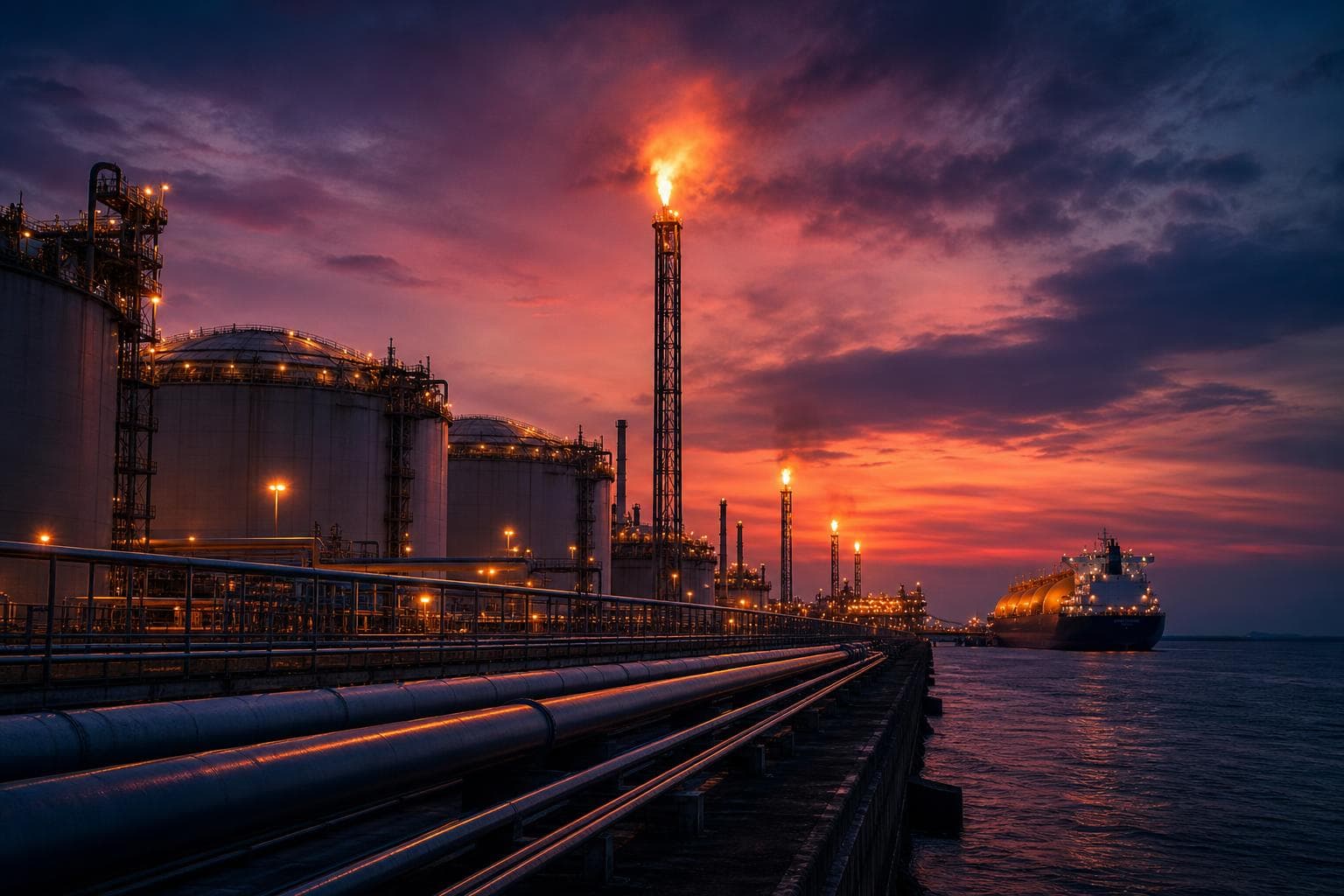
On March 18, Iran attacked the Ras Laffan LNG export facility in Qatar. Two liquefaction trains — representing roughly 17% of Qatar's export capacity — were damaged. QatarEnergy estimates repairs could take up to five years. Qatar supplied nearly 20% of global LNG in 2025. That supply is now structurally constrained, and the shockwaves are still moving through every energy market on the planet.
The immediate arithmetic is brutal for Europe. EU underground gas storage sat at just 33.1% as of May 1 — 17% below last year and nearly 27% below the five-year average, per Gas Infrastructure Europe. The EU mandate requires 90% storage ahead of November. Europe now has a summer injection deficit to fill with Qatari supply partially offline, which means it is leaning hard on spot-market LNG from the United States.
The spread tells the story. Henry Hub is trading around $3.10/MMBtu. The Dutch TTF benchmark recently touched $15.70/MMBtu. That's a gap of nearly $12.60/MMBtu — a spread that has widened by 83% in a single month according to EIA data. American LNG exporters are printing money. American consumers and European industries are absorbing the volatility. And somewhere in the middle of all this, the "natural gas as transition fuel" thesis is quietly having a very bad spring.
Deep Charge: The Bridge That Keeps Catching Fire
The standard case for natural gas as a transition fuel goes like this: it's cleaner than coal, it's dispatchable, it buys time while renewables and nuclear scale up. Reasonable people have made this argument for twenty years. The problem is that "buying time" requires price stability, supply security, and a credible off-ramp. Right now, natural gas has none of those three things.
The geopolitical exposure is structural, not episodic.
The Ras Laffan attack wasn't a black swan. It was a foreseeable consequence of routing 20% of global LNG supply through a single chokepoint in a region with active military conflict. The Strait of Hormuz has been a geopolitical pressure point for decades. What changed is that the world built an LNG trading system that treats Qatari throughput as a baseline assumption — and now that assumption has a five-year repair timeline attached to it.
European TTF already exceeded €60/MWh earlier this spring on fears of halted Qatari flows. It has since pulled back to the €44–45/MWh range as LNG tankers continued transiting Hormuz — but the market is pricing in a serious risk premium even without actual export disruption. Kpler analysts maintain a bullish outlook for European gas through the summer, citing deficit risks and intensifying competition with Asia for spot cargoes. If the summer runs hot and Hormuz tensions escalate further, Henry Hub could push above $4–5/MMBtu driven by LNG export demand alone.
This is the volatility profile of a fuel that is supposed to be providing stability. It is not a bridge. It is a price-discovery mechanism for geopolitical risk, and the people paying the toll are industrial consumers and residential ratepayers who have no hedge.
The price signal is pointing toward electrification, not more gas.
Here's the civilizational read: every time Henry Hub spikes, every time a European utility scrambles for spot LNG, every time an industrial buyer gets a $15/MMBtu invoice instead of a $3 one — the economic case for direct electrification gets stronger. Not because electricity is always cheaper today, but because the volatility premium on gas is now large enough to justify the capital cost of switching.
The data centers driving the AI boom are already doing this math. The IEA projects U.S. data centers will need roughly 130% more energy by 2030. The hyperscalers are not signing long-term gas supply agreements to meet that demand. They are signing nuclear power purchase agreements and building dedicated renewable capacity. Meta has already inked agreements with TerraPower for multiple reactors beyond the Kemmerer, Wyoming plant that broke ground this spring. The demand signal from the most sophisticated energy buyers on the planet is pointing away from gas and toward firm, zero-fuel-cost electricity.
The "transition fuel" framing obscures the real bottleneck.
Natural gas advocates are right that you can't retire dispatchable generation without replacing it with something equally dispatchable. That's a real constraint. But the argument has been used for so long as a reason to delay that it has become structurally indistinguishable from a reason to never arrive. The transition fuel becomes the permanent fuel becomes the stranded asset.
The actual bottleneck isn't gas versus renewables. It's the speed of nuclear permitting, grid interconnection queues, and transmission buildout. Those are solvable engineering and regulatory problems. The DOE is now deploying AI tools to compress reactor licensing timelines — a direct acknowledgment that the NRC review process, not the technology, has been the rate-limiting factor. TerraPower's Kemmerer plant took five years of studies and safety demonstrations before the NRC granted final construction approval in March. The AI licensing initiative is an attempt to cut that timeline materially for future projects.
If it works — and the DOE's milestone test case suggests it can — the "we need gas to bridge the gap" argument loses its strongest remaining leg. The gap shrinks. The bridge gets shorter. And the question becomes whether we're willing to keep paying the geopolitical volatility tax on gas while we wait for the bridge to close, or whether we accelerate the crossing.
The new LNG terminals are a double-edged sword.
U.S. LNG export capacity is expanding. Golden Pass, Plaquemines, and Corpus Christi Stage 3 are strengthening the linkage between Henry Hub and global gas markets. For American LNG exporters, this is a windfall. For American electricity consumers, it means domestic gas prices will increasingly track international volatility rather than domestic supply fundamentals. The insulation that kept Henry Hub at $2–3/MMBtu while TTF hit €60 is eroding with every new export terminal that comes online.
I'd argue this is the underappreciated structural shift in the natural gas story. The U.S. has historically benefited from a domestic gas market that was largely decoupled from global price swings. That decoupling is ending. As it ends, the "cheap and stable" value proposition for gas-fired generation weakens — and the relative attractiveness of nuclear, which has zero fuel cost once built, improves with every LNG terminal that connects Henry Hub to Hormuz.
There's also the question of what we're building toward. Every dollar of capital that goes into a new LNG terminal is a dollar that isn't going into transmission infrastructure, nuclear construction, or long-duration storage. These aren't just competing investment categories — they represent competing visions of what the grid looks like in 2040. One vision has the U.S. as a global gas exporter perpetually exposed to Middle Eastern geopolitics. The other has the U.S. running on firm, domestic, zero-fuel-cost electricity that no Iranian missile can price-shock.
By the Numbers
- $12.60/MMBtu — Current Henry Hub-to-TTF spread, widened 83% in one month per EIA data
- 33.1% — EU gas storage level as of May 1, nearly 27% below the five-year average (Gas Infrastructure Europe)
- ~17% — Share of Qatar's LNG export capacity damaged in the Ras Laffan attack, with repairs estimated at up to five years
- ~20% — Qatar's share of global LNG supply in 2025
- 130% — IEA projection for additional U.S. data center energy demand by 2030
- $2.52–$2.80/MMBtu — Current Henry Hub range, supported by strong domestic production and comfortable storage levels
What We're Fighting For
The natural gas volatility story of spring 2026 is not primarily a commodity story. It's a civilizational argument made in real time, with real money, about what kind of energy system humanity wants to build.
A system built on gas is a system permanently exposed to the decisions of adversarial states, the integrity of chokepoints, and the repair timelines of facilities we don't control. That's not a transition. That's a dependency.
The path to electric abundance runs through firm, dispatchable, zero-fuel-cost generation — nuclear first, long-duration storage second, and a transmission grid capable of moving electrons from where they're generated to where they're needed. The DOE's AI licensing initiative, TerraPower's Kemmerer construction, and the hyperscalers' nuclear PPAs are all steps on that path. They are not fast enough. But they are accelerating.
Watch the DOE's AI licensing milestone results when they publish — that data will tell us whether the NRC timeline compression is real or aspirational. Watch FERC's interconnection queue reform implementation through Q3, which determines whether new nuclear and renewable capacity can actually reach the grid once it's built. And watch whether the Hormuz situation stabilizes or deteriorates through summer: if TTF pushes back toward €60, the economic case for electrification will make itself louder than any newsletter ever could.
The future is electric. The question is how much volatility tax we're willing to pay on the way there.


