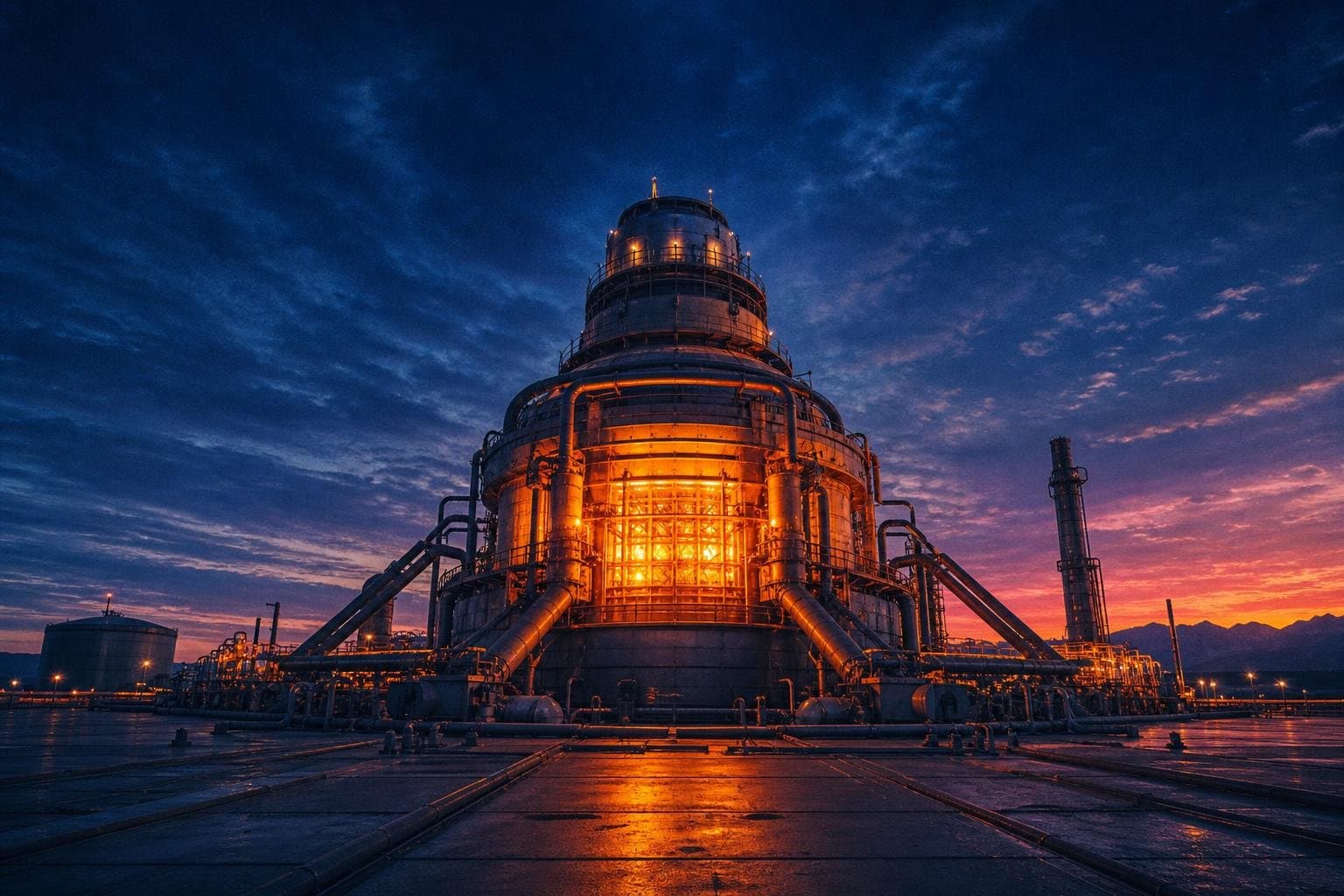

The United States nuclear fleet is a monument to one design decision made in the 1950s. Admiral Rickover needed reactors that could fit inside submarines, and light water reactors — cooled and moderated by ordinary pressurized water — were compact, well-understood, and militarily proven. That engineering choice, made for a Cold War Navy, became the template for nearly every commercial reactor built in the following seven decades. U.S. reactors produced 816 TWh in 2024, roughly 18% of total electrical output, almost entirely from that same basic architecture.
The architecture works. Capacity factors above 90% since 2002 are genuinely impressive. But light water reactors were optimized for a world where electricity demand grew slowly and predictably, where the grid's job was to serve residential and industrial loads that changed by a few percent per year. That world is gone.
Global electricity demand is forecast to grow at 3.6% annually through 2030, and the IEA now calls this the dawn of the "Age of Electricity." Data centers, EVs, heat pumps, industrial electrification — the demand curve has structurally resteepened after 15 years of near-stagnation in advanced economies. AI infrastructure alone is generating load growth that utilities have revised upward in each of the past three years, with Bank of America analysts projecting that data center demand will outpace planned utility capacity additions by more than 100 GW through 2030.
That gap is the civilizational problem. And it's the problem that molten salt reactors were, almost accidentally, designed to solve.
Why Light Water Hits a Wall at AI-Scale Demand
The physics of light water reactors create constraints that are manageable at modest scale and brutal at the scale AI infrastructure requires.
First: siting. Light water reactors require massive water sources for cooling — which is why virtually every existing U.S. plant sits on a river, lake, or coastline. Data centers, by contrast, are being built wherever fiber, land, and power intersect, which increasingly means inland locations far from major water bodies. You can't move the Susquehanna River to Northern Virginia.
Second: temperature. Light water reactors operate at relatively low temperatures — around 300°C — because water boils at 100°C and pressurizing it to stay liquid at higher temperatures requires containment structures of extraordinary engineering complexity. That temperature ceiling limits thermodynamic efficiency. It also means light water reactors can't serve industrial process heat applications that require temperatures above 500°C, locking nuclear out of a huge swath of decarbonization opportunity.
Third: the waste problem. Conventional reactors leave behind spent fuel that remains hazardous for tens of thousands of years. This isn't just an environmental concern — it's a political and regulatory drag that adds cost and timeline to every new project.
Fourth: the capital structure. Light water reactors are large, bespoke, and slow to build. The Vogtle expansion — Unit 3 connected to the grid in April 2023, Unit 4 in March 2024 — came in years late and billions over budget. That's not a project management failure; it's the predictable result of building one-off megaprojects with custom components and decade-long construction timelines. AI infrastructure moves on 18-month chip cycles. A reactor that takes 15 years to permit and build is structurally mismatched to the demand it's supposed to serve.
What Molten Salt Actually Changes
The molten salt reactor concept is not new. It dates to the Molten Salt Reactor Experiment at Oak Ridge National Laboratory in the 1960s, which ran successfully for four years before being shut down — not because it failed, but because the Nixon administration prioritized breeder reactor development. The physics was proven. The program was killed for political reasons. That's a different kind of failure.
Southern Company and TerraPower are now developing a molten chloride fast reactor that uses liquid chloride salts as both coolant and fuel. The DOE has invested more than $45 million in cost-shared funds for the project, with an additional commitment of more than $136 million through the Advanced Reactor Demonstration Program for the Molten Chloride Reactor Experiment. The commercial-scale design targets up to 1,200 megawatts of electrical output.
The engineering advantages over light water are structural, not incremental.
Temperature. Molten salt reactors operate at atmospheric pressure and at temperatures above 700°C. No pressurized containment vessel required. Higher operating temperatures mean higher thermodynamic efficiency — more electricity per unit of heat generated — and the ability to serve industrial process heat applications that light water simply cannot reach.
Passive safety. The Southern Company/TerraPower design has what the industry calls a "walk-away-safe" architecture: if coolant flow is lost, the fuel salt expands through the reactor core to passively halt the reaction and naturally circulate to remove decay heat. No electric pumps required. No operator action required. This is a categorically different safety profile from light water designs, where loss-of-coolant accidents require active intervention.
Waste. MSRs can consume waste from other reactors as fuel. The Southern/TerraPower design is specifically described as capable of consuming spent fuel from conventional reactors — turning one of nuclear's biggest political liabilities into a feedstock.
Siting flexibility. Operating at atmospheric pressure with passive safety systems and without large water cooling requirements means MSRs can, in principle, be sited closer to load centers — including inland data center campuses — than conventional plants.
The global MSR market was valued at approximately $495 million in 2025 and is projected to reach $1.9 billion by 2035, a compound annual growth rate of 14.1%. Kairos Power held the leading market position with over 10.5% market share in 2025, with TerraPower, Terrestrial Energy, Moltex Energy, and Copenhagen Atomics rounding out the top five.
The Honest Accounting: What MSRs Don't Yet Have
Here's where the electricity maximalist has to be honest rather than just loud.
The advantages above are real. They are also, largely, still on paper. No molten salt reactor is operating commercially today. The Southern Company/TerraPower project is in the testing and materials-validation phase — the Molten Chloride Reactor Experiment is a demonstration reactor, not a commercial plant. The gap between a successful experiment and a 1,200 MW commercial unit is enormous, and the history of nuclear energy is littered with designs that worked at demonstration scale and stalled at commercial scale.
The Bulletin of the Atomic Scientists published a pointed analysis in July 2026 arguing that Big Tech's nuclear announcements are substantially more circumspect than media coverage suggests. The Google-Kairos Power agreement, for example, created "a path to deploy" 500 MW by 2035 — not a commitment to purchase power. Amazon's agreement with Energy Northwest funded "the initial feasibility phase" in exchange for the right (not the obligation) to purchase electricity from a first project expected to generate 320 MW in the early 2030s. These are options, not orders.
The cost comparison is also genuinely unfavorable right now. New nuclear electricity in the United States costs roughly three times the equivalent from solar or wind, per the Bulletin's analysis. That gap has to close — through manufacturing scale, regulatory streamlining, and learning-curve effects — for MSRs to compete on pure economics rather than on reliability and dispatchability characteristics.
The U.S. ADVANCE Act of July 2024 and the DOE's Advanced Reactor Demonstration Program are real policy interventions that have, as the market analysis notes, "materially shortened the distance between demonstration and commercialization." The administration's 2025 executive orders targeting a quadrupling of U.S. nuclear capacity to 400 GWe by 2050 set an ambitious direction. But announced targets and operational capacity are different things, and the honest read is that MSRs are a 2030s technology at the earliest for meaningful commercial deployment.
The Civilizational Calculus Anyway
None of the above changes the fundamental argument. It sharpens it.
The IEA's mid-year 2026 update confirms that global power demand is on track to grow faster in 2026 and 2027 than in 2025, accelerating to 3.8% in 2027, driven by structural forces — data centers, EVs, industrial electrification — that are not going away. Bank of America's analysis projects that more than 7.5 GW of data center projects with on-site generation are already under construction, with another 60 GW-plus in pre-construction — a direct response to the grid's inability to serve load fast enough.
That 60 GW in pre-construction is the tell. When hyperscalers start building their own generation because the grid can't keep up, you are watching the demand signal that justifies a decade of MSR development investment right now, even if the first commercial plants don't come online until 2033 or 2035. The alternative — locking AI infrastructure into behind-the-meter gas generation for the next 20 years — is a civilizational detour that trades a decade of convenience for decades of carbon lock-in and fuel price exposure.
Light water reactors will continue to carry the baseload for the foreseeable future. The existing U.S. fleet, with its 90%-plus capacity factors, is irreplaceable on any near-term timeline, and the administration's push to extend plant lifetimes is the right call. But the fleet is aging, and building more of the same architecture — with its water siting constraints, its pressurized containment requirements, its multi-decade construction timelines — is not a credible answer to a demand curve that's rewriting itself every 18 months.
Molten salt reactors are not a finished product. They are a design direction that addresses the specific constraints light water cannot. The DOE is funding the experiments. The policy framework is improving. The demand signal is screaming.
Watch the Molten Chloride Reactor Experiment's materials testing results when they publish — that's the next real data point on whether the Southern/TerraPower design can survive the engineering transition from concept to hardware. Watch whether the ADVANCE Act's licensing reforms actually compress NRC timelines for non-LWR designs, or whether the regulatory machinery reverts to its historical pace. And watch how many of those 60 GW of pre-construction data center projects lock into long-term gas contracts versus keeping optionality for nuclear power purchase agreements.
The future belongs to whoever builds the most electrons. Molten salt is how we build them without inheriting light water's ceiling.


