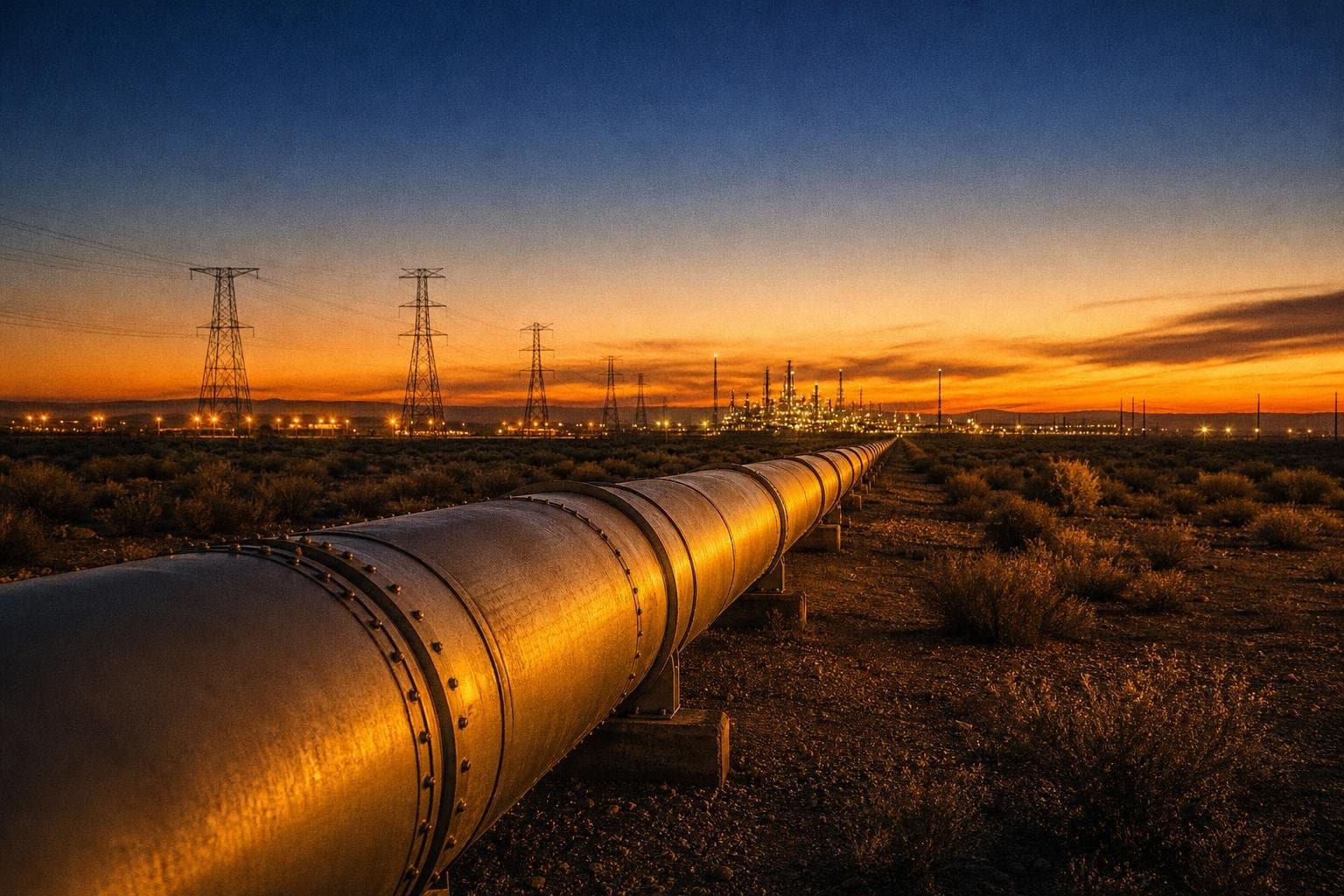

Here's the number that should reframe how you think about the AI power buildout: Kinder Morgan just committed $4.2 billion to a single pipeline, and it's not going to a utility, a refinery, or a chemical plant. It's going to a data center complex. The Permian Link project will move 2.8 billion cubic feet of gas a day across 434 miles of West Texas and the Panhandle, purpose-built to feed compute load. That's not grid infrastructure. That's a parallel fuel-delivery system engineered around a single category of customer, and it tells you something regulators have been dancing around all year: the fastest way to solve the interconnection queue is to stop waiting in line.
I've been tracking the queue problem for months — the sorting-by-who-can-afford-to-quit dynamic I wrote about two weeks ago, the capacity crisis PJM created and then tried to paper over. What's changed since then isn't a new regulatory fix. It's that the hyperscalers and their infrastructure partners have stopped betting on the fix arriving in time. They're building around the grid instead of through it. Permian Link is the biggest piece of physical evidence yet.
The Regulatory Track Is Moving at Committee Speed
Compare the pipeline announcement to what's actually happening inside FERC right now. On October 9, the commission approved PJM's registry of large-load facilities — a database tracking location, ramp schedules, and capacity arrangements — while rejecting the more consequential half of the proposal: a mechanism that would have let data centers connect faster in exchange for accepting curtailment ahead of households during emergencies (Tech Insider). NRDC's reaction captured the fight well: FERC's order, in the advocacy group's framing, leaves data centers able to draw on grid capacity without being required to bring their own new supply, and leaves the public exposed to cost and reliability consequences (NRDC).
Meanwhile PJM's own stakeholder process has spent the back half of October arguing over tariff redlines nobody outside the room will ever read closely. The latest draft, circulated for an October 29 filing deadline, allocates a new cost-recovery backstop by each zone's share of incremental large load, strips the opt-out that let cooperatives and municipal utilities dodge the bill, and makes any utility that exits PJM responsible for the remainder of its charges (AI Data Center Insights). Notably, neither draft uses the words "data center." That's not an oversight — it's an admission that the category is now so large and so politically charged that PJM would rather describe it euphemistically than name it directly in a tariff filing.
And it's not just PJM. In June, FERC issued show-cause orders to all six major grid operators — PJM, MISO, SPP, CAISO, ISO-NE, and NYISO — giving each 60 days to either justify its existing large-load interconnection rules or propose reforms, covering roughly two-thirds of commission-jurisdictional load nationwide (GCN). That's a serious regulatory undertaking. It is also, by design, slow. Show-cause orders, stakeholder redlines, tariff filings, commission votes — this is a process measured in quarters, maybe years, while the compute buildout is measured in months.
This is the gap electricity maximalism has to confront honestly: the policy apparatus protecting grid reliability is doing its job the way a deliberative body should, methodically, with input from cooperatives and municipalities and ratepayer advocates. But deliberation has a cost when the thing being deliberated about is growing exponentially. A pipeline company doesn't have to wait for a FERC order. Kinder Morgan looked at the queue, looked at the timeline, and built a bypass.
Behind-the-Meter Gas Is a Rational Response to an Irrational Queue
I want to be precise about what Permian Link actually is, because precision matters here more than enthusiasm. It is an announced pipeline project — a formal commitment, not yet operational infrastructure. Nothing in the available reporting indicates gas is flowing yet or that the associated generation is built. What we know is the capital commitment, the capacity figure, and the route (Bloomberg). That distinction matters because the whole data center power story this year has been a parade of announcements that outran reality — I've written before about the gap between headline gigawatt figures and what actually gets energized.
But even as an announcement, this is a different category of signal than a generic data center power purchase agreement. A pipeline is dirt in the ground, a 434-mile right-of-way, a multiyear construction schedule that Kinder Morgan is willing to finance at $4.2 billion before a single rack is powered. Companies don't commit capital like that speculatively. The gas turbine manufacturers back this up from the supply side: Siemens Energy's Gas Services segment posted record orders of €10 billion last quarter, up 62%, with the company explicitly attributing the surge to data-center power needs and citing a 2.65 book-to-bill ratio that implies years of backlog ahead of delivery (Turbomachinery Magazine). That's not one pipeline company's bet. That's an entire industrial supply chain reorganizing around the assumption that hyperscalers will build their own generation rather than wait for utility-scale interconnection.
A useful caution here, though, from an analysis of these same OEM backlogs: GE Vernova's widely cited 116 GW figure mixes firm equipment backlog with slot reservation agreements, and Siemens' €73 billion Gas Services backlog is a monetary segment measure, not a turbine count — the two numbers aren't directly comparable, and neither is a delivery schedule (SecondWatt). The demand signal is real. The implied timeline for actually getting a turbine installed and commissioned is longer and murkier than backlog headlines suggest. Even the behind-the-meter escape hatch has a queue — it's just a turbine manufacturer's queue instead of a transmission queue, and reported lead times there run into multiple years.
The Grid Still Has a Veto, Even When You Try to Skip It
Here's where the civilizational optimist in me has to sit next to the realist. Behind-the-meter gas looks like a clean workaround: build your own fuel delivery, build your own generation, skip the interconnection fight entirely. Australia's experience says otherwise. More than three-quarters of the 40-plus large data centers planned around Sydney and Melbourne — representing roughly $70 billion in projected investment — are at risk from strained power grids and local opposition, and just 23% have confirmed secured electricity supply or grid connections, according to a Bloomberg review of company disclosures (Bloomberg). Even projects with a stated intent to self-supply still need grid interconnection for backup, for permitting sign-off, for the local politics that determine whether a county commission approves the site at all.
That's the pattern showing up across Reuters' broader data center coverage this month too: Microsoft pulling out of a UK data center deal after power connection delays pushed the supply date into the 2030s, a cable-manufacturing capacity crunch now bottlenecking construction independent of generation, and at least 35 data center applications covering more than 24,000 acres of federal land pending across six Western states (Reuters). Going behind the meter solves the generation half of the problem. It does nothing for permitting, community opposition, transformer lead times, or cable supply — and those are turning out to be just as binding a constraint as megawatts.
What This Means for the Abundance Case
None of this should read as a retreat from electricity maximalism. It's the opposite case, made more carefully. The pipeline, the turbine backlog, the registry fights, the show-cause orders — all of it is evidence of a system straining against genuine demand growth, not manufactured hype. A grid operator writing tariff language to allocate backstop costs by incremental large load is a grid operator planning for more electrons, not fewer. A pipeline company sinking $4.2 billion into West Texas gas infrastructure is a bet that compute demand is durable, not a bubble.
The lesson for the maximalist case is about sequencing, not scale. The future is still electric. But the next 18 months belong to whoever solves permitting velocity and transformer and cable supply chains, not whoever gets the biggest number into a press release. Watch PJM's October 29 tariff filing for whether the cost-allocation fight gets resolved cleanly or drags into another FERC rejection. Watch whether Kinder Morgan's Permian Link gets a formal in-service date attached to it in coming quarters — that will tell you whether behind-the-meter gas is a real bypass or just another entry in the queue of its own. The abundance case wins on delivered megawatts, not committed billions.


