
This Week in Voltage
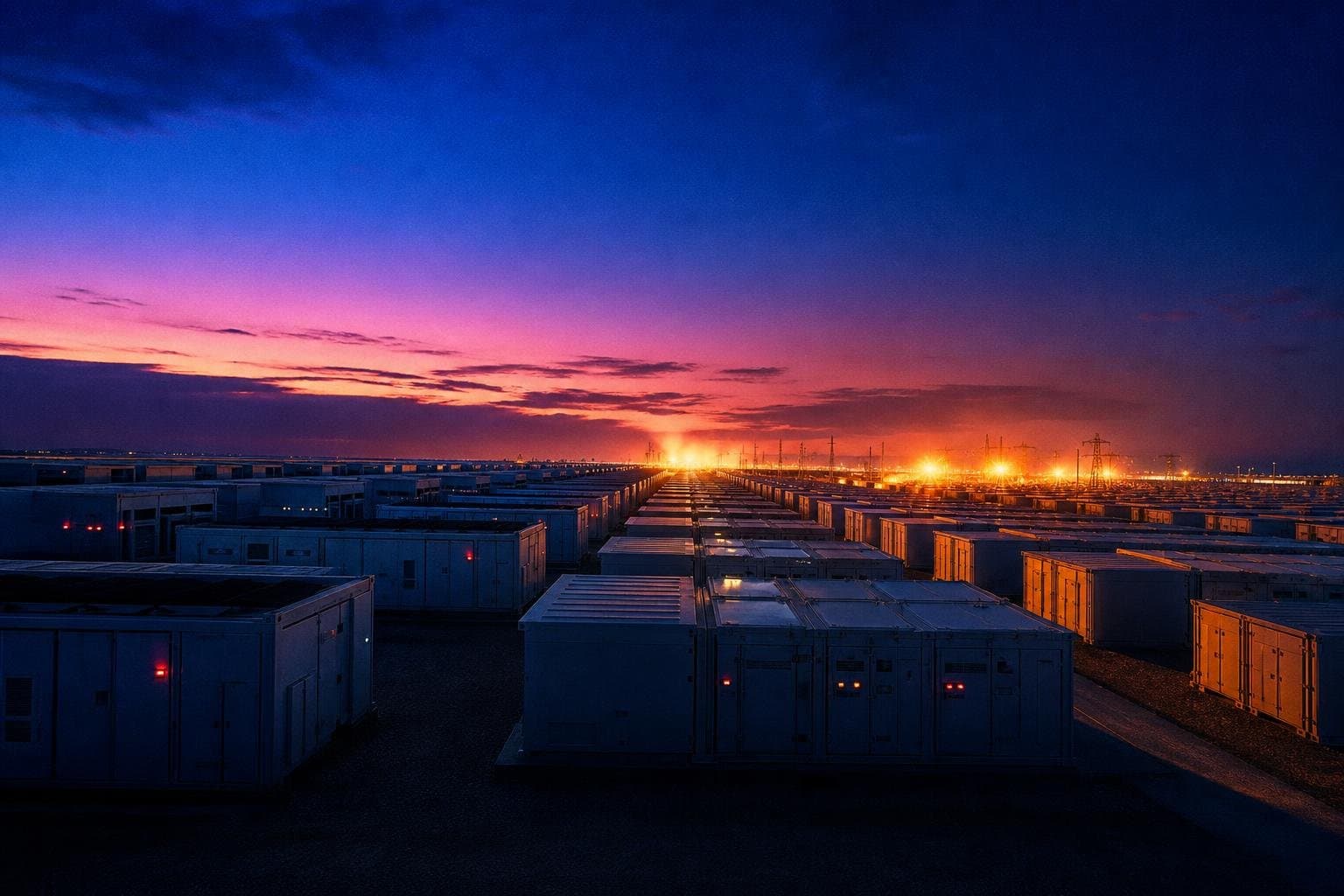
The United States added 3.3 GW/8.4 GWh of energy storage in Q1 2026 — a record for what is historically the slowest quarter of the year. Let that sink in. The seasonally weak quarter. The one where projects slip, financing stalls, and installers are still recovering from the holiday lull. And we still set a record across all three segments: utility-scale, residential, and commercial/industrial.
This is what acceleration looks like when it stops being theoretical.
When I wrote about the battery floor being set back in May (/p/the-battery-floor-is-set-now-the-grid-has-to-catch-up), the argument was that cost curves had matured enough to make grid-scale storage economically inevitable. Q1 2026 is the operational confirmation. The floor held. Now the question is how fast we build on top of it.
The Demand Signal That's Driving This
Storage doesn't scale in a vacuum. It scales because someone needs it to.
The EIA's June 2026 Short-Term Energy Outlook projects U.S. electricity consumption rising by 76 billion kWh in 2026 and 126 billion kWh in 2027, driven by commercial, industrial, and transportation demand. That's not a rounding error — that's a structural shift in what the grid is being asked to do.
The IEA frames this with civilizational clarity: electricity demand grew at nearly twice the average pace of total energy demand over the past decade, and around 3% in 2025 alone. Electrification of transport, heating, industry, and digital infrastructure is compounding simultaneously. The grid isn't just getting bigger — it's getting asked to be more precise, more responsive, and more resilient all at once.
That's exactly where battery storage earns its keep. Peak demand management used to mean building a gas peaker plant that sat idle 340 days a year and fired up when temperatures spiked. Grid-scale lithium-ion storage does the same job faster, with zero fuel cost at dispatch, and it can be sited next to the load rather than upstream of a congested transmission line. The economics of that trade have been improving for years. Now they're showing up in installation data.
FERC Just Made Storage the Center of Grid Policy
The policy catalyst arrived on June 18th, when FERC issued what Benchmark Mineral Intelligence described as one of its most consequential grid actions in years: a directive to all six U.S. regional grid operators to justify or reform their tariffs for connecting large loads above 20 MW — AI data centers, crypto mining, advanced manufacturing. The explicit goal is accelerating large-load grid connections while protecting reliability and affordability for existing consumers.
Read that carefully. FERC isn't just managing the queue — it's acknowledging that the demand profile of the American grid has fundamentally changed, and that the tariff structures governing it were designed for a different era. Battery flexibility sits at the center of the solution because it's the mechanism that lets large, variable loads connect without destabilizing the system for everyone else.
This is the policy-market feedback loop working correctly. Record installations create operational data. Operational data builds regulatory confidence. Regulatory confidence produces policy that accelerates the next wave of installations. We are inside that loop right now.
The Four-Fold Forecast — and Why Methodology Matters
Wood Mackenzie and the American Clean Power Association project cumulative U.S. energy storage capacity reaching 200 GW/655 GWh by 2031 — roughly four times current installed capacity. The EIA's separate outlook is more conservative in its near-term framing, projecting U.S. storage capacity doubling by end of 2027, though both point in the same direction.
The methodology gap matters here. Wood Mackenzie/ACP builds from announced projects, tax policy assumptions, and manufacturing capacity ramp curves. EIA's Short-Term Energy Outlook uses a different baseline and a shorter horizon. Neither is wrong — they're answering different questions. What they agree on is the direction: more storage, faster than historical trends would have predicted, driven by demand signals that aren't going away.
The battery chemistry story is also evolving in ways that matter for long-term grid economics. CATL debuted a new sodium-ion battery storage system in late June, designed for longer service life and better performance in extreme temperatures, with initial deliveries in China slated for September and global rollout beginning in June 2027. Sodium-ion won't displace lithium-ion at grid scale overnight — but it signals that the battery industry is actively diversifying the chemistry stack, which puts downward pressure on lithium-ion pricing and reduces supply chain concentration risk. More competition in the storage cell market is unambiguously good for grid buildout economics.
The favorable tax policy environment is doing real work in the near-term projections. The IRA's investment tax credits for standalone storage have been a consistent tailwind, and relative certainty around tax policy is explicitly cited as a driver of the current installation boom. That certainty is not guaranteed to persist — watch the congressional budget reconciliation process for any changes to ITC treatment of storage assets. That's the single policy variable most likely to move these curves.
The Civilizational Argument
Here's what the quarterly installation figures actually represent: humanity getting better at storing energy at the moments it's generated and releasing it at the moments it's needed. That sounds mundane. It is, in fact, one of the foundational capabilities of a Type I civilization.
The grid of 2031 — if the Wood Mackenzie trajectory holds — is a grid that can absorb massive renewable generation, buffer it through storage, and dispatch it on demand. It's a grid that can accommodate the AI data center buildout without sacrificing reliability for residential customers. It's a grid that treats peak demand as a management problem rather than a capacity crisis. The IEA's demand flexibility analysis makes clear that flexibility — the ability to shift, store, and dispatch — is the defining capability of power systems built for the next decade.
We're building it. Quarter by quarter, gigawatt-hour by gigawatt-hour. The scoreboard is finally moving.


