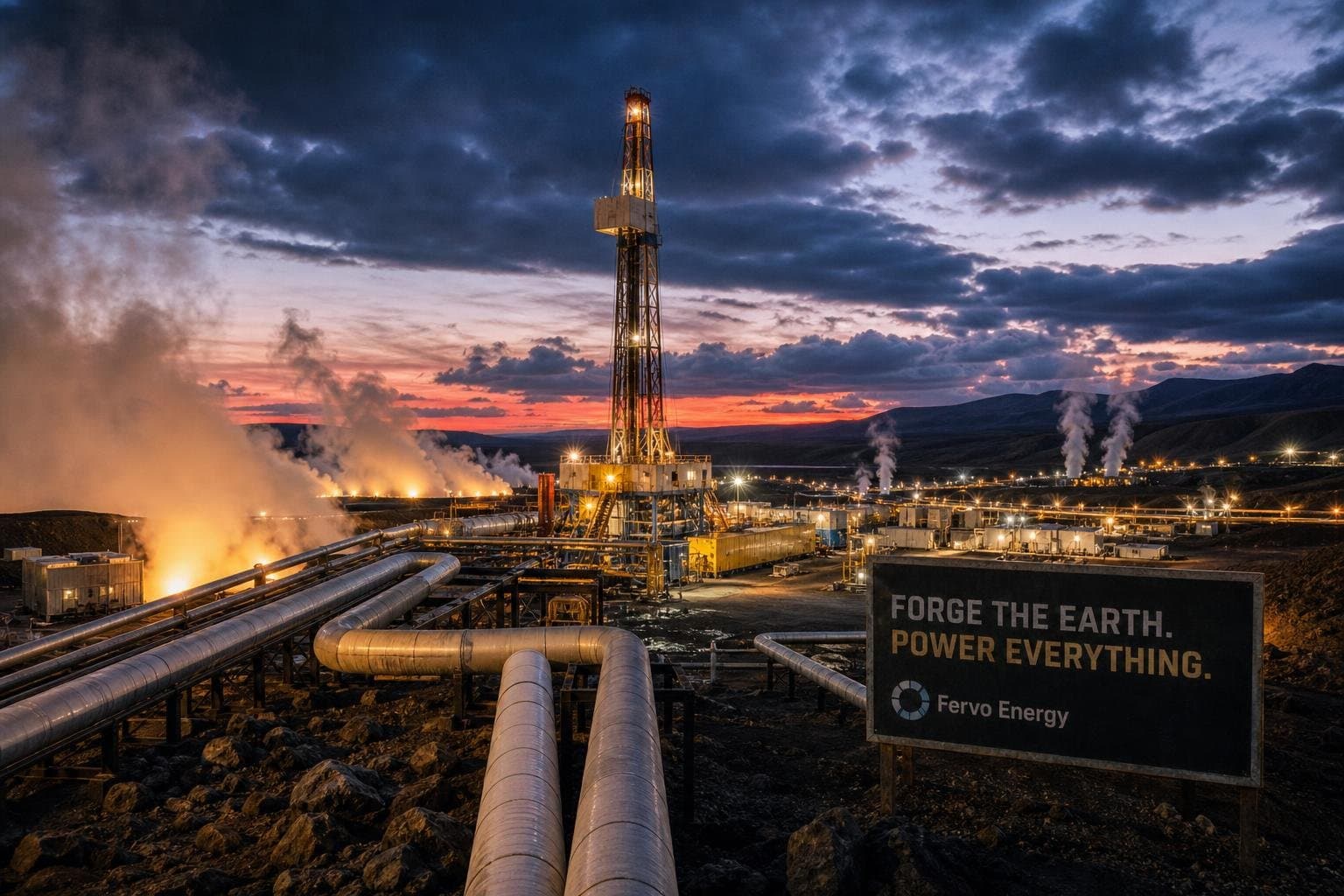

For most of its history, geothermal energy was a geographic lottery. You either lived near a volcanic hotspot — Iceland, the Geysers in California, the Taupo Volcanic Zone in New Zealand — or you didn't play. The resource was real, the baseload profile was extraordinary, but the map was fixed. That constraint is now breaking open, and the capital markets just noticed.
The IPO That Changed the Conversation
When Fervo Energy went public recently, the market didn't just buy a geothermal company. It bought a thesis. Fervo raised $1.89 billion in an upsized IPO at $27 per share, with shares popping 33% on debut to push its valuation past $10 billion — making it, according to Data Center Dynamics, the largest energy or utility IPO since 2013. The demand was so intense that Fervo's bankers upsized the offering multiple times, selling an additional 14.6 million shares.
The driver isn't nostalgia for hot springs. It's AI. Data centers need 24/7 firm power — not solar that disappears at dusk, not wind that drops when the air goes still. Geothermal's capacity factor is what makes it extraordinary: it runs continuously, like a nuclear plant, without the decade-long permitting odyssey. Google had already inked a 100MW deal with Fervo in June 2024 to power its Nevada data centers, and Meta has signed offtake agreements with two other enhanced geothermal developers totaling 300MW. The hyperscalers aren't dabbling — they're building procurement strategies around a technology that barely existed at commercial scale five years ago.
Fervo's flagship Cape Station project in Beaver County, Utah is slated to deliver 100MW to the grid by 2026, scaling toward 500MW in its first phase — with permits in hand for up to 2 gigawatts at the site. That's not a volcanic zone. That's the high desert of Utah, unlocked by directional drilling techniques borrowed wholesale from the shale industry.
The Technology That Broke the Map
The key insight behind enhanced geothermal systems (EGS) is almost offensively simple: heat is everywhere underground. The problem was never the resource — it was the reach. Conventional geothermal required naturally occurring water or brine reservoirs near the surface, which confined development to a handful of geologically lucky regions. EGS drills deeper into hot dry rock, fractures it hydraulically, and circulates water through the created reservoir. As ITIF's May 2026 analysis notes, EGS is now "on the path to price/performance parity with fossil fuels and cheap renewables" — a claim that would have sounded delusional a decade ago.
Then there's the frontier beyond EGS. Quaise Energy is pursuing something more radical: using 105-GHz millimeter-wave beams — masers — to ablate rock at depths where conventional drill bits fail. Their M1 mobile unit in Marble Falls, Texas recently set a record borehole depth using this technique. The target is superhot rock at temperatures above 400°C, where water carries dramatically more usable energy — scientists estimate superhot systems could produce 5-10 times more energy per well than conventional geothermal. If Quaise's approach scales, the geothermal gradient that governs every square mile of Earth's surface becomes a universal energy resource.
Federal Capital Is Flowing — But the Bottleneck Is Deployment Speed
The DOE isn't sitting on the sidelines. In February 2026, the Office of Geothermal announced up to $171.5 million in funding for next-generation geothermal field tests and resource characterization drilling, anticipating as many as 28 awards in the first round. Individual awards range from $4 million to $25 million, targeting field-scale tests at depths appropriate for full commercial development. ITIF's analysis also flags DOE's FORGE R&D project as "highly successful" and argues it should be expanded — with its open-data model serving as a template for other programs.
The national security angle adds urgency. The Atlantic Council has argued that geothermal's continuous, on-site generation profile makes it uniquely suited to military installations — the Department of Defense targets 99.9% energy availability for critical missions by 2030, a standard that diesel backup and natural gas pipelines cannot reliably meet. Geothermal drilled on federal land and military bases doesn't depend on pipelines that can be disrupted, fuel supplies that can be embargoed, or weather that can be forecast but not controlled.
The remaining bottlenecks are real: access to federal lands needs legislative action, cost reductions depend on scale that hasn't arrived yet, and the interconnection queue remains a chokepoint for any new generation source. But the IEA projects global electricity demand growing at 3.6% annually through 2030, driven by data centers, EVs, and industrial electrification. That demand signal is exactly what geothermal needs to justify the capital required to drill the learning curve down.
A $10 billion IPO is a data point. A technology that can produce firm baseload power from hot dry rock almost anywhere on Earth — that's a civilizational


