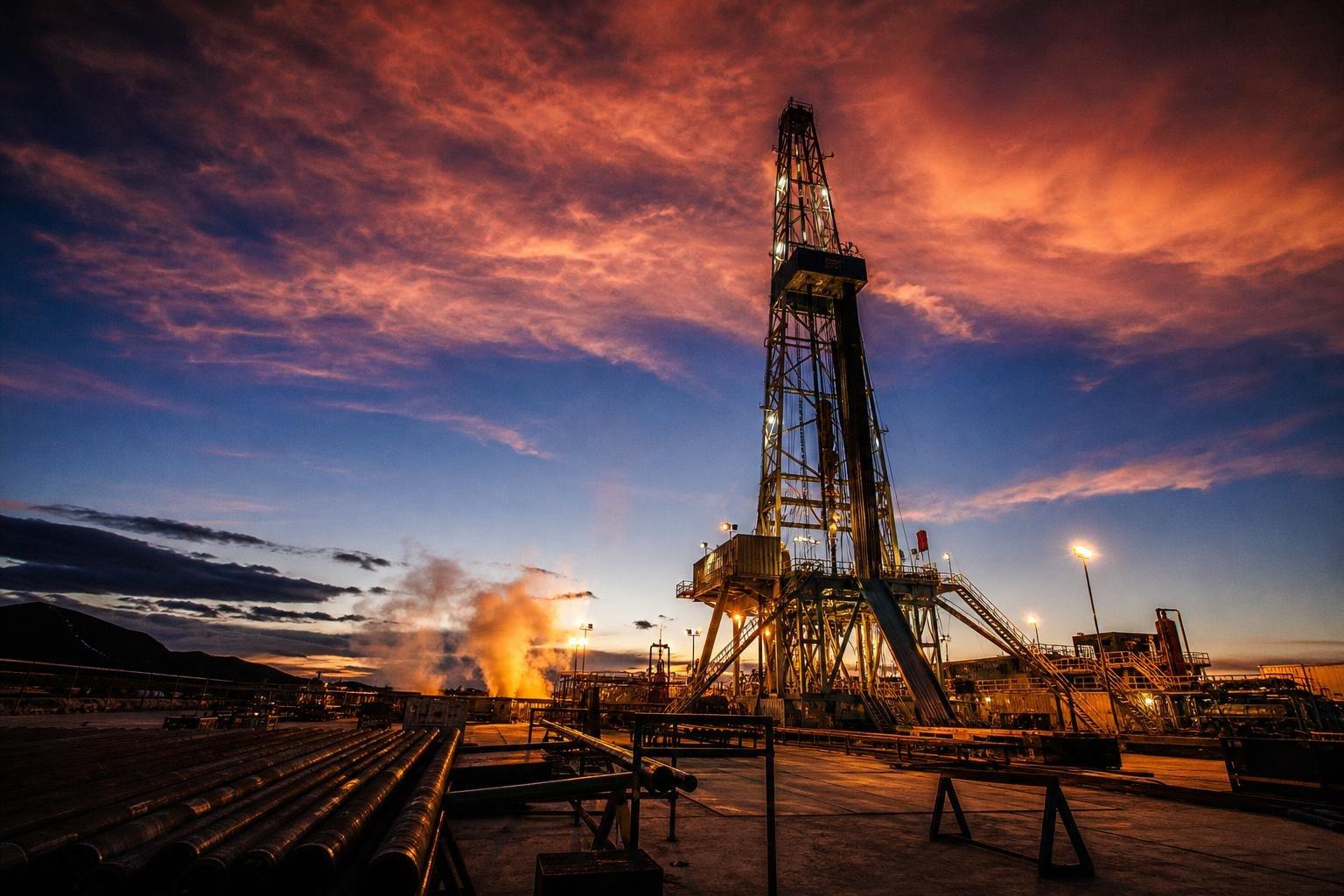

The first enhanced geothermal plant tied to a grid anywhere in the world started selling electrons in the middle of September, and it's worth sitting with that for a second. Not a pilot. Not a demonstration. Revenue, under contract, flowing into California's grid via Shell Energy as a retail buyer. This is the civilizational story buried under a hundred nuclear headlines this year: a startup proved you can manufacture a geothermal reservoir anywhere hot rock sits deep enough, instead of waiting for nature to hand you a volcano.
But the size of what's actually online matters as much as the fact that it's online at all, and this is where I want to be precise, because the geothermal story has a habit of getting rounded up.
What's Actually Spinning Versus What's On the Drilling Schedule
Fervo Energy's Cape Station in Utah brought its first 33-megawatt unit online in mid-September, with two more 33-MW units slated to follow by January — together roughly 100 megawatts of contracted, near-term capacity against a full build-out target of 500 megawatts on a project put at $2 billion in total capital. That's a 5x gap between what's operational-or-imminent and what's promised on the full buildout timeline. Both numbers are real. They are not the same number, and conflating them is exactly the kind of error that lets skeptics dismiss the whole technology the first time a drilling delay hits a press release.
The company's own October seismicity update gives a useful window into why the ramp is staged the way it is. Fervo has finished drilling all wells for its first three well blocks (GeoBlock 1-3) and is now mid-campaign on GeoBlocks 4 through 11, using a newer "3.0" well design. Stimulation — the process of fracturing hot dry rock to create the reservoir that actually produces steam — has been running continuously since February 2024, and production testing on additional pads only started this past June. Enhanced geothermal isn't a switch you flip. It's a drilling and stimulation campaign that unlocks capacity in blocks, pad by pad, over years. Calling the project "live" is accurate. Calling it "500 megawatts" today is not.
The Baseload Pitch Is the Part Worth Getting Excited About
Here's what makes this more interesting than just another renewable interconnection story: enhanced geothermal is marketed on dispatchability, not peak capacity. That distinction matters more every month, as exchanges race to build financial products around the opposite problem — ICE just launched wind derivatives covering 70% of Europe's wind generation capacity precisely because wind output is volatile enough that traders now need instruments to hedge it. Geothermal's pitch is the inverse: power that shows up on schedule rather than power you need a derivatives desk to forecast. The WAMC writeup notes the value proposition explicitly — this is power meant to show up in the evening when solar output declines, the exact window where every grid operator from CAISO to ERCOT is currently scrambling for firm capacity.
That's the same pitch nuclear makes, and increasingly the pitch oil majors are making too. TotalEnergies has built an electricity unit profitable enough that the company expects it to cover a quarter of its annual dividend within four years — proof that firm, reliable power generation is becoming its own asset class distinct from commodity energy trading. If Fervo can hold Cape Station at something close to its nameplate rating around the clock, the way a baseload resource is supposed to behave, it's a genuinely different animal from a wind farm that produces 33 megawatts on paper and delivers a third of that on an average day. I want to be careful here too: nothing in what's public yet gives an operational capacity factor for Cape Station's first unit. "Baseload by design" and "baseload by demonstrated performance" are different claims, and only the second one survives a full winter of operation.
The IEA's Renewables 2026 report, which covers geothermal alongside solar, wind, hydro and biofuels in its forecasts through 2031, is the place to watch for whether the agency starts carving out enhanced geothermal as its own line item rather than burying it inside "other renewables." Methodology matters here — IEA and DOE don't always define "committed capacity" the same way utilities do in their own PPAs, and a 500-megawatt target can mean different things depending on who's counting and when they start the clock.
What to Watch
The next real data point isn't a press release, it's January, when the second and third 33-MW units at Cape Station are supposed to come online. If that timeline holds, Fervo will have gone from zero to roughly 100 megawatts of generating, revenue-producing enhanced geothermal in under four months — a drilling-and-stimulation cadence that, if it repeats across the remaining eight GeoBlocks, says something real about whether this technology can scale the way nuclear advocates wish nuclear could. If it slips, that's data too. Either way, this is the kind of boring, pad-by-pad engineering grind that actual energy abundance is built from — not announcements, not groundbreakings, but megawatts that show up on an invoice to a utility. Cape Station's three-unit winter is the first real test of whether enhanced geothermal earns a permanent seat at the baseload table or stays a promising niche.


